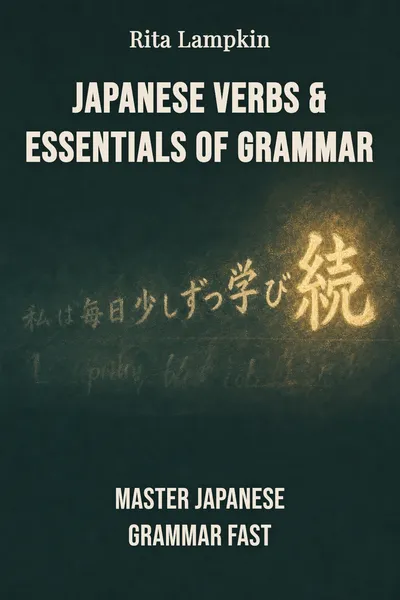
Japanese Verbs & Essentials of Grammar
Master Japanese grammar fast
Description
Anyone who has opened a Japanese textbook and hit a wall knows the feeling. The words look manageable, the sounds are clean enough, and then the grammar arrives and rearranges everything you thought you knew about how a sentence works. The verb sits at the end. The subject vanishes when it's obvious. Tiny words trail after nouns and decide who did what to whom. It's not that Japanese is harder than other languages — it's that it builds meaning in an order that feels backwards to an English speaker, and until that click happens, every sentence is a small puzzle.
Rita Lampkin's "Japanese Verbs & Essentials of Grammar" was written for exactly that moment of friction. It's a compact reference rather than a course — a book you keep open beside whatever else you're studying, so that when a conjugation or a particle stops you cold, the answer is one page away. The second edition widened the vocabulary lists to include everyday idiomatic phrases, added fresh example sentences, and folded in a proper introduction to the writing systems that earlier learners often had to chase down elsewhere.
What makes the book worth reading is not that it promises to make Japanese easy. It doesn't. It's that it treats grammar as a system with an internal logic, and it lays that logic out piece by piece until the pieces start fitting together on their own. The verb, the particle, the register you speak in — these aren't a list of rules to survive. They're the machinery, and once we can see the machinery, the sentences stop being puzzles.
The question we’re asking : Why does Japanese grammar feel backwards to an English speaker, and what does a compact reference do to untangle it?What we’ll see : How the language decides politeness, anchors meaning on the verb, and hands its heavy lifting to a handful of small words.
Table of contents
01Chapter 1 — The politeness you choose before you speak
Before an English speaker gets very far into Japanese, they run into something with no real equivalent in their own language: the sentence changes shape depending on who they're talking to. Lampkin foregrounds this early, because it can't be treated as an advanced flourish. Politeness in Japanese is baked into the grammar itself. The same idea — "I'm going" — takes one form with a close friend and another with a stranger, a teacher, or a client, and the difference isn't tone of voice. It's the verb ending, the vocabulary, sometimes the entire construction.
The book organizes this around a few working levels rather than drowning the beginner in every nuance at once. There's a plain, casual form used with family and friends; a polite form, built on endings like -masu, that carries most ordinary adult conversation; and the more elaborate honorific and humble language reserved for showing respect or lowering oneself relative to someone else. A learner doesn't need all of it on day one, and Lampkin's sequencing reflects that — the polite -masu forms come first because they're the safe default, the register we can use almost anywhere without giving offense.

02Chapter 2 — The verb that carries the whole sentence
If there's one thing the book's title telegraphs, it's that verbs come first, and that ordering is deliberate. In Japanese the verb lives at the end of the sentence and holds an extraordinary amount of information. Tense, negation, politeness level, whether something is a request, a possibility, a completed action — a great deal of what English spreads across auxiliary words and word order, Japanese packs into the tail end of a single conjugated verb. Get comfortable with the verb, Lampkin's structure implies, and most of the grammar follows.
The reassuring part, which the book makes clear, is that Japanese verbs are remarkably regular. English learners braced for the chaos of irregular forms find instead a system with only a small handful of true exceptions. Verbs sort into a couple of main groups, and once we know which group a verb belongs to, its conjugations are predictable — the plain form, the polite form, the negative, the past, the te-form that links actions together. The te-form especially earns its keep: it's the connective tissue that lets one verb hand off to the next, and Lampkin gives it the attention its usefulness deserves.
03Chapter 3 — Particles, the little words that do the heavy lifting
The other pillar of Japanese grammar, and the one that trips up newcomers most reliably, is the particle. These are short words — wa, ga, o, ni, e, de, to, and a handful of others — that attach to nouns and phrases and tell us what role each one plays in the sentence. English does this job mostly through word order: "the dog bit the man" means something different from "the man bit the dog." Japanese does it with particles, which frees word order up and puts the grammatical weight on these tiny markers instead.
Lampkin devotes serious space to them because they are where meaning is actually decided. The particle o marks the direct object; ni and e handle direction and destination; de marks the place where an action happens or the means by which it's done. And then there's the notorious pair, wa and ga — one marking the topic of the sentence, the other the grammatical subject. The distinction between them is subtle enough that even advanced learners argue about it, and the book's contribution is to give clear, worked examples rather than a single tidy rule that would only mislead.
04Chapter 4 — A grammar that reveals how a language thinks
Step back from the individual chapters and a larger point comes into view about what a book like this is really doing. A compact grammar reference succeeds not by listing more rules than the next one, but by exposing the underlying logic that makes the rules cohere. Lampkin's volume works because it treats Japanese grammar as a single system — verb, particle, register, script — rather than as a pile of unrelated hurdles, and that framing changes what learning feels like. We're not memorizing exceptions; we're internalizing a way of assembling meaning.
That way of assembling meaning is genuinely different from the English default, and confronting the difference is half the value. English puts the doer first and drives forward to the action. Japanese sets the scene, marks each element's role with a particle, and delivers the verb last, having already told us how polite, how certain, how finished the whole thing is. Learning the grammar is really learning to hold a sentence in a different order in the mind — to wait for the verb, to trust the markers, to let the subject stay unspoken when it's clear. The rules are the surface; the shift in thinking is the substance.
05Conclusion
The promise on the cover is to master Japanese grammar fast, and it's worth being honest about what "fast" means here. The book doesn't compress years of study into a weekend. What it does is remove the wasted motion — the flailing that comes from not seeing how verbs, particles, and politeness fit together, from treating each new form as an isolated shock. By laying the system out as a system, it lets the learner spend their effort on absorbing the logic rather than on rediscovering it every time a sentence turns strange.
Related books