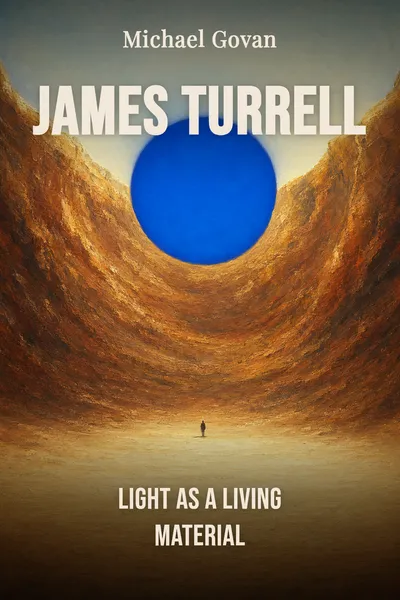
James Turrell
Light as a living material
Description
In 1966, in a shuttered hotel on Main Street in Ocean Park, California, a young artist named James Turrell started renting a room and doing something that looked, from the outside, like nothing at all. He blacked out the windows, sealed the light leaks, and projected controlled beams onto the corners of the space. Visitors who stepped inside saw what appeared to be solid geometric shapes hanging in the air — cubes, wedges, forms with weight and edges. Then they reached out, and their hands passed straight through. There was no object. There was only light, arranged so precisely that the eye insisted on building a thing that wasn't there.
Turrell had trained as a perceptual psychologist and learned to fly as a teenager, and both of those facts matter more than his art-school credentials, because he was never really interested in making pictures of the world. He was interested in the act of seeing itself. Over the following decades he would build rooms that seem to have no walls, cut openings in ceilings that turn the sky into a flat colored panel, and — most improbably — buy an extinct volcano in the Arizona desert and spend the rest of his life reshaping it. The material in every case was the same: light, treated not as something that reveals other things but as the thing itself.
Michael Govan, who has spent years working closely with Turrell and helping realize his largest projects, tells this story as the biography of an obsession. It is the account of an artist who decided that the most familiar substance in the world — the light we look through without ever looking at — could be shaped, weighed, and lived inside, if only someone were patient enough to learn how.
The question we’re asking : How does an artist turn light — the thing we see with, not the thing we see — into a material he can shape, house, and hand to us?What we’ll see : How a pilot's eye, a Quaker upbringing, and a desert volcano converged into a body of work that puts our own seeing on display.
Table of contents
01Chapter 1 — The pilot who painted with the sky
James Turrell was born in Los Angeles in 1943 into a Quaker family, and Govan returns often to that origin because it explains more than any art movement could. Quakers gather in silence and wait for what they call the inner light — a direct, unmediated encounter with the divine, without priest or icon in the way. Turrell absorbed that grammar early: light as presence, attention as a form of practice, the meeting as a shared space where something is felt rather than told. His grandmother's instruction to go inside and greet the light stayed with him, and it turns out to be an oddly precise description of what his rooms ask us to do.
The other formative fact is flight. Turrell learned to fly at sixteen and spent years as a pilot, and the sky he came to know was not the flat blue of a postcard but a volume — a substance with depth, weather, and edges you could feel through the controls. From altitude, light behaves like something you move through rather than something that falls on a surface. That intuition, that light has body, sits underneath everything he later built. He also studied perceptual psychology at Pomona College before turning to art, which gave him the vocabulary for what pilots know instinctively: that the eye does not simply record the world, it constructs it.

02Chapter 2 — A gallery with the lights turned off
The problem with light as a medium is that people arrive expecting to look at something. Turrell's whole project depends on getting them to stop doing that. Govan is clear that the work does not photograph well and cannot really be described — it has to be entered, and it takes time to work. A Turrell space punishes the hurried visitor and rewards the one willing to stand still until the eye adjusts and the room begins to change. This is not a metaphor. In near-total darkness, human vision recalibrates over many minutes, and colors that seemed absent slowly bloom into being.
Out of this came the Ganzfelds, environments that flood the visitor's entire field of vision with even, sourceless color. The German term means whole field, and the effect is disorienting in a specific way: with no edges, no shadow, no object to fix on, the eye loses its bearings. People report the sensation of the color becoming tangible, a fog they could wade into, a wall dissolving into open space. Some feel they could step off an edge that isn't there. What Turrell has engineered is a controlled failure of ordinary perception, and in that failure we notice, often for the first time, how much work our seeing usually does without our permission.
03Chapter 3 — The volcano that became an instrument
In 1974, Turrell went looking, from the air, for the ultimate site — a place where he could work with the sky at the scale it deserved. He found Roden Crater, an extinct volcanic cinder cone on the edge of the Painted Desert in northern Arizona, and set about acquiring it and the ranch land around it. What began then has occupied him for the rest of his life. The crater is not a sculpture placed in the landscape; it is being reshaped from within into a naked-eye observatory, a series of tunnels and chambers and viewing spaces engineered to frame celestial light with astronomical precision.
Govan, who has been deeply involved in the project's realization, conveys both its ambition and its difficulty. Turrell had the bowl of the crater regraded so that, lying at its center, a viewer perceives the dome of the sky as a curved ceiling close enough to touch — an effect called celestial vaulting. Tunnels are aligned to particular events: light from the sun at solstice, the position of the moon at intervals that recur only every eighteen years or so. Some chambers are calibrated to catch starlight that left its source thousands of years ago, so that what enters the space is, quite literally, ancient light arriving on schedule. This is engineering and astronomy pressed into the service of perception.
04Chapter 4 — Light was there all along
What Turrell finally proposes, across every phase Govan traces, is a quiet inversion. We are trained to treat light as a servant — the thing that lets us see the objects we actually care about. A lamp illuminates a book; sunlight reveals a landscape; the light itself stays invisible, a medium we look through and never at. Turrell turns that arrangement inside out. In his rooms there are no objects to illuminate, so the light has nowhere to hide. It becomes the thing present, with color, density, and something close to weight. He has said he wants to give light the physicality of a substance you can almost hold, and the strange power of the work is that, standing inside it, you believe him.
05Conclusion
Turrell is still at work on Roden Crater, decades after he first flew over it, and the project's unfinished state has become part of its meaning — an artwork tuned to timescales longer than a single career. The hotel room in Ocean Park is long gone, but the discovery he made there, that light arranged with enough precision will grow into a thing the eye cannot refuse, has held across every scale he has attempted, from a sealed room to the flank of a volcano.
Related books