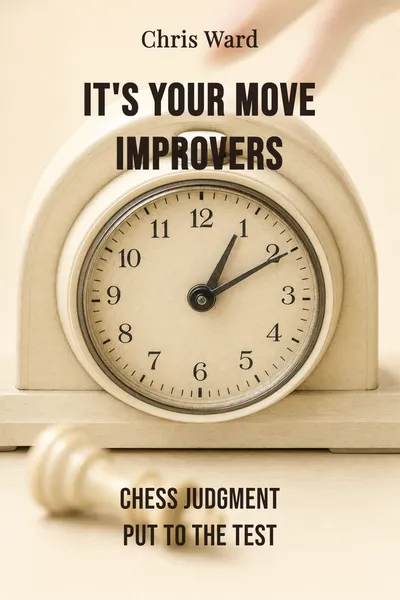
It's Your Move Improvers
Chess judgment put to the test
Description
Open most chess books and the game plays itself out in front of you. The moves arrive in order, annotated, already decided by someone stronger than you, and your job is to follow along and nod. It reads like watching a match through glass — instructive, sometimes beautiful, but strangely passive. You absorb the reasoning of a grandmaster the way you absorb a recipe you'll never cook. Chris Ward, an English grandmaster who has spent years teaching and writing for club players, noticed the obvious problem with that arrangement: nobody improves at chess by watching. You improve by choosing.
So in "It's Your Move Improvers" he closes the glass and hands over the board. The book is built around a single, slightly nerve-wracking premise: at each critical point in a real game, the reader stops and picks a move. No peeking ahead. You commit, the way you'd have to commit sitting across from an opponent with a clock ticking. Then Ward tells you whether you were right, awards points accordingly, and — more importantly — walks through why the position wanted what it wanted. The reader isn't a spectator anymore. They're a player being quietly examined.
It's aimed squarely at the improving club player — the person who knows how the pieces move, has read a bit, maybe lost a few too many games in ways they can't quite explain, and wants an honest measure of where they actually stand. That's the interesting tension the format exposes: the gap between recognizing a good move when it's shown to you and finding it yourself when the board is silent.
The question we’re asking : Can a chess book measure and sharpen judgment rather than just display it?What we’ll see : How Ward turns a game into a test, why he scores it, what he does with the reasoning, and what the guess-the-move method reveals about learning the game at all.
Table of contents
01Chapter 1 — The move is yours, and so is the mistake
The mechanics are simple, which is part of why they work. Ward sets up a position drawn from a real game and stops the action at a moment where a decision matters. The reader is told whose turn it is, given the situation, and then left alone with it. Choose your move. The instruction is small but it changes everything, because it removes the safety net that most chess books quietly leave in place — the assumption that the answer is already there, waiting a paragraph below, if you just keep reading.
Here you can't keep reading, or rather you can, but only by cheating yourself. The whole value of the exercise depends on the commitment happening first. This mirrors what actually occurs at the board, where nobody hands you a shortlist of candidate moves and asks you to rank them. You face the full, indifferent position and you have to generate the options yourself, then pick one, then live with it. Ward's format reproduces that loneliness on purpose. It's the loneliness where real chess judgment either shows up or doesn't.

02Chapter 2 — Points, not praise
Once the reader has committed, Ward reveals the verdict — and attaches a number to it. Strong moves earn the most points, reasonable-but-inferior moves earn partial credit, and weak or losing choices earn little or none. Over the course of a game, and over the book, those points accumulate into a running total the reader can actually read. It's a small design decision with a large effect: it converts a vague feeling of "I think I'm getting better" into something closer to a measurement.
The scoring does a few things at once. First, it's honest in a way self-assessment rarely manages. Most improving players carry a wobbly sense of their own level, inflated after a good game and crushed after a bad one. A point tally, position after position, cuts through that. You either found the moves or you didn't, and the number doesn't flatter you. Ward isn't handing out praise for effort; he's reporting results, which is exactly what a player who wants to improve should want to hear.
03Chapter 3 — Why the position, not the rule
A score without an explanation would just be a test, and a test doesn't teach anybody anything. So the heart of the book isn't the verdict — it's what comes after. Once Ward has told you whether you were right, he explains the position: what the correct move accomplishes, why the tempting alternative falls short, what the pieces were actually asking for. This is where the improving player does the real work, comparing the reasoning they used to the reasoning the position rewarded.
What's notable is how little Ward leans on rules. Club players tend to collect maxims — control the center, develop your pieces, don't move the queen out early, a knight on the rim is dim — and then apply them like a checklist. The trouble is that chess is a game of exceptions, and every one of those rules can be correct in one position and disastrous in the next. Ward's explanations keep returning the reader to the specific board in front of them. The question is never "what does the rule say" but "what does this position, with these pieces on these squares, actually demand."
04Chapter 4 — Judgment is a muscle
Step back from the individual puzzles and the book is making a quiet argument about how chess is actually learned. There's a long-standing temptation to treat the game as a body of knowledge — openings to memorize, endgame positions to file away, principles to recite. And knowledge helps. But Ward's format insists that judgment is not knowledge. It's a capacity, and capacities only grow when they're exercised under something like real conditions. You can read every book on the tactics of the game and still freeze when it's genuinely your move.
This is why the guess-the-move structure is more than a gimmick. It targets the thing that separates players of similar knowledge but different strength: the ability to choose well when nobody is helping. Two club players might know the same principles and recognize the same patterns when pointed at them, yet one consistently finds the right move at the board and the other doesn't. The difference is trained decision-making, and you can't train a decision you're never forced to make. Ward's book manufactures those forced decisions by the dozen.
05Conclusion
What Ward has really done is invert the usual relationship between reader and chess book. Instead of a grandmaster performing his understanding while the reader admires it, the reader performs, and the grandmaster grades. The moves are yours, the mistakes are yours, the accumulating score is yours, and the reasoning that follows each choice is calibrated to the decision you actually made rather than the one you were about to be shown. It's a small reversal with large consequences: it turns reading into playing, and playing is the only activity that has ever made anyone better at this game.
Related books