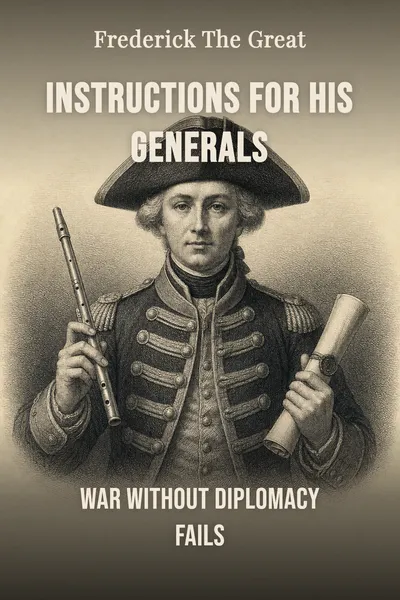
Instructions for His Generals
War without diplomacy fails
Description
In 1747, sitting between campaigns, the King of Prussia wrote a manual for the men who would lead his armies when he was not there to lead them himself. Frederick II had already taken Silesia from Austria in a war most of Europe thought reckless, and he would spend much of the next decade defending that gain against nearly every great power on the continent. The text he produced, circulated only among his senior officers and meant to stay secret, was not a treatise on glory. It was a working document — how to feed a column, how to place a camp, how to read the moment a battle turns. He wrote it, in part, because he had already watched good officers lose armies through ignorance he considered avoidable.
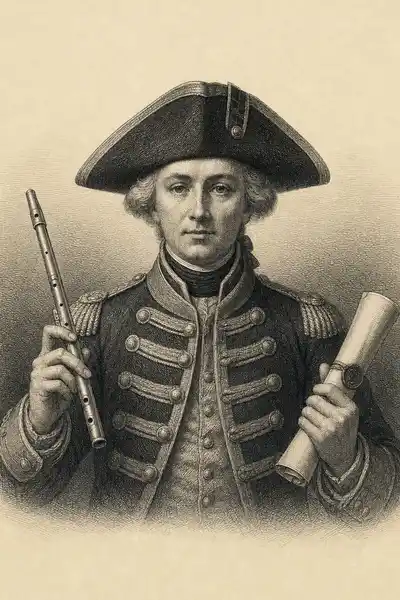
What makes the book unusual is who wrote it and how. Frederick was not only a commander. He played the flute well enough to compose, corresponded with Voltaire, abolished serfdom on his own lands, and defended religious tolerance in an age that rarely bothered. The same man who wrote about the correct depth of a defensive ditch also wrote that diplomacy without arms is like music without instruments. That single line holds the whole argument: for Frederick, war and statecraft were not separate crafts practiced by separate men. They were one instrument, and a general who understood only half of it was dangerous to his own king.
The instructions read, at first, like a checklist of eighteenth-century soldiering — supply, discipline, terrain, the ugly arithmetic of who eats and who starves. But underneath the detail runs a conviction about what an army is for, and about the kind of mind required to command one. We come to a soldier-king who trusted almost nothing to chance, and who insisted that the point of winning was never simply to have won.
The question we’re asking : Why did a king who fought all of Europe insist that battlefield victory was never enough on its own?What we’ll see : How Frederick built and moved his army, how he decided when to fight, and why he treated the general as half-soldier, half-statesman.
Table of contents
01Chapter 1 — The soldier the king built
Frederick begins not with battles but with the men, because he did not trust them. The Prussian army of the mid-eighteenth century was a mixture of native conscripts and foreign mercenaries, many of whom would desert the moment discipline slackened or the woods came close. His instructions are frank about this. Soldiers were not to be marched near forests without precaution, not to be allowed to forage alone, not to be left idle. The army held together, in his account, less through loyalty than through a discipline so constant that desertion became difficult and disobedience unthinkable.
This is where a modern reader can misread him. The famous Prussian discipline was not cruelty for its own sake, though it was harsh by any standard. It was engineering. Frederick wanted an army that could execute a complicated manoeuvre under fire, reload faster than the enemy, and hold a line when men around them were falling. That reliability had to be drilled in until it survived terror. A frightened soldier who has been trained past the point of thinking will still fire, still wheel, still close the gap. Frederick built men who could function when their own judgment had deserted them.

02Chapter 2 — The march is the manoeuvre
If discipline is the foundation, movement is the argument. Frederick devotes extraordinary attention to marching, camping, and supply, and he does so because he had learned that eighteenth-century wars were won and lost long before the armies met. An army that arrived first, arrived fed, and arrived in good order had already half-won. One that straggled in exhausted and hungry could be beaten by a smaller force that had simply travelled better. The unglamorous work of logistics, in his hands, becomes the decisive art.
He is precise about it to the point of obsession. Where to place magazines of grain and fodder, how to route columns so they did not tangle, how to choose a campsite that could be defended and supplied and, if necessary, abandoned in a hurry — all of it is spelled out. Bread mattered as much as gunpowder. An army in the field consumed enormous quantities of food and forage every day, and a general who could not keep that flow moving would watch his force shrink through hunger and desertion without an enemy firing a shot. Frederick treats the supply line not as support but as the campaign itself.
03Chapter 3 — How Prussia chose its battles
Given all this preparation, one might expect Frederick to counsel caution — and in part he does. He warns against fighting without necessity, against battles that risk everything for little, against the vanity that pushes a general to attack when waiting would serve better. Prussia was small, surrounded, and could not replace an army the way Austria, France, or Russia could. Every battle he fought was, in a sense, a gamble against a house that had far deeper reserves. That arithmetic made recklessness not brave but suicidal.
And yet the same book is emphatic that a decisive battle, fought at the right moment, is often the only way to end a war on favourable terms. This is the tension that runs through the whole text. Frederick despised aimless campaigning, the shuffling of armies back and forth that exhausted a state without deciding anything. For a power that could not outlast its enemies, a long war was a lost war. Prussia had to win quickly and hard, force a decision, and then negotiate from strength. Caution before the battle, boldness in it — the two were not opposites but a sequence.
04Chapter 4 — The general who was also a diplomat
This is where Frederick's instructions open onto something larger than tactics. His line about diplomacy without arms being like music without instruments is usually quoted for its wit, but it is a genuine theory of power, and it cuts both ways. Arms without diplomacy are just as useless — noise without a score, force with no idea of what it is for. A general who understood only how to win battles was, to Frederick, a half-formed instrument. The complete commander had to hold both halves at once: he had to know why the war was being fought and what settlement it was meant to produce, or his victories would be spent achieving nothing.
This is why Frederick refuses to treat the general as a purely military figure. In his own person the two roles were fused — he was king and commander at once, negotiating and fighting the same war with the same mind. But he wrote for officers who would command in his absence, and he wanted them to think politically even when he could not be there to do it for them. A general who did not grasp the diplomatic situation might win a battle that made peace harder, or press an advantage that turned a wavering neutral into an enemy. Force disconnected from statecraft was not strength; it was liability with a uniform on.
05Conclusion
Frederick wrote his instructions for a war he had not yet fought, and the years that followed put them to a test few commanders have faced — Prussia standing against Austria, France, and Russia at once, surviving less through numbers than through the discipline, mobility, and timing the book had insisted upon. The manual meant to stay secret became, over time, one of the most studied military texts in Europe, read by the very powers it had been written to defeat. Its detail dated quickly; armies changed, and bread magazines gave way to railways. What did not date was its argument about the mind of the man in command.
Related books