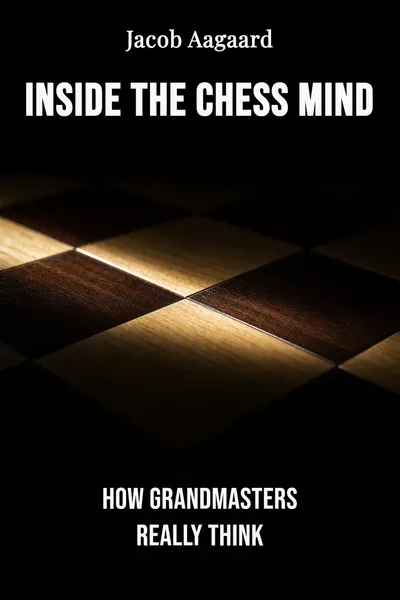
Inside the Chess Mind
How grandmasters really think
Description
Give a strong chess player a position they have never seen, hand them a stopwatch, and ask them to think out loud until they choose a move. That is roughly what Jacob Aagaard did. A Danish-Scottish grandmaster and one of the most respected chess trainers of his generation, Aagaard collected a set of test positions and put them to players across the whole range of strength — from club amateurs to full grandmasters — recording not just the move each one landed on, but the entire path they walked to get there. The result became the book Inside the Chess Mind. What he was after wasn't who found the best move. It was how they looked for it.
The assumption most of us carry is straightforward. The grandmaster is a kind of human engine: they see further, calculate more lines, hold more branches of the tree in their head at once. The weaker player loses because they simply can't compute enough. It's an intuitive picture, and it fits everything we imagine about chess as a game of raw brainpower. Aagaard's transcripts tell a different story — one where the strongest players often think about fewer moves than the amateurs, spend their time on things the weaker players never notice, and arrive at good decisions through a route that looks almost lazy from the outside.
What he assembled, in effect, is a rare look at thinking itself: not the polished analysis that appears in chess magazines after the fact, but the messy, real-time reasoning of people at every level trying to solve the same problem. Reading the protocols side by side, the gap between strong and weak turns out to sit somewhere other than where we'd expect.
The question we’re asking : If it isn't raw calculating power that separates a grandmaster from an amateur, then what actually happens in the strong player's head?What we’ll see : How a set of test positions, answered out loud by players at every level, quietly dismantles what we assume about calculation, intuition, and the mind at the board.
Table of contents
01Chapter 1 — The experiment nobody had quite run before
Chess has never lacked for opinions about how to think. Coaches hand out rules — examine all checks, captures and threats; count your candidate moves; calculate to the end of forcing lines. Whole training methods rest on these instructions. But almost none of it came from watching what strong players actually do. It came from what strong players said they did, or from what seemed sensible in principle. Aagaard's move was to stop asking players to describe their method in the abstract and instead catch them in the act.
The setup was deliberately plain. A handful of positions, chosen so that the right answer wasn't obvious and often ran against the grain of intuition. Each participant faced them alone, thinking aloud, with the clock running, and Aagaard transcribed the whole stream — the false starts, the moves considered and dropped, the moments of doubt, the sudden decisions. The players ranged from ordinary club members to titled grandmasters, which is the part that makes the exercise work. A protocol from a single strong player tells you little. A protocol placed next to a weaker player's on the very same position tells you where the two minds diverge.

02Chapter 2 — What calculation actually looks like
Open a chess book and calculation is presented as a clean tree. A root position, branches for each candidate move, sub-branches for each reply, evaluated tidily at the leaves. It is a beautiful model and almost nobody thinks that way. The protocols show something far more human: players jumping between lines, forgetting where a piece stood three moves deep, revisiting a variation they'd already dismissed, following a hunch down one branch while leaving the neighbouring branch untouched. Real calculation is not a tree searched exhaustively. It is a stumble through the promising parts of the position.
The interesting thing is that the grandmasters stumble less, but not because they are more thorough. They tend to spend their calculation on lines that matter and to abandon dead ends quickly. A weaker player, faced with the same position, will often calculate a long forcing sequence with great care — and it turns out to be the wrong sequence to have cared about. The effort is real, the discipline is real, but it is aimed in an unrewarding direction. The strong player's advantage is not in the calculating; it is in knowing which line deserves to be calculated at all.
03Chapter 3 — The stronger you are, the less you count
The most counterintuitive finding in the whole exercise is also the simplest to state: strength does not correlate with the number of moves considered. If anything, the relationship runs the other way. On several positions, the grandmasters looked at fewer candidate moves than the club players, decided faster, and chose better. The amateur, trying to be responsible, generates a long list and works through it. The master glances at the position and two or three moves suggest themselves, one of them usually the right one. The list never needed to be long because the good moves announced themselves first.
This is the part de Groot had already glimpsed and that Aagaard's practical players confirm: the difference lives in perception, not in search. A strong player does not see a board of thirty-two pieces and then reason about it. They see structures — a weak square, an overloaded defender, a king that has stopped feeling safe — and the candidate moves flow out of those structures automatically. The pattern recognition has been built over years, so that recognizing the shape of a position and knowing roughly what to do about it are nearly the same act. The calculation, when it comes, mostly confirms what the eye already proposed.
04Chapter 4 — The board is a mirror
Step back from the sixty-four squares and the same picture shows up wherever people get genuinely good at something. We tend to imagine expertise as amplified effort — the expert works harder, thinks longer, holds more in mind. The chess protocols suggest almost the reverse. The expert has reorganized how they perceive the problem so thoroughly that most of the work disappears before conscious effort begins. What looks like brilliance is often the absence of a struggle the novice can't avoid.
This reframes what it means to be skilled. The grandmaster's edge is not a bigger engine bolted onto the same machine the amateur is running. It is a different machine, built quietly over years, in which recognition has replaced computation for the vast majority of decisions. The deliberate, effortful thinking we associate with expertise is the small visible tip of a much larger, invisible perceptual apparatus. The master thinks less, in the effortful sense, precisely because they have learned to see more.
05Conclusion
Aagaard set out with a modest tool — a stopwatch, a set of tricky positions, and the willingness to record what players actually said instead of what they thought they did. What came back was a quiet correction to the folklore of chess. The grandmaster is not the human engine of the popular imagination, grinding through more variations than mortals can hold. More often they are the player who looked at the position, saw the two moves worth taking seriously, checked the risky one, and moved on while the amateur was still building a list.
Related books