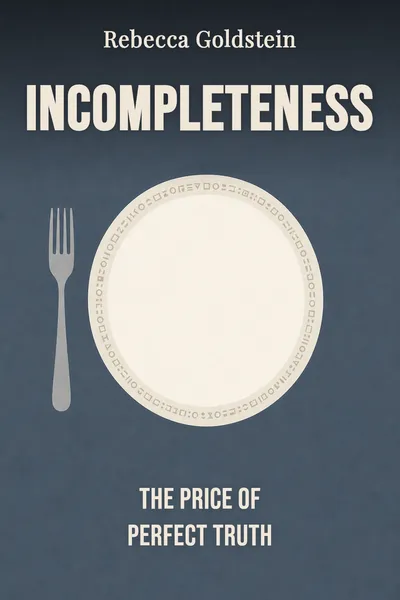
Incompleteness
The price of perfect truth
Description
On a January morning in 1978, a man weighing about sixty-five pounds died in a Princeton hospital. The death certificate recorded the cause as malnutrition and inanition brought on by a personality disturbance. The man was Kurt Gödel, and by most accounts he was the greatest logician since Aristotle. He had stopped eating because he was convinced someone was trying to poison him, and the only person he trusted to prepare his food, his wife Adele, had been hospitalized and could no longer taste it first. So he simply starved, guarded by a suspicion no argument could reach.
Rebecca Goldstein, a philosopher and novelist, tells this story not as a tragedy of eccentricity but as something stranger and more coherent. The same cast of mind that let Gödel see, at twenty-five, what no one else had seen about the limits of formal systems was, she argues, of a piece with the mind that ended up sealed off from the world. His two incompleteness theorems, published in 1931, showed that any consistent formal system rich enough to describe arithmetic contains true statements it can never prove. It was one of the most disorienting results in the history of thought.
Goldstein's book sits at the crossing of a life and an idea, refusing to let either explain the other away. Gödel proved that truth outruns proof — that there are things which are so, and which no system can establish. He believed this not as a technical curiosity but as a claim about reality itself. And he spent the rest of his years among people who thought the opposite, in a century that increasingly agreed with them.
The question we’re asking : How did a young man's proof about the limits of mathematics grow out of, and finally consume, the whole shape of his life?What we’ll see : A portrait of Gödel that reads his theorem, his Vienna, his walks with Einstein, and his terrible end as one continuous thought.
Table of contents
01 Chapter 1 — Vienna, where meaning was supposed to be everything
Gödel came of age intellectually in the Vienna of the 1920s, in the orbit of a group of philosophers and scientists who met on Thursday evenings and came to be known as the Vienna Circle. Led by Moritz Schlick, the circle included figures like Rudolf Carnap and Otto Neurath, and its guiding conviction was bracing in its severity: a statement had meaning only if it could be verified by observation or was true by the rules of logic. Everything else — metaphysics, theology, talk of a reality behind appearances — was, strictly speaking, nonsense. Not false. Meaningless.
Goldstein makes a point that is easy to miss. Gödel attended these meetings, absorbed their rigor, learned their formal tools better than almost anyone in the room. And he disagreed with nearly everything they believed. The circle held that mathematical truths were empty, mere consequences of the definitions we had chosen, like the rules of a game. Gödel was a Platonist. He thought numbers were as real as chairs, that mathematical facts were discovered rather than invented, and that the human mind could perceive them the way the eye perceives color.

02 Chapter 2 — The proof that broke the dream of a closed system
To feel the force of what Gödel did, you have to feel the size of the dream he interrupted. Since the ancient Greeks, mathematics had been the model of certainty, the one place where a claim, once proven, was settled forever. In the early twentieth century, the great mathematician David Hilbert had set out a program to make this certainty total: to reduce all of mathematics to a finite set of axioms and rules, a system in which every true statement could be proven and no contradiction could ever arise. It was the dream of a perfectly closed, self-guaranteeing account of truth.
Gödel's 1931 paper ended it. His method was ingenious enough that Goldstein takes real care to render it. He found a way to make a formal system talk about itself — to assign numbers to statements so that arithmetic could encode claims about arithmetic. With that device he constructed a sentence that, in effect, says of itself: this statement cannot be proven within the system. If the system could prove it, the system would be lying, and so inconsistent. If the system is consistent, then the sentence is true — and unprovable. Truth, in that instant, came apart from proof.
03 Chapter 3 — A friendship on the road to the Institute
The story crosses the Atlantic. As Austria darkened in the 1930s and was absorbed into Nazi Germany, Gödel — apolitical, unworldly, absurdly slow to grasp his own danger — eventually made his way, with Adele, across Russia and the Pacific to Princeton and the Institute for Advanced Study. Schlick had been murdered on the steps of the university by a former student in 1936, and the Vienna Circle had scattered. The world that formed Gödel no longer existed. What waited for him in New Jersey was a colleague who became, by all accounts, his closest friend: Albert Einstein.
Goldstein lingers on this pairing because it is so unlikely and so telling. Einstein, warm, rumpled, famous beyond measure; Gödel, precise, fragile, almost spectral. And yet they walked home together nearly every day, deep in conversation, and Einstein reportedly said in his last years that his own work no longer meant much to him and that he came to the Institute mainly to have the privilege of walking home with Gödel. Two men who had each, in their domain, shown the universe to be stranger than common sense allowed found in each other an understanding they got nowhere else.
04 Chapter 4 — The mind that could not stop dividing
Step back from the biography and a single thread runs through all of it. Gödel spent his life insisting that truth is not something we manufacture — that it stands outside us, complete and objective, whether or not any system or mind can reach it. His theorem was the mathematical form of that faith: there is more that is true than can ever be proven. Goldstein's quiet, devastating suggestion is that the same conviction shaped the way he lived, and the way he died.
Because a man who believes reality is fully determinate, fully out there, may find it very hard to live with the fog the rest of us tolerate. Most of us survive by not demanding certainty about whether the food is safe, whether the doctor is honest, whether the world means us harm. Gödel could not seem to hold that looseness. The suspicion that hardened into his fatal delusion had the same shape as his genius: an unwillingness to accept that something might be so without being verifiable, a refusal to rest in the merely probable. The logician who proved that consistency cannot be guaranteed from inside a system could not find, inside himself, any guarantee he could live by.
05 Conclusion
The man who starved in that Princeton hospital had shown, forty-seven years earlier, that truth is larger than any system built to hold it.
Related books