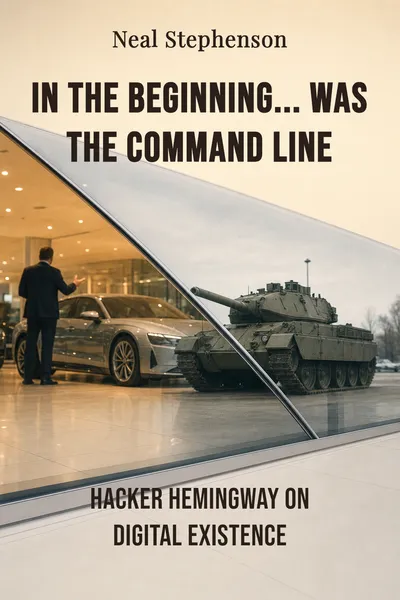
In the Beginning... Was the Command Line
Hacker Hemingway on digital existence
Description
Somewhere near the end of the 1990s, a novelist better known for cyberpunk than for consumer advice sat down to write a long essay about operating systems. Neal Stephenson had already given us Snow Crash and Cryptonomicon, and Newsweek had pinned on him the label "the hacker Hemingway" — spare prose, big engines under the hood. But In the Beginning… Was the Command Line is not a novel. It is roughly a hundred pages of reasoning, reminiscence, and open ranting about a question that sounds narrow and turns out to be enormous: why do we let a strip of software decide how we meet the world?
His way in is disarmingly ordinary. Buying an operating system, he says, is like buying a car — except the choices are stranger than any showroom. One company hands out sturdy tanks for free and almost nobody takes them. Another sells shiny sedans by the million, and the sedans keep breaking down in traffic while their owners defend them fiercely. Stephenson wrote this before the smartphone, before the app store swallowed the desktop, and yet the scene he describes — millions of us choosing the comfortable option without quite knowing what we chose — has only grown more familiar.
That is the pleasure and the provocation of the little book. It reads like a friend who happens to have written the compiler explaining, over a long evening, why the thing on your desk is not neutral. The command line and the graphical interface are not just two ways to open a file. They are two different bargains about how much of reality we are willing to touch directly, and how much we would rather have handed to us, pre-chewed and smiling.
The question we’re asking : Why does the way a computer talks to us — a blinking prompt or a friendly window — say something larger about how we choose to live?What we’ll see : How a novelist turned a fight over operating systems into a meditation on interfaces, mediation, and the price of comfort.
Table of contents
01Chapter 1 — The car dealership and the tank
Stephenson opens the book with a scene he clearly enjoys. Imagine a road lined with dealers selling the machine everyone needs to get anywhere. Microsoft sells station wagons — heavy, reliable-looking, comfortable — and sells an awful lot of them. Apple sells sleeker, pricier models with better upholstery. Then, further down the road, there is a group of hippies giving away tanks. The tanks are free, they are nearly indestructible, they will go over any terrain, and hardly anyone stops. That is his picture of the market for operating systems around 1999, and the free tank is Linux.
The joke lands because the behavior it describes is genuinely odd. Given a choice between a durable machine at no cost and a fragile one that keeps stalling, most people took the fragile one and stayed loyal to it. Stephenson does not treat this as stupidity. He treats it as revealing. What the station-wagon buyers were paying for was not the engine. They were paying to not have to think about the engine — to be shielded from the whole apparatus of gears, oil, and combustion that a tank obliges you to at least acknowledge.

02Chapter 2 — Metaphors we compute by
The heart of the book is Stephenson's suspicion of metaphor. A graphical interface, he argues, is a system of metaphors laid over a machine — the desktop, the window, the file, the folder, the button you "press" that is not a button and does not move. Each metaphor is a small mercy. It lets someone who knows nothing about the underlying operations get useful work done. But every metaphor is also a wall, and behind the wall is the thing itself, which you are now discouraged from ever seeing.
He reaches for an unlikely comparison to make the stakes feel large: Disney World. A visitor to the Magic Kingdom moves through a version of the world that has been designed, sanded down, and made safe — a jungle cruise with no danger, a Main Street with no poverty, history rendered as a pleasant ride. It is enormously appealing and it asks nothing of you but your admission and your trust. Stephenson calls this the Disneyfication of experience, and he sees the graphical interface doing the same job for computing: turning a raw, complicated reality into a curated attraction that flatters the guest.
03Chapter 3 — The fine art of doing without a mediator
Against the world of comfortable metaphors, Stephenson sets the world of the command line — and here his prose warms up, because this is home. Typing commands to a machine is austere and often maddening. There is no picture to click, no reassurance, nothing to guess at from context. You must know the words, and the words must be exact. In return you get something the graphical interface cannot offer: a direct line to what the machine is doing, unmediated by anyone's idea of what you ought to want.
He tells the story with real affection through Unix, the operating system born at Bell Labs in the early 1970s and carried forward, eventually, into the free Linux that his ignored tanks represent. Unix is difficult on purpose. It assumes you are willing to learn its grammar, and it rewards that willingness with power and transparency. It is also, he notes, a kind of accumulated culture — decades of engineers refining a shared language — rather than a product designed to be sold to people who never asked how it worked.
04Chapter 4 — What the operating system says about us
Read a certain way, the whole book is not really about operating systems at all — and Stephenson knows it. The choice between the prompt and the window is a rehearsal of a much older choice about mediated experience. How much of the world are we content to meet through an interface someone else designed? He drifts, in the later pages, from software to religion, to the Big Bang, to the meaning of life, and the drift is not indulgence. It is the point. The same appetite that made us love the friendly desktop shapes how we take in almost everything.
He reaches for the phrase that gives the book its title — "in the beginning was the Word" — and turns it into a claim about origins. At the root of a computer is not a picture but a text: instructions, code, language that does exactly what it says. The graphical era buried that Word under imagery, and Stephenson finds something almost theological in the burial. We prefer the icon to the text, the ritual to the reading, the interface to the thing. The pattern is older than computing; the machine merely made it visible.
05Conclusion
By the end, the free tank at the side of the road has become something more than a joke about Linux. It stands for everything we can have but do not want: the direct, difficult version of things, offered at no charge and largely declined. Stephenson never pretends the choice is simple. He types at a command line by preference and shops at Disneyfied stores like the rest of us, and he lets both facts sit side by side without resolving them. The book closes not on a verdict but on an awareness — that the interface is never innocent, and that ease is always a bargain whose terms we rarely read.
Related books