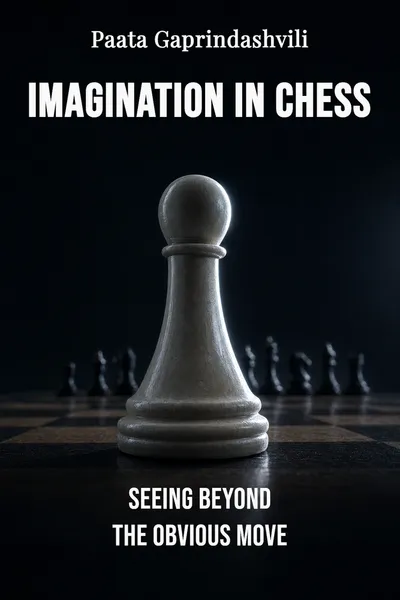
Imagination in Chess
Seeing beyond the obvious move
Description
Sit a strong club player in front of a position and something odd happens in the first few seconds. Their eye slides past the natural recapture, the obvious check, the move any beginner would grab, and lands somewhere strange — a quiet retreat, a piece offered for nothing, a pawn push that looks like a blunder. Then they start calculating. Paata Gaprindashvili, a Georgian grandmaster and trainer, built an entire book around that first sideways glance. In Imagination in Chess, he argues that what separates a good player from a dangerous one is not memory or nerve but the ability to see the move that isn't obvious — and then prove it works.
The book is a training manual disguised as a puzzle collection. Hundreds of positions, drawn from real games and composed studies, each asking the same thing: what would you play here, and what would you never even consider? Gaprindashvili is not interested in the move you find in ten seconds. He wants the one hiding behind it, the resource you dismiss because it violates a rule you learned too well. His wager is that imagination in chess can be trained the way calculation is trained — deliberately, painfully, one position at a time.
That wager cuts against a comfortable belief. We tend to file creativity under talent, something you either have or don't, and calculation under work, something you grind at. Gaprindashvili scrambles the two. For him the flash of insight and the cold arithmetic of variations are not opposites at all; they feed each other, and both can be built. A book of exercises turns out to make a quiet claim about where inventive thinking actually comes from.
The question we’re asking : Can the ability to see the unexpected move — the thing we file under talent — actually be trained like any other skill?What we’ll see : How a grandmaster's puzzle book turns imagination into a discipline, and why that reframes where invention comes from.
Table of contents
01Chapter 1 — The move that isn't on the board yet
Every chess position offers a handful of moves that announce themselves. A hanging piece gets captured. A check gets answered. A threat gets parried. These are the candidate moves the eye reaches for automatically, and most of the time they are fine. Gaprindashvili's problem is precisely that they are fine — good enough to keep a game going, never good enough to win one against a resourceful opponent. The book opens on this frustration: the plateau where a player calculates accurately, follows the principles, and still misses the moves that decide games.
What those winning moves have in common is that they hide behind the obvious ones. They ask a player to give something up — a rook, the right to castle, a pawn structure carefully maintained for twenty moves — in exchange for something that cannot yet be seen on the board, only imagined a few moves ahead. Gaprindashvili's term for the faculty that finds them is imagination: the willingness to entertain a move that looks wrong before the calculation confirms it is right.

02Chapter 2 — Calculation is the muscle, imagination is the eye
It would be easy to read a book about imagination as an argument against hard calculation, a plea to trust intuition over arithmetic. Gaprindashvili argues the reverse. Imagination without calculation is just wishful thinking — a pretty idea that collapses two moves later when the opponent finds the refutation. The inventive move is worthless until it has been checked to the end of the line. What he wants is the two working together: the eye that spots the strange resource, and the discipline that verifies it move by move, variation by variation, until nothing is left to chance.
This is why so many of the positions demand long, precise calculation. A combination might run six or eight moves deep, with the opponent trying every defense along the way. The imaginative leap is only the first step — it opens a door. Walking through it safely requires seeing every branch, every zwischenzug, every quiet resource the other side might have hidden in reply. Gaprindashvili treats the two skills as a single act performed in sequence: imagine widely, then calculate ruthlessly, and discard the idea the instant a line fails.
03Chapter 3 — The exercises that teach the mind to wander
A book that claims imagination can be trained has to show its method, and Gaprindashvili's method is repetition under difficulty. The positions are hard on purpose. Many come from real tournament games, where the winning idea was found under a ticking clock by a strong player, which is its own reassurance: this is not a puzzle contrived to have a trick, it is a resource that actually decided a game. Others are composed studies, where the artificial cleanliness of the position sharpens the aesthetic of the idea. Together they form a graded course in seeing what isn't obvious.
The design has a logic. Early positions loosen the reader's assumptions gently — a sacrifice that pays off quickly, a quiet move whose point appears within a couple of turns. Later ones demand deeper vision and longer calculation, the reward buried further from the surface. Throughout, the instruction is the same: do not settle for the first reasonable move. Ask what else the position contains. The reader is trained, quite literally, to spend the extra seconds that separate the fine move from the winning one.
04Chapter 4 — What a chessboard reveals about invention
Step back from the sixty-four squares and Gaprindashvili's book makes a claim that reaches past chess. The move we admire as imaginative — the sacrifice, the quiet resource, the counterintuitive retreat — is not a gift that visited a lucky player. It is the product of a mind that has been deliberately taught to look where others stop looking, and that has the calculation to back up what it sees. Invention, on this account, is not the opposite of discipline. It is discipline pointed in an unusual direction.
This cuts against the folk theory of creativity as a spark, something that either strikes or doesn't. What the exercises demonstrate is that the strange move becomes findable only after a player has absorbed enough patterns to know which rules can be broken and when. The beginner cannot be imaginative in chess because they do not yet know what is normal; there is nothing for them to see beyond. Imagination requires a dense floor of knowledge to stand on. The freedom to break rules is earned by first knowing them cold.
05Conclusion
We come back to that first sideways glance — the strong player's eye sliding past the obvious recapture toward something stranger. Gaprindashvili's book spends hundreds of positions teaching that glance, and its quiet argument is that the glance can be taught at all. The move that looks like inspiration is really the endpoint of a trained habit: cast wide, calculate deep, distrust the first reasonable answer, and hold the unseen position steady in the mind until it can be proven won.
Related books