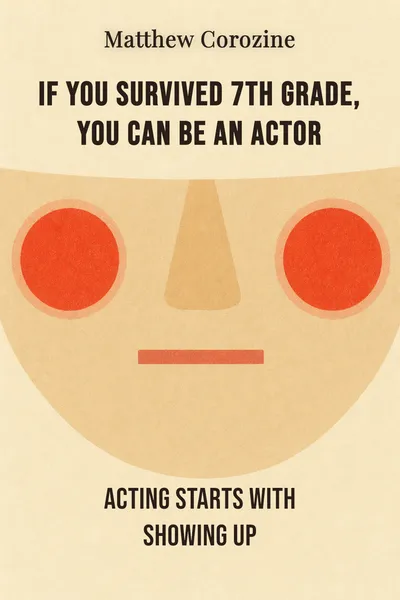
If You Survived 7th Grade, You Can Be an Actor
Acting starts with showing up
Description
Somewhere out there is a version of you that once stood up in front of a seventh-grade class, cheeks burning, voice cracking, absolutely certain that everyone could see straight through to how terrified you were. And you survived it. You sat back down, the world kept turning, and you went on to do a thousand harder things since. Matthew Corozine, a New York acting teacher who has spent decades coaching working and aspiring actors, opens his book on exactly this memory — because the fear that stops most people from ever trying to act is the same fear they already beat, badly and publicly, at twelve.
His premise is deceptively small: acting is not a mystical talent handed out at birth to a chosen few. It's a craft, and like any craft it rewards people who show up and do the reps. The book demystifies the whole thing — the technique, the training, the dreaded audition, the long unglamorous middle of a creative life — with the warmth of someone who has watched hundreds of nervous beginners walk into his studio and slowly stop apologizing for wanting to be there.
What makes the book worth sitting with is not a secret method or an insider shortcut. It's the steady insistence that the door is not locked the way we assume it is. The barrier most aspiring actors run into isn't a casting director or a lack of connections. It's the story they tell themselves about who gets to try in the first place.
The question we’re asking : If acting isn't a gift you're either born with or not, what actually stands between wanting to act and doing it?What we’ll see : How Corozine takes the mystery out of the craft, the audition, and the working life — and hands the fear back to you as something manageable.
Table of contents
01Chapter 1 — The intimidation is the first illusion
Ask most people why they never pursued acting and you'll hear some version of the same sentence: I'm not talented enough, or I'd be too nervous, or that world isn't for people like me. Corozine's first move is to gently take that sentence apart. The intimidation, he argues, is doing almost all the work of keeping people out — and it's an illusion dressed up as a verdict. Nobody is checking your credentials at the door of a beginner's class. The only thing genuinely required to start is the willingness to be a beginner in front of others, which, yes, feels exactly as exposed as it did in middle school.
That comparison is not a throwaway joke. Corozine keeps returning to it because seventh grade is the shared trauma that proves the point. Almost everyone reading has already done the hardest part of acting — being watched while unsure of themselves — under the least forgiving conditions imaginable, with an audience of merciless twelve-year-olds and no chance to prepare. Compared to that, walking into a supportive studio full of other adults who all want the same thing is not a leap into the void. It just feels like one because the body remembers the old fear.

02Chapter 2 — The work is a craft, not a gift
Having cleared the fear out of the doorway, Corozine spends the heart of the book on what actually happens once you're inside — and it's a lot less mysterious than the word talent implies. Acting is a set of skills that can be learned, practiced, and improved, the same as playing an instrument or learning to cook. There are techniques for listening to a scene partner instead of waiting for your line. There are ways to break down a script, find what a character wants, and stop performing emotions you're trying to fake. None of it is magic. All of it is teachable.
He's generous with the practical layer without turning the book into a dry manual. The emphasis lands again and again on presence — being genuinely alive and responsive in the moment rather than delivering a pre-planned imitation of feeling. Beginners tend to think acting means pretending very hard. Corozine reframes it as doing very little that's false: telling the truth under imaginary circumstances, reacting honestly to what's actually in front of you. That shift, from performing to responding, is the one most students have to make, and it's the one that separates a stiff read from a living one.
03Chapter 3 — The audition room is not the enemy
If technique is the part beginners underestimate, the audition is the part they dread most. Corozine treats it head-on, because it's where most of the discouragement in an acting life actually accumulates. The audition, he insists, is not an execution. It's a job interview and, more usefully, a chance to act. Reframing it that way changes everything about how it feels to walk in — you're not begging for approval, you're doing the thing you love in front of people who genuinely want you to be good, because a great audition solves their problem.
That last point is his quiet corrective to the paranoia most actors carry. Casting directors are not sadists hoping you'll fail. They have a role to fill, they've been watching mediocre reads all day, and they are rooting for the next person through the door to be the one who ends it. Understanding that they're on your side, at least in that narrow sense, drains a lot of the adversarial charge out of the room. You're not entering enemy territory. You're arriving with something they need.
04Chapter 4 — A career is a practice, not a lottery
Step back from the individual scene or audition and Corozine's larger picture of the acting life comes into focus — and it looks less like a lottery than most fantasies of stardom assume. A creative career, in his framing, is a practice you maintain, not a jackpot you're waiting to hit. The people who make it are rarely the most gifted; they're the ones who kept showing up long after the initial excitement wore off, who treated the slow years as the job rather than as a waiting room before the real thing began.
This is the mindset the whole book has been building toward. Commitment, patience, and a tolerance for the unglamorous middle matter more than any single break. Corozine is candid that the middle is long: day jobs, small parts, self-tapes into the void, stretches where nothing seems to move. He doesn't sell an overnight-success story because he's seen how corrosive that expectation is — it makes people quit at year three when the whole game is played over decades. Reframing the career as an ongoing practice makes the dry spells survivable instead of disqualifying.
05Conclusion
Corozine ends more or less where he began, back with that terrified seventh-grader who lived to tell about it. The point of the book was never to convince readers they're secretly brilliant. It was to strip acting of the mythology that keeps people watching from the outside — the belief that it takes a gift, a lucky break, or permission from someone with a clipboard. What it actually takes, in his telling, is the willingness to be a beginner, the patience to treat it as a craft, and the stubbornness to keep coming back to the room.
Related books