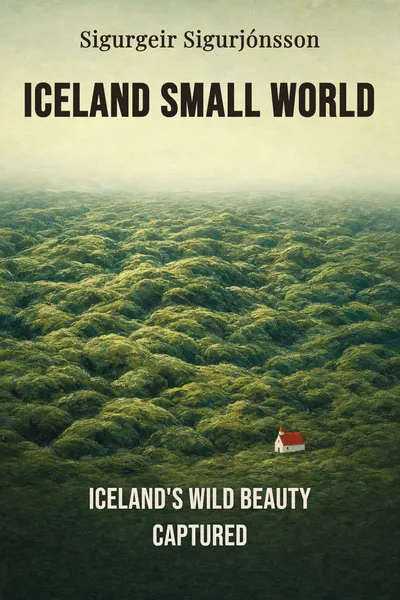
Iceland Small World
Iceland's wild beauty captured
Description
Open Sigurgeir Sigurjónsson's Iceland Small World and the first thing that catches us off guard is the scale. A meltwater river photographed from directly above stops looking like a river and starts looking like the veins on a leaf, or a nervous system, or a satellite map of somewhere much larger. A patch of moss becomes a continent. A glacier's edge becomes a coastline seen from orbit. The title is not a marketing flourish. It is the book's actual argument, worked out in image after image: that this one island in the North Atlantic contains, in miniature, nearly everything the planet can do.
Sigurjónsson has spent decades pointing a camera at his home country, and his earlier books have sold across the world to people who will likely never stand in an Icelandic wind. This one gathers the landscape at its most dramatic — black beaches, steaming vents, ice the color of a bruise, lava fields furred green with moss — and sets it beside the small human marks that survive out there. A single farm. A church with a red roof. A road that vanishes into fog. The pictures are gorgeous, and they are also doing something quieter underneath the beauty.
Because a photograph of a place is never only about the place. It is about the person who decided to stand there, at that hour, in that light, and press the shutter. A book of landscapes is really a record of attention — of what one pair of eyes learned to notice over a lifetime of returning to the same fjords and the same skies.
The question we’re asking : What is a photographer actually giving us when they spend a lifetime showing us a single country?What we’ll see : How Iceland's raw geography, its stubborn human presence, and one sustained way of looking come together in a book that makes an island feel like a whole world.
Table of contents
01Chapter 1 — A whole country held in the palm of a hand
The organizing idea of the book is right there in its name, and it works on two levels at once. Iceland is small — a bit over a hundred thousand square kilometers, roughly the size of a mid-range American state, with a population that would fit comfortably inside a single large city. And yet almost no other patch of land on Earth packs so many of the planet's moods into so little space. Glaciers and active volcanoes, desert and wetland, geothermal steam and North Atlantic ice, all within a day's drive. Sigurjónsson builds the book around that compression.
The aerial photographs are where this lands hardest. Shot from above, a braided glacial river fans out across black sand in patterns that look drawn rather than found — silver threads splitting and rejoining, delicate as frost on a window. From that height the eye loses its sense of size entirely. Is this a stretch a person could walk across in an hour, or a river system spanning a whole continent? The picture refuses to say, and that refusal is the point. The land keeps performing as something bigger than itself.

02Chapter 2 — The land that keeps rearranging itself
Most landscape photography quietly promises permanence. The mountain was there before us and will be there after. Iceland refuses that promise, and Sigurjónsson's images know it. This is one of the youngest and most restless surfaces on the planet, sitting astride the ridge where two tectonic plates pull apart, and it is still being made. Volcanoes rebuild it. Rivers carve it. Ice grinds it down and then retreats and leaves fresh ground behind. The country in these photographs is not a finished thing being admired. It is a process caught mid-motion.
The book leans into that instability. There are the raw scars of eruption — fields of hardened lava, still black and sharp, not yet softened by the centuries of moss that will eventually swallow them. There is steam rising off the ground in places where the crust is thin enough that the heat below leaks through. There are the pale, mineral-stained pools of the geothermal areas, colors that look chemical rather than natural, sulphur yellows and clay reds bleeding into each other. The energy the brief describes, the flow, is literal here. The ground is warm. It moves.
03Chapter 3 — Where people live at the edge of the weather
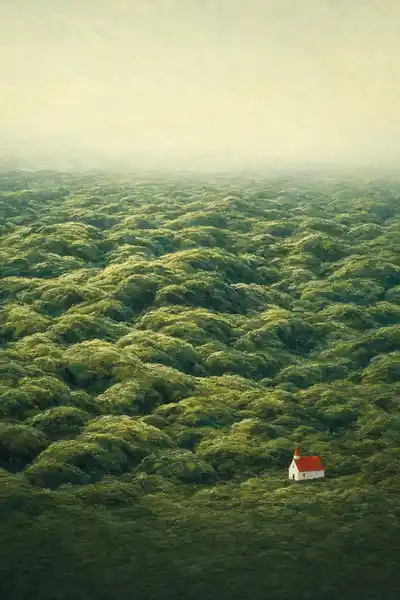
For all its wildness, Iceland is inhabited, and the book never lets us forget it. Scattered among the aerials and the ice are the human marks — and they are almost always small, almost always alone. A single white farmhouse against a mountain that dwarfs it. A tiny church with a bright roof standing on an empty coast, the nearest neighbor apparently kilometers away. A fence line, a gravel road, a boat pulled up on black sand. The people themselves are usually absent from the frame, present only through the things they have built and maintained against long odds.
This is where the book earns the word the brief reaches for — the entwining of nature and culture. Sigurjónsson does not photograph the wilderness and the settlements as separate subjects. He photographs the meeting point, the seam where a thousand years of stubborn habitation presses up against a landscape that never made it easy. Iceland was settled in the ninth century, and survival here has always meant living inside the weather rather than sheltered from it. The photographs carry that history without narrating it. The isolation of a single dwelling says more than a caption could.
04Chapter 4 — The photographer as a way of seeing
Step back from the individual pictures and a different subject comes into focus: not Iceland, but the act of looking at it, sustained over a lifetime. Sigurjónsson has been photographing this country for decades, returning to the same regions across changing seasons and shifting light. A book like this is not the record of a trip. It is the record of a long relationship, and that changes what we are actually being shown. A visitor captures a place. Someone who has come back a hundred times captures a way of knowing it.
This is worth dwelling on because it cuts against how most of us now encounter Iceland — through a torrent of near-identical images taken by people passing through, chasing the same waterfalls and the same aurora from the same pullouts. Those photographs show us what the place looks like. Sigurjónsson's show us what it looks like to someone who has waited for it, who knows which hour the light turns a glacier blue and which weather brings the fog down over a particular fjord. The difference is not equipment. It is patience, and the intimacy patience buys.
05Conclusion
Iceland Small World ends where it began, with that quiet double meaning. An island small enough to drive across, holding within it nearly every landscape the Earth is capable of — desert and glacier, fire and ice, the newest ground on the planet and the oldest blue trapped inside its ice. Sigurjónsson gathers all of it and, through the discipline of decades pointed at the same fjords and skies, makes the immensity feel like something we can carry.
Related books