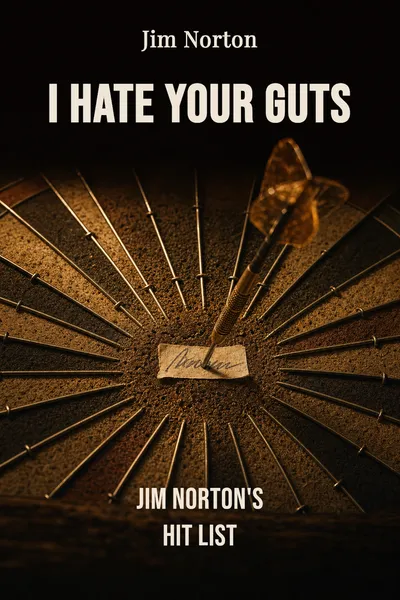
I Hate Your Guts
Jim Norton's hit list
Description
In 2008, Jim Norton published a book with a title that doubles as a mission statement: I Hate Your Guts. Norton had already built a reputation as the loudest, filthiest voice on Opie and Anthony and as a stand-up who treated his own worst impulses as raw material. His first book, Happy Endings, had been a pseudo-memoir stitched together from his fondness for prostitutes, his romantic disasters, and a general refusal to make himself look good. The follow-up narrows the aim. Instead of turning the microscope on himself, Norton points it outward, at a gallery of people he has decided, with theatrical conviction, that he cannot stand.
The lineup is deliberately mismatched. Steve Martin sits alongside Al Sharpton. Dr. Phil shares space with Hillary Clinton, a childhood bully, telemarketers, and the anonymous strangers who ruin an ordinary day. Some are celebrities Norton has never met; some are figures from his own life; some are just types of person he finds intolerable. The book runs through them one at a time, each a small essay in disdain, each an excuse to say the thing most people keep behind their teeth. The humor is uncensored by design, and it lands wherever Norton decides to swing.
What holds a book like this together is not the targets but the voice pointing at them. A hit list is only interesting if the person compiling it is interesting, and Norton knows it. Underneath the insults runs a familiar comic move: the man who spends most of his career admitting his own flaws has earned the right to name everybody else's. The venom is real, but it is also a performance of candor, and the performance is where the work happens.
The question we’re asking : What is Jim Norton actually doing when he tells us, at length and by name, exactly whose guts he hates?What we’ll see : How a book built entirely out of contempt turns into something closer to confession, and why the meanness reads as honesty.
Table of contents
01Chapter 1 — The list is the point
The structure of I Hate Your Guts is almost aggressively simple. Norton picks a target, tells us why the target deserves contempt, and moves on to the next one. There is no overarching argument, no build toward a thesis, no attempt to connect Steve Martin to Al Sharpton beyond the fact that both men happen to occupy space in Norton's head. The book is a catalog, and the catalog format is the joke. It says, in effect, that hatred is abundant enough to fill a volume, and that the author has plenty to spare.
The targets themselves are chosen for range rather than coherence. Some are enormous public figures. Norton takes aim at Hillary Clinton, at Al Sharpton, at Dr. Phil, at the kind of celebrity whose public image is built on being decent, likable, and above reproach. Part of the pleasure, for Norton, is in refusing the image, in treating a beloved figure as fair game and daring the reader to flinch. The bigger and safer the reputation, the more satisfying the swing.

02Chapter 2 — Comedy as controlled cruelty
Norton comes out of a specific comic tradition, one that treats cruelty as a legitimate instrument rather than a failure of manners. His radio years on Opie and Anthony had trained him in a form where nothing was off limits and the fastest, filthiest reaction won. His stand-up worked the same territory. I Hate Your Guts is that sensibility poured into prose, and it carries the same rule: the joke justifies almost anything, provided the joke actually works.
The cruelty is controlled, though, in ways that matter. Norton is not spraying insults at random. He aims at people who occupy positions of power, comfort, or public sanctimony, and the aim gives the meanness a shape. When he goes after a figure whose whole brand is moral authority, the attack functions as a puncture, a refusal to grant the reverence the figure expects. There is a long comic lineage here, the tradition of the insult as a leveling device, and Norton knows exactly which lineage he is working in.
03Chapter 3 — The confession under the insult
The strange thing about a book of pure contempt is how much of the author it reveals. Every target Norton chooses is a small self-portrait. The high-school bully is still there because the wound is still there. The sanctimonious public figures irritate him because he has built a career on the opposite of sanctimony, on admitting the ugly stuff rather than hiding it. Tell me who a man hates and you have learned a great deal about the man, and Norton, whether he means to or not, hands over a lot.
This connects the book to Happy Endings, where the target was himself. There, Norton catalogued his own failures, his fondness for prostitutes, his romantic humiliations, his general inability to be the person a decent life would require. I Hate Your Guts flips the direction of the microscope but keeps the same commitment to exposure. In the first book he confessed his own guts; in the second he assaults everyone else's. The two moves are versions of the same instinct, which is to refuse the polished surface and go straight to the mess.
04Chapter 4 — Why the hate reads as honesty
Step back from the individual targets and a larger question comes into view: why does an audience tolerate, even enjoy, a comic being this openly hostile? The answer has to do with the unspoken contract between a comedian like Norton and the people who listen. The contract is that the comic will say the things the audience feels but cannot voice, and will pay the social price for saying them. Norton's contempt for other people is only bearable because he has spent so long being contemptuous of himself first.
This is the load-bearing move in the whole Norton project. His self-deprecation is not a garnish; it is the license. A man who presents himself as a wreck, who has told you about his worst appetites and cheapest impulses, has earned a certain freedom to point at others. He is not standing above the mess and judging. He is standing in the middle of it, filthy hands and all, and the shared filth is what makes the judgment feel earned rather than pompous. The insult reads as honesty because it comes from someone with no pretense left to protect.
05Conclusion
The hit list runs its course the way it began, one name at a time, from Steve Martin to Al Sharpton to Dr. Phil to the bully who has been dead to everyone but Norton for thirty years. Nothing gets resolved, because resolution was never the plan. The book ends where it started, with a man who has decided that naming his enemies out loud is more honest than pretending he doesn't have any. The venom never softens, and Norton would consider softening it a betrayal of the whole premise.
Related books