I Fought With Custer
Custer's last stand survivor
Description
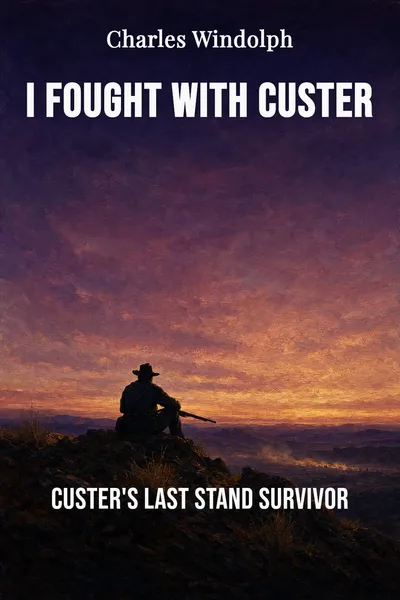
In the summer of 1876, a twenty-five-year-old sergeant named Charles Windolph lay on a bare ridge in Montana Territory, firing into the dark and listening to the Sioux and Cheyenne circling below. He had emigrated from Germany a few years earlier, dodging conscription into the Prussian army only to enlist in the American one. Now he was pinned down with Captain Frederick Benteen's battalion on a bluff above the Little Big Horn River, hearing distant volleys from the direction George Armstrong Custer had ridden, and not yet knowing that those volleys were the sound of five companies being wiped out to the last man.
Windolph survived. He would go on to earn the Medal of Honor for carrying water to the wounded under fire, live to a remarkable old age, and die in 1950 as the last white soldier who had fought at the Little Big Horn. In the early 1940s, when he was in his late eighties, he told his story to the writers Frazier and Robert Hunt, who set his recollection down alongside the documentary trail — the orders, the testimony, the maps, the court of inquiry that dissected the disaster afterward. The result was the book "I Fought With Custer."
It is an unusual kind of history: half memoir spoken from the far edge of a long life, half careful reconstruction built from the record. The battle it describes is probably the most retold defeat in American history, layered over with legend, painting, and grievance. What Windolph offers is narrower and stranger than legend — the thing a single man actually saw, heard and felt on one hill over two days, and could still recall nearly seventy years later.
The question we’re asking : What does the last living voice from the Little Big Horn actually remember, and how does one soldier's account sit against the official record of the disaster?What we’ll see : A German immigrant's path into the Seventh Cavalry, the two days on the hill that destroyed a regiment, the ordinary soldier the Custer myth erased, and what it means to build history on a single surviving memory.
Table of contents
01Chapter 1 — The German boy who ran to the cavalry
Charles Windolph was born in 1851 in Bergen, in what was then the kingdom of Hanover, and grew up in a Germany being hammered together by war and conscription. He had no appetite for the Prussian draft, and like a great many young men of his time and place, he looked west across the Atlantic for a way out. He landed in New York as a poor immigrant with almost no English, and found the country in a hard economic stretch where work was scarce and a foreigner's options were thin.
So he did what a striking number of new arrivals did: he joined the United States Army. It was steady food, a bed, thirteen dollars a month, and a place for a young man with nowhere else to be. Windolph is candid in the book about this. He did not enlist out of some grand patriotic vision of the frontier. He enlisted because the army took him, and it gave a stateless young German a role, a uniform, and a company of men who became, in effect, his new country.

02Chapter 2 — Two days that emptied a regiment
On the morning of June 25, 1876, Custer split his command. He detached Major Marcus Reno to attack the huge village along the river, sent Benteen's battalion — Windolph among them — off to the left to scout and cut off any escape, and kept five companies with himself. It was a decision that has been argued over for a century and a half, and Windolph, who was in Benteen's column, only learned its full shape afterward. What he knew at the time was that his troop was riding away from the sound that would soon become gunfire.
Reno's attack collapsed almost at once against a village far larger than anyone had reckoned. His men were driven back across the river and up onto the bluffs in a bloody, disordered retreat. Benteen's battalion, recalled by a hurried scrawled order from Custer's adjutant — the famous note urging him to come on and bring the packs — arrived in time to join Reno's battered survivors on the hilltop. There the two commands dug in with knives, cups and tin plates, scraping shallow shelter into the ridge while the warriors closed around them.
03Chapter 3 — The soldier the myth left out
Almost from the moment the news reached the East, the Little Big Horn stopped being a battle and became a myth. Custer was recast as a golden-haired martyr, the last stand painted and reprinted and hung in barrooms across the country, the whole disaster folded into a story about a heroic officer overwhelmed by savage hordes. In that story there is a leading man and a wall of faceless enemies, and very little room for a German sergeant lying in the dirt on a different hill.
Windolph's voice cuts against that grain simply by being ordinary and specific. He is not interested in ennobling anyone. He remembers thirst and fear, the names of men he served with, the smell and mess of the field. He is measured about Custer, neither worshipping nor condemning him, and he is measured about the tribes, whom he came to see as men defending their families and their land against an army sent to force them onto reservations. That evenhandedness is rare in the early Custer literature, and it comes from a man who had no career to protect and no legend to sell.
04Chapter 4 — What one survivor's voice does to history
There is something vertiginous about the fact that our fullest personal account of the Little Big Horn comes from a man speaking in his late eighties about a June afternoon nearly seventy years earlier. By the time Windolph told his story, everyone who had ridden with Custer's own five companies had been dead for two-thirds of a century. The event had passed almost entirely into painting and legend. And then, near the very end of the human chain that connected the living to that hill, one old soldier was still there to say: this is what it was actually like.
A single surviving witness both anchors history and unsettles it. It anchors it because memory carries texture that documents cannot — the thirst, the sound of the firing dying out to the north, the faces of particular men. No court of inquiry transcript conveys those things. But it also unsettles the record, because one man on one hill saw only his own fragment. Windolph did not see Custer fall; almost no one on the army's side did, which is precisely why the last stand became a canvas for imagination rather than a matter of testimony. What he could vouch for was Benteen's hill, and he is scrupulous about the difference.
05Conclusion
Charles Windolph lived until 1950, dying at ninety-eight as the last white survivor of the Little Big Horn and, by then, a living relic of a vanished frontier. He had left Germany to escape one army and spent the defining day of his life pinned to a Montana hilltop by another kind of war entirely. The Medal of Honor he earned carrying water to the wounded was a small, concrete thing in the middle of an event that swelled, in the retelling, into national myth.
Related books