

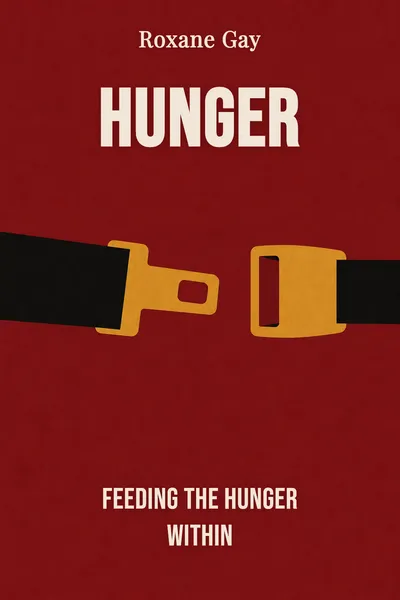
Hunger
Feeding the hunger within
Description
In 2017, the writer Roxane Gay published a memoir with a plain, brutal title: Hunger. She had already become known for Bad Feminist, the essay collection that made her one of the sharpest cultural voices of the decade. But this book was different, and she said so from the first pages. She called it the hardest thing she had ever written, a book about her body, a book she had spent years avoiding. She was not going to give the reader the story they wanted — the triumphant weight-loss arc, the before-and-after, the redemption. She would give them something harder to sit with instead.
Gay is a large woman. At the time of writing she described weighing well over four hundred pounds, living in a body that the world reads instantly and rarely kindly. Hunger is her account of how that body came to be, and of what it means to move through daily life inside it — the chairs that don't hold, the seatbelts that don't reach, the strangers who feel entitled to comment. It is a memoir of the flesh, told without the usual consolations. She refuses to pretend the story is over or that she has it figured out.
What makes the book cut so deep is that Gay is unflinching about the event underneath the weight, and equally unflinching about her own contradictions. She knows what the culture expects a fat woman to feel and to promise. She declines to perform any of it. Instead she asks us to sit with hunger itself — the literal kind, and the kind that has nothing to do with food.
The question we’re asking : What is Roxane Gay's Hunger really about, when it refuses to be the weight-loss story we expect?What we’ll see : A memoir that traces a body back to what happened to it, and reckons honestly with living, and being seen, inside it.
Table of contents
01Chapter 1 — The body as a record
Gay begins with a distinction that organizes the whole book. There is her body, and there is the story of her body, and the two are not the same thing. Most memoirs about weight promise to resolve the gap — to show the body being brought into line with a better story. Gay does the opposite. She insists that her body is itself a record, a physical archive of everything that happened to her, and that reading it honestly means refusing to skip to the part where it changes.
She is precise about the terms. She calls herself fat, deliberately, rather than reaching for the softer clinical words. The precision is a form of refusal: she will not let language do the work of shrinking her. And she is clear-eyed that her body is not, in the current cultural math, an acceptable one. She lives in what she calls an unruly body, one that takes up more space than the world has decided a body should, and she narrates the daily consequences of that without asking for pity.

02Chapter 2 — The story before the story
The center of Hunger is an event. Gay was raped when she was twelve years old, by a boy she trusted and a group of his friends, in an abandoned cabin in the woods near her home. She writes about it directly, though she is careful about how much detail she owes anyone. What matters for the book is not only the violence but what she did with it afterward: she told no one. She carried it alone, a Catholic girl from a loving, high-achieving Haitian-American family, convinced that what happened was her fault and that she could not speak it.
In the silence that followed, food became the answer to a problem she could not name. Gay describes eating as a way of building a body that felt safe — a body large enough, she believed, to be undesirable, to be left alone, to become a fortress no one would want to break into again. This is the book's hardest and most important reframe. The weight was not a failure of willpower. It was a strategy, a child's logic turned into a lifelong architecture of protection.
03Chapter 3 — What the world does with a large body
From the private wound Gay turns outward, to how the culture treats the body she built. She is merciless about the reality of being fat in public. Strangers comment on the contents of her grocery cart. People offer unsolicited diet advice as though it were kindness. Waiters hesitate. Doctors moralize. The assumption everywhere is that a large body is a body that has failed, a moral verdict written on the flesh for anyone to read and correct.
She dissects the machinery of it. The weight-loss industry, she notes, depends on selling a fantasy of transformation that mostly does not last, while treating each individual failure as personal rather than structural. She writes about her own attempts, including a stint on a televised weight-loss program, and about the way even well-meaning regimens frame fatness as a problem of the self to be conquered. The message is always the same: you are wrong, and here is how to become someone acceptable.
04Chapter 4 — The hunger nobody names
Step back from Gay's particular body and the book opens onto something wider. The title carries two meanings that she keeps braided together. There is literal hunger, the appetite for food that she has spent her life managing, indulging, and being judged for. And there is the other hunger — for safety, for love, for acceptance, for a way of being in the world that does not require armor. The book's argument is that we routinely mistake the second for the first, and that the culture is built to keep us confused.
Gay's insight is that we treat hunger as an enemy to be defeated. Discipline, willpower, the shrinking of the self — these are the virtues the culture rewards. But the appetite for care and for belonging is not something that can be dieted away, and trying to starve it only drives it underground, where it finds cruder ways to be fed. Her memoir is less a story about losing weight than a slow refusal of the idea that the answer to hunger is to want less.
05Conclusion
Roxane Gay set out to write the book she had spent years avoiding, and the difficulty is on every page. Hunger returns, at the end, to where it began: a woman inside a body the world misreads, telling the truth about how it came to be and refusing the comforts of a neat resolution. She names the rape she carried in silence, the fortress she built out of food, the daily indignities of moving through a space made for other bodies, and the war she is still, quietly, fighting with herself.