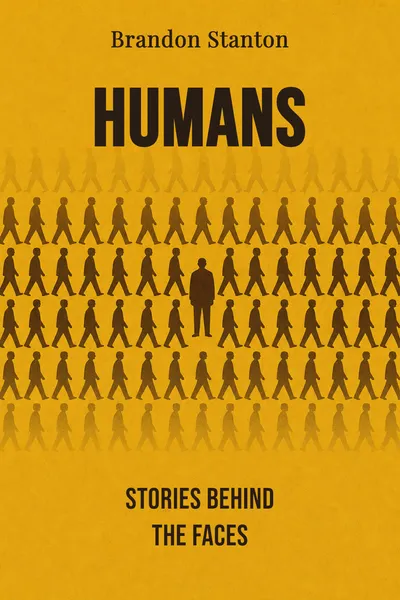
Humans
Stories behind the faces
Description
In the summer of 2010, a twentysomething named Brandon Stanton lost his job trading bonds in Chicago and did something that, on paper, made very little sense. He moved to New York with a camera he barely knew how to use and set himself a task with the scale of a public-works project: photograph ten thousand strangers and pin them to a map, borough by borough, a portrait of the city told through the faces that filled it. He called it Humans of New York. The plan was a visual census. He wanted the pictures, and only the pictures.
The census never quite happened the way he drew it up. Somewhere in the routine of stopping people on sidewalks and subway platforms, Stanton started talking to the people he shot. First a line here and there, a quote under a photo. Then a few sentences. Then, increasingly, the words on the screen mattered as much as the image above them — sometimes more. What had begun as a mapping exercise slid, almost without his deciding it, into something closer to a listening exercise. The book Humans, and its companion Humans of New York: Stories, is the record of that slide.
The pictures are still there, still arresting: a man mid-laugh on a bench, a couple holding each other in a doorway, a kid staring dead into the lens. But the surprise of the book is how much a stranger will hand over when someone stops, asks, and stays long enough to hear the answer. The candor is the thing. People confess grief, regret, small joys and enormous ones to a man they met four minutes earlier, and it lands with a weight most journalism spends pages trying to earn.
The question we’re asking : How did a photographer's plan to map a city turn into one of the most-read collections of stranger confessions in the world?What we’ll see : How the project drifted from image to interview, what people reveal when a stranger simply asks, and why that format traveled far beyond one city.
Table of contents
01Chapter 1 — A census that turned into a conversation
Stanton was not a photographer by training. He had spent three years trading bonds and, by his own account, loved the work until he was let go in 2010. Instead of finding another desk, he bought a camera and started shooting concerts, buildings, whatever held still long enough. The turn came when he pointed the lens at people. He decided to build a photographic census of New York — his phrase — with a stated goal of ten thousand portraits plotted onto a map of the city, so that a viewer could scroll from neighborhood to neighborhood and watch the population change in front of them.
The mechanics were as blunt as the idea. He walked the streets, approached people he found visually interesting, and asked to take their picture. Most days meant a great deal of rejection, which he has never hidden. A lot of people said no. Some were suspicious, some annoyed, some frightened of a young man with a camera closing in. The work of Humans of New York, in its earliest form, was mostly the work of being told no and asking the next person anyway.

02Chapter 2 — The moment the caption got longer than the photo
The early captions were short by necessity — a line or two, whatever fit the mood of the picture. But Stanton kept noticing the same thing. When he included a real quote, the response was different in kind, not just degree. People commented, argued, shared, returned. A face is an invitation; a sentence in that person's own voice is a door. He started asking more questions on the street, and staying longer to hear the answers, which meant fewer portraits per day and far more depth in each one.
The questions themselves became the craft. Stanton developed a way of asking that got past the reflexive small talk. Not just "what do you do" but "what's your biggest struggle right now," "what's the saddest moment of your life," "what do you feel guiltiest about." Direct questions, the kind we rarely put to people we know well, let alone strangers on a corner. What surprised him, and what surprises the reader of the book, is how often people answered them fully. A stranger has no history with you to protect, no reputation to manage. Sometimes that makes the truth easier to say, not harder.
03Chapter 3 — What strangers say when someone actually asks
The contents of the stories are what give the book its pull, and they resist easy summary because they refuse to be representative. Stanton is not building an argument about New York or about humanity. He is collecting particulars. A retired man speaks about the wife he still talks to every morning though she died years ago. A young woman explains why she left home. A father describes the exact moment he understood his son was gone from addiction. None of these is offered as a lesson. They are simply there, in the person's own words, under their own face.
The candor scales with the format. In Stories, freed from the constraint of a single line, people go further than they did in the first book. They admit to shame, to failure, to fears they have never said aloud to family. Stanton has spoken about the strange trust of the encounter — that being approached by a stranger who will photograph you and move on can loosen something that stays locked with the people who know you. There is no ongoing relationship to damage, no dinner-table consequence. The exchange is complete in a few minutes, and that completeness is a kind of safety.
04Chapter 4 — The book that made a global audience out of eavesdropping
Step back from the individual stories and the more curious fact is the size of the audience that wanted them. Humans of New York grew into one of the most-followed photography projects in the world, with millions of readers returning daily to look at strangers and read what those strangers said. This is worth sitting with, because it runs against the assumption that people online crave spectacle, celebrity, the extraordinary. What Stanton's readers came back for was the opposite: the unfamous, the unremarkable, the person who would never otherwise cross their screen.
The format tapped something the culture had left underfed. We move through cities surrounded by strangers we will never know, trained to keep our eyes down and our questions to ourselves. Stanton's project performed the transgression on our behalf — it walked up to the person on the bench and asked the question we would never ask, then handed us the answer. Reading it is a permitted form of eavesdropping, the guilty pleasure of overhearing someone's real life, made generous by the fact that the person chose to tell it.
05Conclusion
The census Stanton set out to build in 2010 never got finished on its original terms, and it hardly matters. He wanted a map of ten thousand faces sorted by neighborhood; what he made instead was a form that stopped strangers, asked them the questions we swallow, and printed the answers under their portraits. The book Humans is the mature version of that accident — photographs given room to breathe beside stories long enough and candid enough that a reader closes the page feeling they have met someone.
Related books