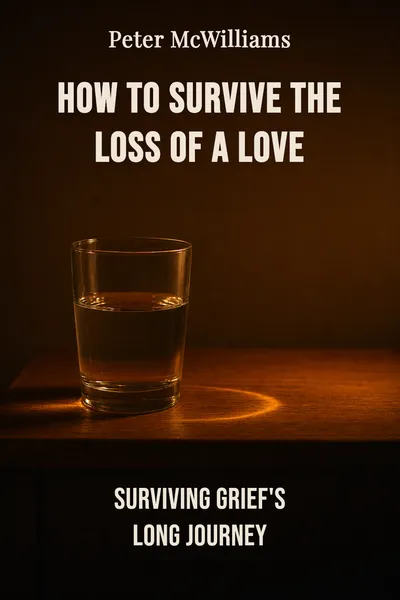
How to Survive the Loss of a Love
Surviving grief's long journey
Description
In 1971, three friends — Peter McWilliams, Melba Colgrove, and Harold Bloomfield — put together a small book after McWilliams went through a breakup that flattened him. It wasn't a textbook or a clinical manual. It was closer to a care package: short passages of plain advice on one page, a poem on the facing page, white space where a reader might need to breathe. They called it How to Survive the Loss of a Love, and it went on to sell millions of copies, mostly by being handed quietly from one person to another at the worst moment of their year.
The premise is deceptively modest. Loss is not something to be fixed, optimized, or hurried. It's something to be survived, in the literal sense — to get through the hours, then the days, then the strange flat weeks that follow, without the reassurance that any of it will feel better on a schedule. McWilliams doesn't promise a shortcut. He promises company. The book reads like a friend sitting on the end of your bed at two in the morning, not saying anything clever, just staying. And it takes as given that staying is enough, that presence is its own kind of medicine when nothing else will hold.
That patience is what set it apart, and what has kept people returning to it for half a century. Most grief writing wants to explain grief, to name its stages and chart its arc as if understanding it were the same as getting through it. This one mostly wants to keep you alive while it passes through you — and it treats that as the whole job, not a lesser one. It is less interested in why you hurt than in what you do with your hands at three in the afternoon when the hurt is all there is.
The question we’re asking : When a love is gone, what do we actually need — an explanation of the pain, or something to help us get through the night?What we’ll see : How a small book of plain advice, poetry and white space became the thing people reach for when everything else feels beside the point.
Table of contents
01 Chapter 1 — Loss is bigger than heartbreak
The title says love, and most people pick the book up because a relationship has just ended. But McWilliams widens the frame almost immediately. A love, in the book's sense, is anything we've attached ourselves to and then had taken away. A marriage, yes. But also a friend who dies, a parent, a pet, a job, a home, a version of the future we'd already started living in. The insight is that these losses share a shape, even when their causes look nothing alike. The nervous system doesn't file a divorce and a death in separate drawers.
This matters because it dissolves a private shame a lot of grieving people carry: the sense that their loss doesn't rank. Someone whose long relationship collapses often feels they have no right to fall apart, because nobody died. Someone mourning a pet apologizes for how hard it's hitting them. McWilliams refuses the ranking. If it mattered to you, its absence is a real wound, and the size of the wound is set by the size of the attachment, not by what other people think you're allowed to feel.

02 Chapter 2 — The body keeps the first appointment
Long before grief becomes a feeling we can talk about, it's a physical event. McWilliams is unusually direct about this. Loss shows up as a tight chest, a stomach that won't hold food, sleep that either won't come or won't stop, a fatigue that no rest touches. The book insists these aren't side effects to push past on the way to the real, emotional work. They are the real work. The body grieves first, and it grieves whether or not the mind has caught up.
From this comes the book's most practical strand, and its least glamorous. Drink water. Eat something, even if it's small and you don't want it. Sleep when you can. Don't make big decisions — don't sell the house, quit the job, or cut off contact in a rage you'll have to explain later. The advice sounds almost insultingly basic until you're inside a loss and discover that basic is exactly what goes first. Grief strips away the automatic self-maintenance we normally don't notice ourselves doing.
03 Chapter 3 — What actually helps, and what only looks like it
Once survival is handled, the book turns to the harder question of what genuinely moves a person through grief rather than just numbing it. Here McWilliams draws a quiet line between comfort and escape. Some things soothe you and leave you a little more intact; others promise relief and hollow you out further. Learning to tell them apart, especially when you're desperate for any relief at all, is one of the book's central lessons.
On the helpful side: letting yourself cry, and often. Talking about the loss to someone who will simply listen. Writing — letters you may never send, journals nobody reads. Small routines that give a shapeless day some edges. Time with people who don't need you to be okay. And, crucially, solitude in measured doses, chosen rather than collapsed into. The book treats reaching out and being alone not as opposites but as two tools, each useful at different hours.
04 Chapter 4 — A book that stays on the nightstand
Half a century of grief research has come and gone since three friends assembled this book. The neat five-stage model it gently borrowed has been questioned, revised, and partly retired by the field. Newer thinking talks about grief as something we carry and reorganize our lives around rather than something we complete. And yet the book itself keeps getting bought, borrowed, and pressed into the hands of the newly bereaved. That endurance says something about what people actually want when they're breaking.
What they want, it turns out, is rarely a theory. It's company. The book's staying power comes from its refusal to be smart at the reader. It doesn't explain your grief back to you or promote a method with your name on the receipt. It sits beside you at the pace you can manage — a page, a poem, a glass of water — and asks nothing. In a culture that treats almost every difficulty as a problem to be solved and optimized, a book that just agrees to stay is quietly radical.
05 Conclusion
The book began with one man's breakup and grew into a companion for every kind of loss — the deaths, the endings, the futures that quietly stopped being possible. Its advice never got more sophisticated over the decades, and that was the point. Drink water, cry when you need to, don't decide anything big, let the days pass at their own unhurried speed, and trust that hope will return before you can quite believe it will. Survival first; meaning later, if at all.
Related books