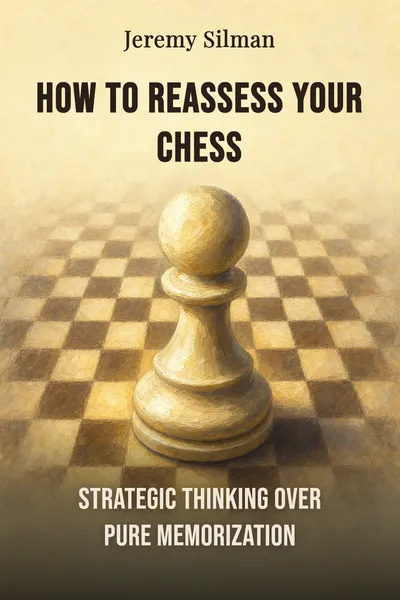
How to Reassess Your Chess
Strategic thinking over pure memorization
Description
Somewhere around 1993, a chess teacher named Jeremy Silman noticed the same thing happening again and again with his students. A player would reach a quiet middlegame — no immediate threats, no piece hanging, nothing to calculate — and simply freeze. They knew opening theory. They could spot a two-move tactic. But faced with a position that asked "what should I even be trying to do here?", they had nothing. They pushed a pawn, shuffled a knight, waited for the opponent to do something. And they lost, slowly, without ever being able to say where.
Silman's diagnosis was blunt: these players had been taught to memorize and to calculate, and almost nothing in between. They had a library of openings and a knack for spotting tricks, but no method for the long stretch of a game where nothing is forced and everything is a choice. His book, How to Reassess Your Chess, first published in 1993 and revised across editions since, set out to fill exactly that gap — to give ordinary players a repeatable way of looking at a silent position and knowing what it wanted.
The tool he built has a slightly clinical name and a very practical payoff. Instead of asking players to feel their way forward or recall a pattern, Silman asked them to take inventory. Every position, he argued, can be read through a short list of concrete features — and once we can name those features, the plan is rarely a mystery. What follows is less a chess lesson than a way of thinking that happens to use a board.
The question we’re asking : How do we decide what to do in a position where nothing forces our hand and no move is obviously right?What we’ll see : How one teacher turned the fog of the middlegame into a short, readable list — and what that changes about the way we improve.
Table of contents
01Chapter 1 — The move nobody could explain
Ask a strong player why they made a certain quiet move and the answer is often useless to everyone else: "it felt right," "it's just a good square," "you develop toward the center." Silman spent years watching amateurs try to convert these vague slogans into decisions, and watching them fail. The slogans were true, but they weren't operable. "Control the center" tells us nothing when both sides already have pawns there and the real question is whether to trade them. Intuition, he realized, was the compressed output of thousands of hours of experience — and you can't hand someone the output without the experience.
So he went the other way. Rather than teach students to imitate a master's instincts, he tried to reconstruct what those instincts were actually tracking. When a grandmaster looks at a position, they aren't running a memorized script. They are noticing things — that one side's pieces are cramped, that a square can never be defended by a pawn, that the pawn chains point in opposite directions. These noticings happen fast and mostly below awareness, which is exactly why they're so hard to pass on.

02Chapter 2 — Reading a position by its imbalances
The core of Silman's method is a single word: imbalances. An imbalance is any concrete difference between the two sides that isn't just "who's ahead." His list is short enough to actually use. There's the pawn structure — doubled pawns, isolated pawns, pawn chains, weak squares that no pawn can ever guard. There's space, meaning who controls more territory and whose pieces therefore have more room to maneuver. There's the matter of good versus bad pieces: a bishop hemmed in by its own pawns is worth far less than a knight sitting on a square it can never be kicked from.
To this he adds the difference between bishops and knights as a standing question rather than a fixed rule — bishops love open positions and long diagonals, knights love closed positions with fixed pawns and outposts. There's control of a key file or a key square, the kind of real estate a rook or knight can dominate. And there's development and initiative, the temporary lead one side may hold in getting pieces active. Some imbalances are permanent, like a ruined pawn structure; others are fleeting, like a lead in development that vanishes if you don't use it.
03Chapter 3 — Making the plan the position already wants
Once the imbalances are named, Silman argues, the plan almost writes itself — and this is the part that surprises players who expected chess wisdom to be more mysterious. His rule is close to a slogan: play in the area where you hold the advantage, and aim your effort at making your favorable imbalances count. If your strength is a superior pawn structure on the queenside, you play on the queenside. If your strength is a knight that dominates an outpost, you build everything around keeping and using that knight.
The mirror rule is just as important: figure out what the opponent's plan should be, and interfere with it. Because both sides read the same board, the position is a negotiation. Silman spends much of the book on carefully chosen examples where a player, having correctly listed the imbalances, still loses — because they pursued the wrong one, or acted where they were weak instead of where they were strong. A common failure is impatience: attacking on the kingside for the drama of it, when the real, boring advantage sits quietly on the other wing.
04Chapter 4 — When the pieces stop being interchangeable
Step back from the sixty-four squares and the deeper claim in Silman's method is about how anyone makes good decisions in a domain too big to memorize. Chess has more possible games than atoms in the observable universe; no amount of stored answers can cover it. What Silman offers instead is a vocabulary — a small set of names for the features that recur, so that a never-before-seen situation becomes an instance of something you already know how to reason about. The strength isn't recall. It's the ability to describe.
This is why his approach outlasts the trend of raw memorization that dominates a lot of chess improvement, especially now that engines can hand players the "correct" move instantly. Knowing the right move in a position you've studied is fragile; the moment the position drifts, the memorized answer is worthless. Knowing why one side stands better — because a bishop is bad, because a file is open — travels. It applies to the next position and the one after that, none of which you've ever seen.
05Conclusion
The frozen student from the opening — stuck in a quiet position with a head full of openings and no idea what to do — is the reader Silman wrote the whole book for. His answer was never a better move to memorize. It was a habit: before choosing anything, list the imbalances, decide which one is decisive, and play toward it. The fog of the middlegame doesn't lift because you've seen this exact position before. It lifts because you finally have words for what you're looking at.
Related books