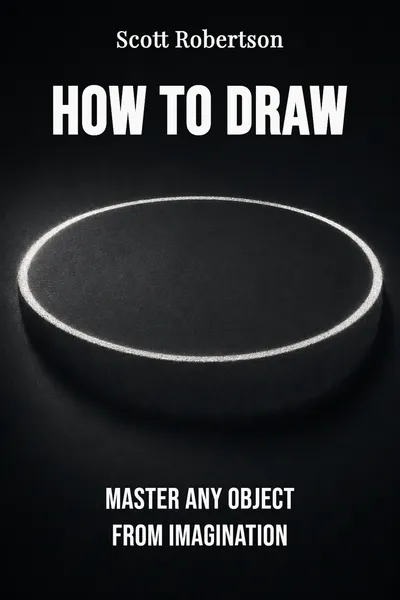
How To Draw
Master any object from imagination
Description
There is a moment in almost every drawing class where a student stops mid-sketch and says some version of the same thing: I can copy what's in front of me, but I can't invent. Show them a chair and they'll render it; ask them to draw a chair that doesn't exist yet, from a three-quarter view, catching the light from the left, and the pencil freezes. Scott Robertson, who spent years teaching transportation and entertainment design at Art Center College of Design in Pasadena, built an entire book around the conviction that this freeze is not a lack of talent. It's a lack of a system. His 2013 volume, written with longtime collaborator Thomas Bertling, is called simply How to Draw, and its subject is the one thing most drawing books quietly avoid: drawing things that aren't there.
What makes the book unusual is where it starts. Not with gesture, not with still life, not with the human figure — but with a horizon line and two vanishing points. Robertson's wager is that if you can construct accurate space on a flat page, everything else becomes a matter of placing forms inside that space. The early chapters are almost aggressively technical: perspective grids, the behavior of ellipses, the geometry of how a circle sits on a receding plane. It reads less like an art book than a manual for building a machine. And that, more or less, is the point.
The promise on the cover is bold — master any object from imagination — and the method behind it is patient, cumulative, and a little contrarian in a field that often treats drawing as intuition you either have or don't. Robertson and Bertling bring a combined twenty-six years of teaching to the argument, and the argument is that invention on the page is engineered, not summoned.
The question we’re asking : How does a working method let someone draw an object that has never existed, without a reference to copy?What we’ll see : How Robertson turns perspective, ellipses and simple solids into a toolkit for building imagined objects — and what that says about drawing itself.
Table of contents
01Chapter 1 — The grid before the object
Most people who want to learn drawing expect to begin by drawing something — an apple, a hand, a face. Robertson makes them begin with nothing. Or rather, with the invisible scaffolding that everything else will hang on: the horizon line, the vanishing points, the receding grid. Before a single object appears, the reader is asked to understand that a drawing is first a description of space, and space on a flat page obeys rules. Lines that are parallel in the world converge as they recede. A grid drawn correctly is not decoration; it is the coordinate system inside which any form can later be located precisely.
The book spends real time on the mechanics that other guides skip. How to place vanishing points far enough apart to avoid the bloated distortion of a too-wide lens. How to divide a receding plane into equal units even though those units shrink as they move away. How to build a grid on the ground and then project it up into the air to establish height. These are not glamorous skills, and Robertson doesn't pretend they are. He treats them the way a builder treats a foundation — unseen in the finished work, but the reason the finished work stands.

02Chapter 2 — Ellipses, the vocabulary of volume
If the grid is the book's skeleton, the ellipse is its vocabulary. Robertson devotes an extraordinary amount of attention to what is, on the surface, a humble shape: a circle seen at an angle. But almost nothing in the built world is drawn without them. Wheels, bottles, cups, engine parts, the cross-section of any cylinder or cone — all of it depends on being able to draw a convincing ellipse in the right place, at the right tilt, at the right degree of openness. Get the ellipse wrong and the object looks broken, no matter how clean the linework.
The technical concepts here are precise. Every ellipse has a minor axis, the short line through its narrowest dimension, and that axis must align with the axis of the cylinder it belongs to — a rule beginners violate constantly, producing wheels that look like they're falling off the car. The ellipse's degree, its apparent roundness, changes depending on how far it sits from the horizon line. A circle lying flat on the ground reads as a narrow sliver near eye level and opens toward a full circle as it drops away below you. Robertson drills these relationships until they become reflex, because in a from-imagination drawing there is no photograph to correct against.
03Chapter 3 — From primitive to invented thing
With the grid and the ellipse in hand, the book makes its real move: turning simple solids into complex, never-before-seen objects. Robertson's method is additive and subtractive. You begin with primitive forms — a box, a cylinder, a sphere — placed accurately in perspective, and then you cut into them, extend them, round their edges, and combine them until the primitive disappears into a designed thing. A camera, a piece of furniture, a vehicle: each starts life as a crude arrangement of boxes and tubes sitting inside the grid, refined stage by stage.
The book is honest that this is a research and design process, not a single act of inspiration. Robertson demonstrates how professionals generate concepts — gathering visual reference not to copy but to understand how real objects are constructed, then recombining that understanding into something new. The imagination doesn't produce the object whole; it directs a sequence of informed decisions. Where does the form need to widen for a hand to grip it? How does a rounded edge catch light differently from a sharp one? The invented object earns its believability by obeying the same spatial and material logic as a real one.
04Chapter 4 — Drawing as a way of thinking
Step back from the wheels and the perspective grids and a larger claim comes into view. Robertson is not really teaching people how to make attractive pictures. He is teaching a way of thinking in which drawing is a tool for reasoning about objects and space, the same way an equation is a tool for reasoning about quantity. When an industrial designer sketches a product that does not yet exist, the drawing is where the design is actually worked out — proportions tested, mechanisms fit together, decisions made and discarded. The page is not a record of the idea; it is the place the idea gets made.
This reframes what the book's bold cover promise actually means. To draw any object from imagination is not to possess a magical inner vision that pours onto paper. It is to have internalized a system reliable enough that the mind can pose a problem — a vehicle from this angle, in this light — and the hand can construct the answer, step by verifiable step. The freeze that stops the beginner is the absence of that system. Robertson's whole architecture, grid before ellipse before form before light, is designed to replace the freeze with a procedure.
05Conclusion
The student who froze at the blank page began, in Robertson's method, nowhere near the object they wanted to invent. They began with a horizon line and two vanishing points, then a grid, then ellipses drawn until the elbow ached, then boxes and cylinders arranged in measured space. By the time an imagined vehicle or an unbuilt machine finally appears, it arrives as the last step of a long ordered sequence, not the first flash of a gift. The freeze dissolves because there is now a procedure where there used to be only hope.
Related books