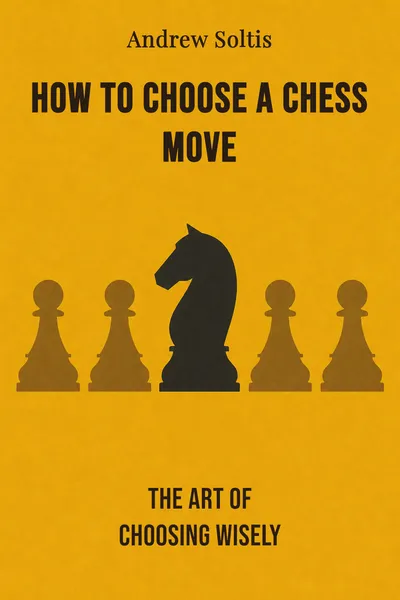
How To Choose A Chess Move
The art of choosing wisely
Description
Sit a strong player down in front of a position they have never seen, and watch what happens in the next few minutes. There is a pause. A hand hovers, then withdraws. The eyes move across the board in a pattern that looks nothing like reading, more like circling. What that player is doing is the thing every chess book promises to teach and almost none actually explains: choosing a move. Not finding the brilliant one — that is rare, and mostly luck dressed as genius — but deciding, out of the four or five reasonable options in front of them, which one to actually play.
Andrew Soltis, an American grandmaster who spent decades writing about the game for players who are good but stuck, built a whole book around that quiet moment. His premise is almost rude in its bluntness: most amateurs do not lose because they miss winning combinations. They lose because they choose badly among ordinary moves. They fall in love with a plan, or trust a rule they half-remember, or calculate one line to death while ignoring the three next to it. The gap between a club player and a master, Soltis argues, is less about knowing more and more about deciding better.
That reframing is what makes the subject worth sitting with. Deciding is not the same as knowing, and chess turns out to be an unusually honest laboratory for the difference — every choice is recorded, every consequence arrives, and there is nobody to blame. What Soltis offers is not a secret weapon but a way of thinking at the board, a discipline for the moment when the clock is running and the position refuses to tell us what it wants.
The question we’re asking : When there is no single best move staring back at us, how does a player actually decide which one to trust?What we’ll see : How a grandmaster takes apart the moment of choice — candidates, rules, calculation and the human sitting behind the pieces.
Table of contents
01Chapter 1 — The move is never obvious
Soltis starts by killing a comforting myth: that good players simply see the right move. In sharp tactical positions, sometimes they do — the pieces line up and the answer is forced. But those moments are the exception. Far more often, the board offers several playable moves, none of them clearly best, and the work of chess is choosing between them. Soltis calls these the candidate moves, and his first piece of practical advice is almost embarrassingly simple: name them. Before calculating anything, list the two or three or four moves that deserve a look. Amateurs skip this step. They fixate on the first idea that catches their eye and pour all their energy into justifying it.
The trouble with the first idea is that it is rarely the best one, and it is almost never chosen for good reasons. It is chosen because it is aggressive, or because it looks active, or because it resembles a move that won a game once. Soltis is unusually honest about how much of amateur play is driven by mood rather than analysis — the urge to attack, the fear of looking passive, the itch to do something. Building a proper list of candidates is a way of forcing the mind to slow down and consider moves it would otherwise dismiss, including the quiet ones that do not flatter the ego.

02Chapter 2 — Rules are cheap, reasons are expensive
Every chess player carries a pocketful of rules. Develop your pieces. Control the center. Castle early. Do not move the same piece twice in the opening. Rooks belong on open files. Soltis does not throw these out — they exist because they usually work — but he spends a great deal of the book showing how they mislead the players who lean on them hardest. A rule is a compressed summary of thousands of positions. The moment you are in a position the rule did not anticipate, following it blindly is how good players talk themselves into bad moves.
His point is that a rule is a starting suggestion, not a verdict. "Rooks belong on open files" is true right up until the open file leads nowhere and the rook was doing useful work where it stood. The skill is not memorizing more rules but knowing why each one exists, because the why is what tells you when it stops applying. A player who understands that development matters because it prepares an attack will happily delay development when there is no attack to prepare. A player who just knows "develop fast" will develop into a worse position and feel virtuous about it.
03Chapter 3 — When calculation runs out
At some point the general reasoning stops and the concrete work begins: if I go here, he goes there, then I have this. Calculation is where amateurs both overreach and underperform. Soltis describes two opposite failures. Some players barely calculate at all, playing on feel and walking into two-move tactics. Others calculate obsessively, disappearing down a single line for ten minutes while ignoring the opponent's best replies. Both lose. Good calculation is not deeper; it is better organized — checking the candidate moves in turn, and within each, giving the opponent credit for their strongest response rather than the one that is convenient.
The hardest discipline, Soltis insists, is looking for the opponent's ideas as hard as your own. Amateurs calculate their own attack in loving detail and assume the other side will cooperate. The correction is almost mechanical: after settling on a move, ask what the opponent most wants to do, and whether this move allows it. This single habit — the prophylactic question — prevents more disasters than any tactical trick. Many blunders are not miscalculations at all; they are moves made without ever asking what the opponent was threatening.
04Chapter 4 — The player behind the board
Step back from the pieces and Soltis's real subject comes into focus. Choosing a chess move is a compact model of deciding under uncertainty — with incomplete information, a running clock, an opponent who wants you to fail, and no formula that finishes the job for you. The reason he spends so little time promising secret techniques is that he does not believe the technique is the bottleneck. The bottleneck is the human doing the deciding, with all their impatience, wishful thinking and attachment to a plan they have outgrown.
What makes chess an unusually honest teacher is that it strips away the excuses. In most of life, a bad decision can hide behind bad luck or someone else's failure. On the board there is nobody else. The position is symmetrical in information — both players see everything — so a loss is a decision you made, recorded in notation, available to be replayed. Soltis's method is really a method for confronting your own choices without flinching: name the candidates you were tempted to ignore, state the reason rather than the rule, and check whether you gave the opponent full credit.
05Conclusion
Come back to that player pausing over an unfamiliar position, hand hovering. What looked like waiting for inspiration turns out to be work — the quiet labor of listing what is playable, testing the reasons behind each move, calculating just far enough to reach a position they can judge, and asking the whole time what the opponent is really after. Soltis's achievement is to make that labor visible and repeatable, to turn the mystery of the strong player's choice into a set of habits an ordinary player can actually practice.
Related books