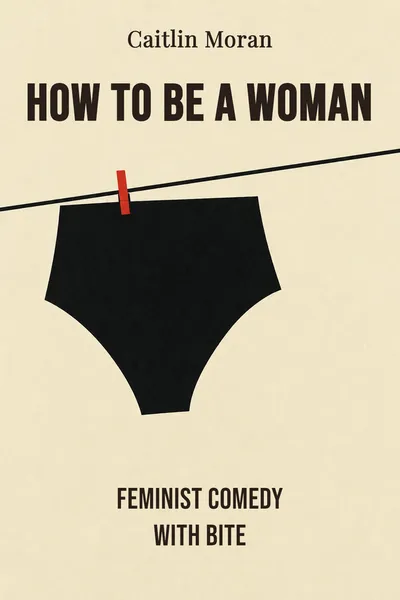
How to Be a Woman
Feminist comedy with bite
Description
On her thirteenth birthday, in a council house in Wolverhampton in the late 1980s, Caitlin Moran was overweight, home-schooled, and being chased across a field by neighbourhood boys throwing stones and shouting a word she didn't yet have a reply to. She was one of eight children, the family lived on benefits, and books arrived from the library in carrier bags. That birthday scene opens "How to Be a Woman," the part-memoir, part-manifesto she published in 2011, and it sets the tone for everything after: the biggest questions about being a woman, told through the smallest, most embarrassing details of one actual life.
The book was a phenomenon. It sold hundreds of thousands of copies in the UK within months, won Book of the Year at the 2011 Galaxy National Book Awards, and was translated into dozens of languages. Marie Claire called Moran the UK's equivalent to Tina Fey, Chelsea Handler and Lena Dunham rolled into one. Critics reached for the word "revolution." What made it land wasn't a new theory — it was the decision to talk about periods, knickers, weddings and childbirth in the same breath as the word feminism, and to do it while making people laugh out loud on the train.
Moran wasn't writing for the seminar room. She was writing for women who assumed feminism was something finished, or something for other people, or a word too solemn to claim. Her wager was that if you told the truth about a woman's body and life plainly enough, and funnily enough, the politics would arrive on its own — no footnotes required.
The question we’re asking : How does a book about bras, body hair and bad dates end up making a case for feminism that reached readers theory never did?What we’ll see : A working-class childhood turned into a manifesto, a one-question test for feminism, and the wager that a joke can carry an argument.
Table of contents
01 Chapter 1 — The girl who decided to be a woman
Moran built the book as a life told in stages, each chapter pinned to a milestone of female embarrassment. Puberty arrives as a horror show she has to face mostly alone: the first period, the first bra, the dawning realisation that her body is now public property, subject to comment from strangers. She writes about these things with a bluntness that was rare in 2011 and still feels bracing — the pubic hair, the masturbation, the sheer physical strangeness of becoming a woman, all rendered in the voice of someone who found it hilarious and mortifying in equal measure.
The autobiography is not incidental. Moran grew up poor, the eldest daughter in a chaotic, loving, overcrowded house, and she left formal schooling early. She taught herself by reading everything, and at sixteen she won a music-journalism competition and started writing professionally for the London press. The trajectory matters because it shapes the book's whole posture: this is not a critique from a woman with a degree in gender studies but from one who arrived at feminism by living, at speed, through the things it describes.

02 Chapter 2 — Feminism as a question you ask yourself
At the centre of the book is a test Moran offers readers who feel uneasy about the word. Put your hand in your knickers, she writes, and ask two questions: do you have a vagina, and do you want to be in charge of it? If the answer to both is yes, congratulations — you're a feminist. It is deliberately crude and deliberately simple, and it does a lot of work. It strips feminism of its baggage of factions and jargon and reframes it as the plainest possible proposition: women should have control over their own lives and bodies.
The move was a direct response to a mood Moran diagnosed sharply. By the late 2000s, plenty of women had come to treat feminist as a slightly embarrassing label — humourless, angry, dated, something their mothers cared about. Surveys of the period kept finding young women who believed in equal pay and reproductive rights but recoiled from the word itself. Moran's test was engineered to close that gap, to make declining the label look sillier than accepting it.
03 Chapter 3 — The politics hiding in the small stuff
Having lowered the barrier to the word, Moran spends the middle of the book showing that the political questions live inside things women are told not to take seriously. She writes about weddings and the pressure to want the fairytale, about the industry built on female insecurity, about high heels and Brazilian waxes and the strange modern expectation that women should present themselves as hairless and permanently youthful. None of it is treated as trivial. Each is examined as a place where a woman's money, time and self-image are quietly extracted.
The book's most serious chapters are also its funniest in their setup and its bleakest in their landing. Moran describes her own two experiences of childbirth in unsparing physical detail, then writes at length about a later abortion — a decision she presents without drama or apology, arguing that the choice to not have a third child was as legitimate and as important as her choice to have the first two. The chapter was among the book's most talked-about, precisely because she declined the expected register of guilt. She simply refused to perform regret she didn't feel.
04 Chapter 4 — Why the joke is the argument
Step back from the individual chapters and the book's real proposition comes into focus: that comedy is not the sugar coating on the argument but the argument itself. Moran's bet is that laughter does something a lecture cannot. When a reader laughs at a description of her own teenage humiliation, she has already agreed with the premise — that this was absurd, that it shouldn't have felt so shameful, that something in the arrangement was wrong. The joke smuggles the politics past the reader's defences and lands it somewhere solemn prose rarely reaches.
This is why the book connected with people who would never have picked up a work of feminist theory. The humour signalled that no prior reading was required, that they would not be tested or scolded, that the author was on their side and just as embarrassing as they were. In a period when the word feminist had curdled into something forbidding, Moran made it sound like the most obvious and least frightening thing in the world — a stance you could hold while still being funny, flawed and fond of a nice dress.
05 Conclusion
The book ends more or less where it began, with Moran insisting that the point of all of it — the periods, the abortions, the terrible shoes, the arguments about the word itself — is simply that women should get to run their own lives with the same ease men take for granted. The girl chased across the Wolverhampton field grew up to write the most-discussed feminist book of her generation, and she did it not by acquiring authority but by refusing to pretend she had any. The voice that carried the book is the same one that opened it: candid, self-mocking, unembarrassed.
Related books