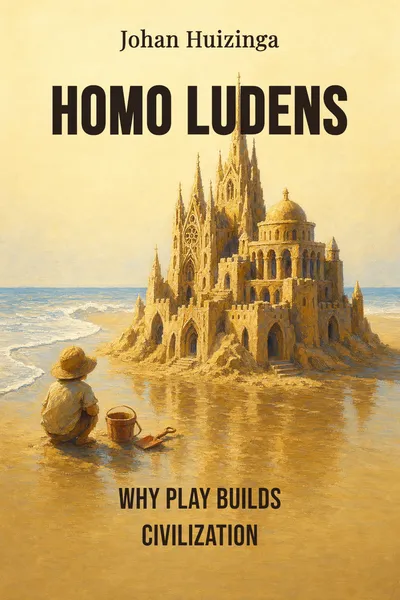
Homo Ludens
Why play builds civilization
Description
In 1938, as Europe slid toward a war that would kill millions and drive him into detention, a Dutch historian named Johan Huizinga published a book arguing that the deepest engine of human culture was play. The timing was almost perverse. Huizinga was rector of Leiden University, a scholar of medieval life best known for a lush study of the fourteenth and fifteenth centuries. Now, at sixty-five, he was proposing something that sounded like a provocation: that law, poetry, war, philosophy and ritual all grew out of the same impulse that makes a child build a fort or two men agree to fight by rules. He called the book Homo Ludens — Man the Player.
The claim was not that humans play in their spare time, once the serious business of survival is handled. It was the reverse. Huizinga argued that play is older than culture itself, that animals play without any human teaching them, and that the great structures we call civilization — the court, the sacred rite, the poetic contest, the treaty between nations — carry the DNA of the game inside them. Take play away, he suggested, and much of what we treasure as human achievement stops making sense.
Decades later, the book sits on the shelf of nearly every serious game designer, and its central term — the "magic circle" of play — has become common currency far beyond philosophy. But Homo Ludens was never really about games in the narrow sense. It was an attempt to read all of human history through a single lens, and to sound a quiet alarm about what happens when that lens goes dark.
The question we’re asking : What did Huizinga mean by claiming that play, not work or reason, is the hidden foundation of civilization?What we’ll see : How one historian traced the play-element from ancient contests through the whole architecture of culture, and why he feared his own century was losing it.
Table of contents
01Chapter 1 — The philologist who took games seriously
Huizinga came to play the way a linguist comes to anything — through words. Before he was a theorist of culture he was a scholar of language and Sanskrit, and he had a habit of noticing that the terms people used for their most solemn activities kept sliding toward the vocabulary of games. We speak of the play of a legal case, the players in a market, playing politics, playing to the crowd. These are not lazy metaphors, he thought. They are fossils, traces of a truth the language remembers even when we have forgotten it.
So he set out to define his subject with unusual care, because a sloppy definition would let critics wave the whole argument away. Play, in Homo Ludens, is a free activity — you cannot be ordered to play and mean it. It stands outside ordinary life, in its own time and its own bounded space, what he famously called the magic circle: the chessboard, the court, the stage, the temple, the arena. Inside that circle, special rules apply that would be meaningless outside it. And it is absorbing, taken with complete seriousness by those inside it, even though everyone knows it is "only" play.

02Chapter 2 — Play comes before culture
The boldest move in the book is chronological. Culture, Huizinga argued, does not produce play as one of its later refinements. Play produces culture. It is there before the human, visible in young animals bowing to invite a chase, and it is present at the origin of every human institution we can trace far enough back. We do not add play to a serious world; we build serious worlds out of the play-form.
Consider the sacred rite. To the modern eye, religion is the opposite of a game — the most solemn thing there is. But Huizinga pointed out that ritual has exactly the structure of play. It happens in a consecrated space set apart from ordinary ground, at appointed times, following rules that must be observed precisely, performed by participants who step into roles. The priest and the masked dancer are both, in his sense, players inside a magic circle, and the community treats the performance with total seriousness while knowing, at some level, that it is a representation. Sacredness and play, he suggested, spring from the same root: the marking-off of a special reality where things mean more than they ordinarily do.
03Chapter 3 — The contest that built the ancient world
If play is the seed, the contest is the plant. Huizinga devoted much of the book to the agon — the competitive impulse — because he saw it as the form in which the play-element did its most visible cultural work. Human beings do not only play; they play against one another, and they play to win honor. The desire to be first, to be acknowledged best before a watching community, turns out to be a builder of institutions.
The Greeks are his richest case. Their whole civilization, he argued, was structured around the contest. Athletic games at Olympia, dramatic competitions where tragedies were entered for prizes, contests of oratory and beauty and drinking and music — the Greek word arete, excellence, was inseparable from the idea of proving it against rivals in public. What looks to us like the height of high culture was, in its own eyes, a tournament. The famous rivalry of the philosophers was of a piece with the footrace and the choral competition.
04Chapter 4 — When the play-element drains out
Having traced the play-element up through the centuries, Huizinga turned, in his final chapters, to his own age — and here the book stops being a history and becomes a warning. His argument was that modern civilization, for all its noise and spectacle, was losing genuine play. The forms were everywhere; the spirit was leaking out. And a culture that keeps the shell of the game while losing its soul is, he thought, in a dangerous condition.
The nineteenth century, with its cult of work, utility, and material progress, had struck the first blow. Seriousness became a virtue in itself, and the amateur, the dilettante, the one who did a thing for the joy of doing it well, gave way to the specialist and the professional. Even sport, which looks like play triumphant, had in his eyes hardened into an industry — organized, quantified, monetized, its outcome a matter of records and revenue rather than the free delight of the contest. He coined a word for the counterfeit: puerilism, the mass adoption of adolescent habits and gestures without the freedom or the honor that real play requires.
05Conclusion
Huizinga finished Homo Ludens on the eve of catastrophe, and the war soon reached him personally; he spent his final years under German detention and died in 1945, weeks before the liberation of the Netherlands. The book that came out of that darkening moment was not a treatise on games. It was a claim that the freedom, the beauty, and the binding seriousness we find in a good game are the same qualities that hold a civilization together, and that they cannot be faked for long.
Related books