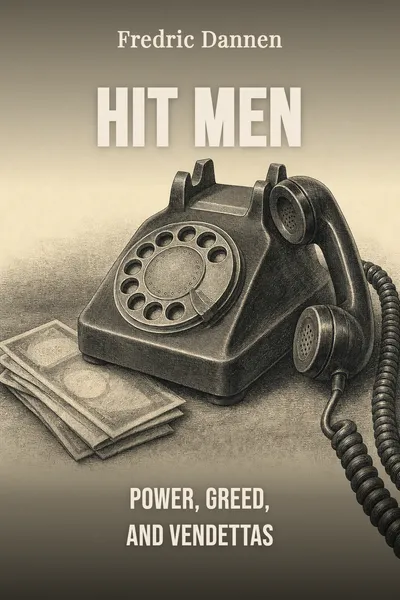
Hit Men
Power, greed, and vendettas
Description
For most of the 1980s, if you wanted a record played on American radio, there was a good chance you paid a man you never met to make it happen. Fredric Dannen, a business journalist who spent years reporting inside the labels, opens his 1990 book on exactly this — a loose confederation of independent promoters, later nicknamed the Network, who sat between the record companies and the radio stations and collected staggering sums to move songs up the charts. At its peak the labels were funneling something on the order of $60 to $80 million a year into these hands. Nobody could quite say what the money bought, except results.
Dannen's subject is bigger than one payola scandal. "Hit Men" traces the whole American record business from its Tin Pan Alley song-plugging origins to the vertically integrated giants of the CBS and Warner era — and finds the same character recurring under different suits. The hustler. The fixer. The executive who understands that in music, the product is unpredictable but the distribution can be controlled, and control is where the real money sits. It is a portrait drawn less from the recording studio than from the accounting office and the corner suite.
What makes the book land, decades on, is its refusal to romanticize. There are no misunderstood geniuses here, or very few. There are men — almost entirely men — chasing profit, settling scores, and treating the songs themselves as inventory. Dannen reports it with the patience of someone who checked the numbers, and the result is one of the most contested accounts of how popular music actually gets sold.
The question we’re asking : How did the American record business come to be run less by the people who made music than by the people who controlled how it reached us?What we’ll see : A tour through the labels, the promoters, and the executives who turned songs into leverage — and kept the leverage for themselves.
Table of contents
01Chapter 1 — The men who owned the charts
Dannen starts with a corrective. The record industry likes to present itself as a talent business, a place where a great song finds its audience because it is a great song. His account is closer to the opposite: a distribution business wearing a creative costume. From the Tin Pan Alley days, when publishers paid vaudeville singers to plug their sheet music, the trade understood that exposure could be manufactured. Whoever controlled the channel between a recording and a listener held the power, and the song was almost incidental to the transaction.
By the postwar decades that channel was radio, and radio play was the single thing that turned a record into a hit. A label could sign the finest act in the country and get nowhere if the stations would not add the single to their rotation. So the labels needed the stations, the stations needed something in return, and into that gap stepped the promoter — the man whose entire job was to persuade a program director to play a record. Persuasion, in Dannen's telling, was a flexible word.

02Chapter 2 — The Network and the price of a hit
The independent promoters of the 1970s and 1980s organized themselves, informally, into what the press came to call the Network. Dannen describes a small group of men who had effectively divided up the country's most important radio stations among themselves, each with his own relationships and his own turf. A label that wanted a single worked at a major-market station generally had to go through the promoter who covered it. There was no menu of alternatives; there was the Network, and there was silence.
The costs were extraordinary. A single record could accumulate promotion fees running into the hundreds of thousands of dollars, and the labels collectively were paying tens of millions a year for a service whose mechanics no one would fully describe. What Dannen documents is the labels' own unease: executives who privately suspected the money was buying something illegal, who could not prove it, and who kept paying anyway because the alternative — not getting played — was worse. Fear did the negotiating.
03Chapter 3 — Walter Yetnikoff and the war at the top
If the promoters are the book's connective tissue, Walter Yetnikoff is its central character. As head of CBS Records through much of this period, Yetnikoff presided over the most powerful label group in the world during the era of Michael Jackson's "Thriller" and Bruce Springsteen's ascendance. Dannen renders him as a figure of enormous appetite and volatility — brilliant at the deal, ferocious in conflict, and utterly at home in an industry that rewarded both. He is the human embodiment of the book's title.
Yetnikoff's rivalries were legendary, above all his running war with Warner and its executives. Dannen chronicles the feuds not as gossip but as the actual mechanism of the business at the top: partnerships made and broken, artists fought over, egos managed and wounded. The music trade at this altitude looked less like commerce than like court politics, with alliances shifting according to who had insulted whom and who controlled which asset this quarter.
04Chapter 4 — A business that runs on leverage
Step back from the individual scandals and Dannen's real argument comes into focus. The record business, more than most industries, is built on a mismatch: the product — a hit song — is wildly unpredictable, while the thing that determines its success — access to distribution and airplay — is highly controllable. Value therefore flows not to whoever creates the unpredictable thing but to whoever controls the reliable thing. The artist gambles; the intermediary collects a toll regardless of the outcome.
That structure explains why the same character keeps reappearing across the decades Dannen surveys. The song plugger of Tin Pan Alley, the payola DJ of the 1950s, the independent promoter of the 1980s, the label chief who manages the whole apparatus — these are variations on one role, the person who inserts himself into the narrow channel between music and ears and charges for passage. The technology changes; the choke point does not. And whoever owns the choke point owns the economics.
05Conclusion
Dannen ends more or less where the reporting led him: with an industry that briefly flinched, then adapted. The independent promoters were suspended, the federal heat came and went, and the business found new arrangements for the old necessity of buying attention. The specific scandal closed; the underlying logic did not. "Hit Men" leaves us not with a villain caught but with a system revealed — one that had always paid more to move a song than to make it.
Related books