

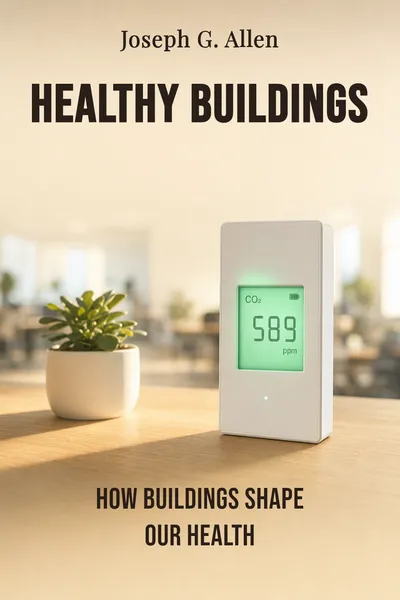
Healthy Buildings
How buildings shape our health
Description
We spend roughly ninety percent of our lives indoors. Not most of it — almost all of it. The average person passes their hours inside an apartment, an office, a school, a car, a store, breathing air that has been shaped by the walls around them far more than by any weather outside. Joseph G. Allen, a public health researcher at Harvard, keeps returning to that number because of what usually follows it: a shrug. We think about the food we eat and the water we drink. We rarely think about the thing we consume more than either — the air in the rooms we occupy — even though we take something like fifteen thousand breaths a day, almost all of them indoors.
Allen comes at this from an unusual angle. He trained as a building investigator, the person called in when an office made its workers sick, when mold or bad ventilation or some chemical off-gassing from the carpet turned a workplace into a slow-motion health complaint. What he found across dozens of these cases wasn't exotic. It was ordinary buildings, quietly underperforming, and the people inside them paying for it in headaches, sick days, and a fog they couldn't name. The building was doing something to them. Nobody was measuring it.
From that fieldwork he and his colleagues built a body of research arguing something larger: the spaces we inhabit aren't neutral backgrounds. They are active inputs into how we think, how well we sleep, how often we get sick, how productive we are at a desk. And unlike genetics or luck, this input can be engineered. A building can be tuned, the way you'd tune an instrument, toward the health of the people inside it. The strange part is how little we ask of the places where we spend our lives.
The question we’re asking : If we spend almost all our time indoors, what exactly are our buildings doing to us — and can it be measured?What we’ll see : How a building investigator turned bad offices into a science of air, light, and human performance, and what it costs to keep ignoring it.
Table of contents
01Chapter 1 — The invisible third of our lives
Allen likes to make the scale concrete. If we spend ninety percent of our time inside, then a building isn't a place we visit — it's the primary environment of a human life, the ecosystem we actually live in. And yet when we talk about health, we talk about diet, exercise, sleep, stress, almost never about the room those things happen in. The building is the one variable touching all of them at once, and it stays invisible precisely because it's always there.
Part of the problem is that a building fails quietly. A gas leak announces itself. Poor ventilation does not. Carbon dioxide builds up over an afternoon in a packed conference room, volatile compounds drift off furniture and cleaning products, particles from outside traffic seep in through the intake — and the occupants feel tired, foggy, vaguely off, and blame the meeting, the lunch, themselves. The signal is real. The source is the room. But nobody thinks to look up at the vents.

02Chapter 2 — What air does to a working brain
The most cited work from Allen's group is also the most unsettling, because it takes something we treat as trivial — stuffy air — and shows it reaching into cognition. In a controlled study, his team put office workers in an environment they could tune invisibly: they varied ventilation rates and carbon dioxide levels without telling the participants, then ran them through standardized tests of decision-making. Same people, same desks, different air.
The results were not subtle. On better-ventilated days, with lower CO2 and fewer volatile compounds in the air, participants scored dramatically higher on cognitive tasks — the biggest gains showing up in the higher-order skills that matter most at work: strategy, crisis response, using information to make decisions. The differences ran to sixty percent or more on some measures between the worst indoor conditions and the best. The air people barely noticed was quietly setting a ceiling on how well their brains worked.
03Chapter 3 — The nine foundations of a healthy building
To keep the idea from staying abstract, Allen organizes it into what he calls the nine foundations of a healthy building — a way of naming every lever a space actually has over the people inside it. It's less a checklist than a map of the inputs we usually ignore. Ventilation and air quality lead, but they sit alongside thermal comfort, moisture, dust and pests, water quality, safety and security, noise, and lighting with views.
Each foundation carries its own research trail. Moisture is the quiet villain behind mold and the respiratory problems that follow, which is why controlling leaks and humidity matters more than it sounds. Lighting is not just about seeing; exposure to daylight, and the views that come with it, tracks with better sleep and mood, because our internal clocks are still calibrated to a sun most of us barely see during a workday. Noise, easy to dismiss, erodes concentration and raises stress in ways occupants adapt to without ever recovering from.
04Chapter 4 — The building as a public health decision
Step back from the sensors and the studies, and Allen's larger claim comes into view: a building is a public health decision that we've been treating as an engineering afterthought. We've spent a century optimizing buildings for energy, cost, and appearance — sealing them tighter, cutting ventilation to save on heating and cooling — often at the direct expense of the people breathing inside. The tighter, cheaper building and the healthier building have been quietly at odds, and health kept losing because it was the input nobody was tracking.
That reframing changes who is responsible. If air is a health input, then the person who sets a building's ventilation rate is making a decision about human cognition and disease the same way a public health official does about water or outdoor pollution. The choice was always being made. It was just being made by default, by whoever wrote the energy code or signed off on the cheapest system, rather than by anyone weighing the people affected. Allen wants that decision brought into the light and owned.
05Conclusion
The ninety percent figure that opens Allen's argument ends up doing something more than shock. It relocates the question. For decades we've searched for health in the choices we make with our bodies — what we eat, how we move — while spending almost every hour of our lives inside spaces we never audited. Allen's fieldwork, from the sick offices to the cognition studies, keeps arriving at the same quiet conclusion: the room was a variable all along, and a measurable one.