
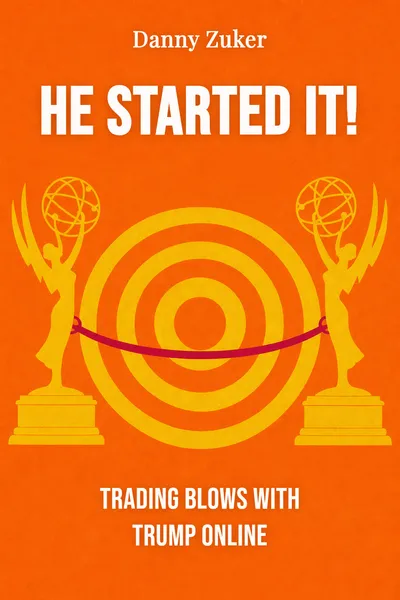
He Started It!
Trading blows with Trump online
Description
Sometime in 2012, a television comedy writer named Danny Zuker looked at his Twitter feed, saw something Donald Trump had posted, and decided to answer back. Zuker was, by any normal measure, a nobody in this fight. He wrote for Modern Family, had a couple of Emmys on a shelf, and a following that was respectable but not vast. Trump was a reality-TV star with millions of followers and a habit of using them like a cudgel. On paper it was no contest. Zuker replied anyway, with a joke, and Trump — improbably, memorably — replied to the reply.
That exchange became the first shot in a running feud that stretched across years, one that Zuker eventually gathered into a book with a title that reads like a schoolyard defense: He Started It! The premise is exactly as petty and exactly as pointed as it sounds. A working comedy writer and a celebrity billionaire trading insults in public, one tweet at a time, screenshotted and annotated for posterity. What makes it worth reading is not that Zuker won — you cannot really win these things — but the way he treats the whole absurd enterprise as material.
The book arrived after Trump had left the world of reality television for the one where the insults carried different weight. That timing gives the collection a strange double life. What began as one man heckling a famous blowhard on a social platform became, in hindsight, a record of a very specific moment in American public life — the years when a tweet from a private citizen could genuinely land on a future president, and when nobody yet knew how the joke would end.
The question we’re asking : What does one comedy writer's private war with Donald Trump on Twitter actually capture about the moment it belonged to?What we’ll see : A running feud told as comedy — the exchanges, the craft behind the comebacks, and what the whole thing looks like once the stakes changed.
Table of contents
01Chapter 1 — The night a sitcom writer picked a fight
Danny Zuker did not set out to become Donald Trump's most persistent online antagonist. He was a comedy writer with a day job, a man who spent his hours building jokes for other people's mouths, and who treated Twitter the way a lot of writers did in the early 2010s — as a place to try out lines and blow off steam. Trump, at the time, was a fixture of that same platform: loud, thin-skinned, and endlessly willing to engage. He was a target that talked back. For a comedian, that combination is close to irresistible.
The first real exchange set the tone for everything that followed. Zuker fired off something sharp, expecting the usual fate of a tweet aimed at a celebrity — silence, the void, a like from three friends. Instead Trump answered, and once Trump answered, the dynamic locked into place. A billionaire with a vast megaphone had chosen to notice a comedy writer, and the comedy writer, who made his living being funnier than the room, was not about to let it drop. The mismatch was the whole joke.

02Chapter 2 — The mechanics of a good burn
Strip away the celebrity and the politics, and He Started It! is really a book about craft. Zuker is a professional joke writer, and the pleasure of the collection comes from watching a professional at work in an unusually hostile setting. A good comeback on Twitter is not just an insult; it is a piece of engineering. It has to fit in a cramped character count, it has to land on the first read, and it has to be sturdy enough to survive being screenshotted and passed around by people who missed the setup. Zuker walks through his own reasoning with the matter-of-factness of someone explaining a trade.
The core principle he keeps returning to is that the best replies are not the meanest — they are the most surprising. Anyone can call Trump names; the internet was already saturated with people calling Trump names. The move that works is the one that reframes, that takes the target's own bluster and turns it slightly so the light hits it differently. Zuker's better lines tend to grant Trump's premise and then walk it somewhere ridiculous, which is a far older comic technique than Twitter and one that translated onto the platform almost perfectly.
03Chapter 3 — The book as time capsule
Read now, the exchanges function as a document of a platform and a period that already feel oddly distant. There was a stretch of the early 2010s when Twitter felt like a genuinely level playing field — a place where a comedy writer and a billionaire could, briefly, meet on the same terms, where the reply was as visible as the original post and a sharp unknown could get inside a famous man's guard. Zuker's feud lives entirely inside that window, and the book preserves it the way a jar preserves an insect: intact, and clearly from another climate.
Trump, in these pages, is not yet the figure he would become. He is a reality-television personality with an outsized ego and a lot of time on his hands, a man who could be baited, who cared about being mocked, who would spend the energy of his enormous account trying to squash a single needling reply. That version of him — combative but essentially unserious, a celebrity feuding with celebrities — is the one Zuker was sparring with. The book captures a Trump the culture treated as entertainment before it had reason to treat him as anything else.
04Chapter 4 — When the comedy stopped being funny
The uncomfortable thing lurking under He Started It! is that the sparring partner did not stay a sparring partner. The man Zuker had been heckling for laughs ran for president, and won, and the whole architecture of the feud changed underneath it. A joke aimed at a reality-TV blowhard is one thing; the same joke aimed at the most powerful office in the country is something else, even when the words are identical. Zuker does not resolve this tension so much as let the reader feel it accumulate across the pages.
This is where the book quietly widens beyond its own premise. It becomes, almost against its will, a case study in what happens when the line between celebrity and political power dissolves. Trump had spent years treating public life as a branding exercise conducted through insults, and the tools he honed feuding with comedians turned out to be the same tools he carried into governing. Zuker had been playing a game with a man who, it emerged, had never really understood it as a game — or who understood that the game and the power were the same thing all along.
05Conclusion
What began with a single tweet from a comedy writer who could not resist a target ended as an accidental record of a decade. He Started It! is at its best when it stays small — one man, one running joke, one improbable opponent who kept answering back. The craft is real, the pettiness is admitted, and the humor holds up because Zuker never asks us to see him as anything grander than a professional who found a fight he was good at and refused to walk away from it.