Hateship, Friendship, Courtship, Loveship, Marriage
How love survives forgetting
Description
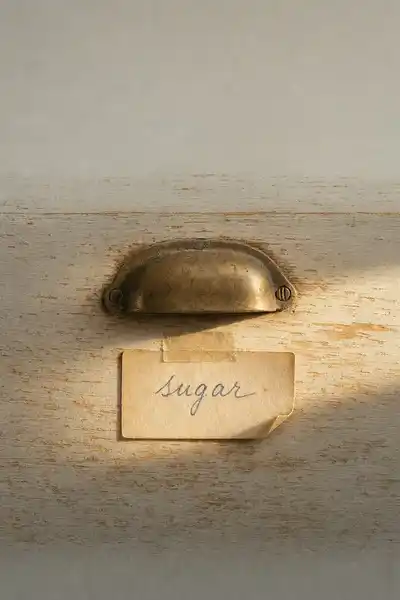
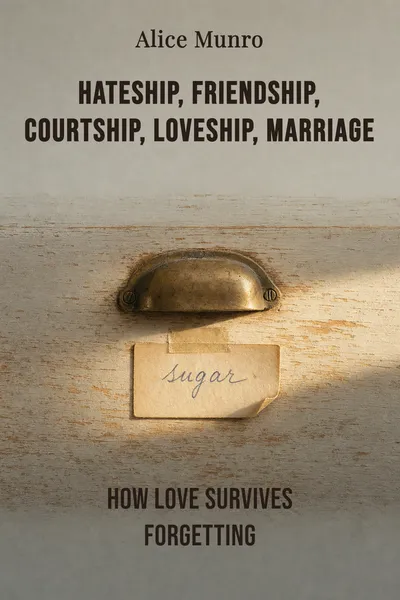
Grant is a retired professor, and Fiona is his wife of nearly fifty years, and one winter she starts writing labels on the kitchen drawers. Forks here, dish towels there. She does it lightly, almost as a joke on herself, the way a bright person mocks the first small betrayals of the mind. Then the labels stop being a joke. She wanders into a field in her nightgown. She calls their long-married house a place she has never seen before. Grant watches the woman he has known longer than he has known anyone begin to leave the room even while she is sitting in it. This is where Alice Munro sets us down in "The Bear Came Over the Mountain," the story that anchors her 2001 collection and that Sarah Polley later filmed as Away From Her.
What follows is not a story about a disease, though a diagnosis arrives and a care home called Meadowlake takes Fiona in. It is a story about a marriage that has been, quietly, not entirely faithful — Grant had his years as a charming professor among younger women — and about what that history is worth once one half of the couple can no longer hold it against him. Munro does the thing she does better than almost anyone: she lets the surface stay calm while the floor shifts underneath. A man loses his wife slowly, and then loses her to another resident of the home, and has to decide what a husband even is under those conditions.
Munro was writing, by 2001, as one of the most exact observers of ordinary lives in the language. She trusted small rooms and long marriages to carry weight that other writers reach for wars to find. What she stages here is almost unbearably plain and almost impossible to resolve: love running on after the shared memory that made it has gone.
The question we’re asking : When one person forgets the marriage, what is left for the other one to keep — and is it still love if only one of you remembers?What we’ll see : A retired professor watching his wife drift out of reach, and the strange, unglamorous choices he makes to stay close to her anyway.
Table of contents
01Chapter 1 — A wife who packs a suitcase
Munro opens on marriage, not illness. Grant and Fiona met young at university; she was the well-off girl with the mocking wit who proposed to him half-seriously on a beach, and he took her up on it. Fifty years later they live in her family's farmhouse in Ontario, and the details of that life — how she teases, how she cooks, the shorthand of a couple who have said everything already — are laid down like sediment. This is the marriage Munro wants us to feel as solid before she starts pulling threads.
The forgetting comes in small, almost comic increments. The labels on the drawers. A stove burner left on. A phone number she once knew by heart and now cannot find. Fiona treats her own decline with a light irony that makes it worse to watch, because we can see the sharp woman still there, narrating her own disappearance. Grant tells himself it is age, distraction, nothing. Denial is easier when the person is still funny about it.

02Chapter 2 — The rule of the first thirty days
The thirty-day rule is where Munro tightens the screw. Grant cannot see Fiona for a month, and in that absence he does what a husband does: he imagines her missing him, counting the days, holding on to their life through the fog. He builds a whole scene in his head of the reunion. The story has trained us to expect it too. We want the recognition, the moment where she looks up and it is still them.
That is not what he walks into. When the thirty days end and Grant returns, Fiona has made a life at Meadowlake that does not have much room for him in it. She is calm, occupied, socially at ease in the way she always was. And she has attached herself to another resident, a silent, wheelchair-bound man named Aubrey, whom she tends with the tender, absorbed attention a wife might give a husband. Grant she treats politely, as a pleasant visitor she cannot quite place. He has been demoted, in his own marriage, to a caller.
03Chapter 3 — Aubrey, and what Fiona chooses
Aubrey, it turns out, is only at Meadowlake temporarily — his wife, Marian, has placed him there while she takes a break, and she means to bring him home. When she does, Fiona collapses. She stops eating, stops speaking much, fades in a way that alarms the staff and terrifies Grant. The man she had built her days around has been removed, and the damaged, present-tense version of Fiona grieves him as fully as any healthy person grieves a loss. Whatever this attachment is, it is not nothing.
Grant is left with an unbearable arithmetic. He could let his wife decline, or he could try to bring Aubrey back to her — which means going to Marian, Aubrey's tired, practical, unsentimental wife, and asking her to return her husband to the woman he has, in effect, run off with. It is an absurd errand and a devastating one. To save his marriage, Grant must arrange his wife's affair. Munro walks him up to Marian's door and lets us feel every degree of the strangeness.
04Chapter 4 — A husband who bargains with a stranger
Step back from the plot and the story is really an argument about what love is made of once memory stops holding it together. We tend to think of a long marriage as a shared archive — the private jokes, the grievances kept and forgiven, the ledger of who did what to whom. Munro's insight is that Grant has been treating that archive as the marriage itself. His guilt over the affairs, his hope for recognition, his sense of being owed loyalty: all of it depends on Fiona remembering. When she forgets, the archive turns out to belong only to him.
And so the love that survives is not the remembering kind. It is the tending kind. What Grant ends up doing — driving to Marian's house, swallowing his pride, arranging the return of the man his wife prefers — is love reduced to pure maintenance. It expects nothing back, not even acknowledgment. Fiona will not know he did it, or will not know for long. He does it anyway. Munro quietly proposes that this unrewarded caretaking may be the truest form the thing ever takes, and that we usually only see it when everything else has been stripped away.
05Conclusion
Munro ends where the illness never resolves, because illnesses like Fiona's do not resolve. In the final scene Grant brings Aubrey back, and Fiona, surfacing for a moment from wherever she has been, seems briefly to know Grant again, to reach for the old shorthand between them, calling him by the affectionate teasing she always used. Whether it lasts, whether she will remember it tomorrow, the story does not say. It gives him the recognition he waited a whole book for, and hands it over as something that may already be dissolving even as he receives it.
Related books