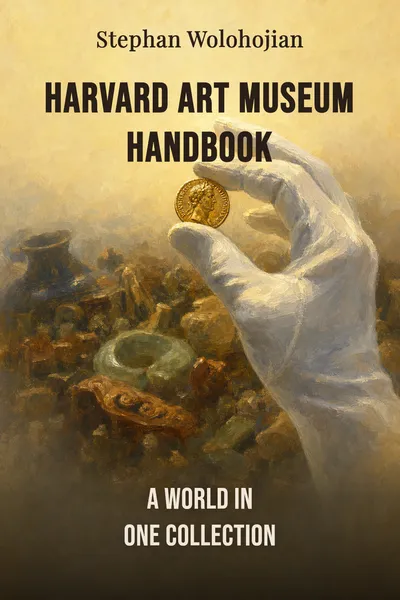
Harvard Art Museum Handbook
A world in one collection
Description
Walk into the Harvard Art Museums on Quincy Street in Cambridge, and the first thing that hits you is the light. Renzo Piano's 2014 renovation put a glass roof over a central courtyard, so daylight pours down through five floors of galleries. Below it sits a collection that runs from ancient Chinese jades to a Rothko, from a Roman coin to a Bauhaus chair. Roughly a quarter of a million objects, spanning most of recorded human making. And the book that tries to hold all of that between two covers is the museum's own Handbook, edited by Stephan Wolohojian, one of the institution's longtime curators.
A handbook sounds modest. Something you grab at the front desk, flip through on the train home, forget in a drawer. But this one is doing something quieter and stranger than a gift-shop souvenir. It is trying to take a collection assembled over more than a century — through three separate museums, thousands of gifts, purchases, and bequests — and turn it into a single readable object. A few hundred works, each with a photograph and a paragraph, standing in for a quarter of a million. Every inclusion is a decision. Every decision leaves something out.
That is the real subject here, underneath the beautiful plates. Not just what Harvard owns, but how an institution decides to show itself — what it puts forward as the face of its holdings, and what that choice reveals about a museum that is also a teaching tool, tied to a university, built to be used rather than merely admired.
The question we’re asking : What does a museum choose to show when it tries to fit a whole collection into one book — and what does that choice reveal?What we’ll see : How three museums became one, why a teaching collection looks different from a treasure house, and what it means to introduce a world through a few hundred carefully chosen things.
Table of contents
01Chapter 1 — One museum, three museums
The name on the door hides a plural. The Harvard Art Museums are three institutions folded into one building, and the Handbook keeps that structure visible because it explains almost everything about the shape of the collection. The oldest is the Fogg Museum, founded in 1895, which holds the Western tradition — Italian painting, French Impressionism, American work, prints and drawings. Then the Busch-Reisinger, established in 1903, which focuses on the art of German-speaking Europe, and became the main repository outside Germany for material from the Bauhaus. And the Arthur M. Sackler, opened in 1985, which covers Asian, Islamic, and ancient Mediterranean art.
Three museums means three different logics of collecting, and the book lets them sit side by side rather than blending them into a smooth chronology. A visitor moving through the galleries crosses from a Chinese ritual bronze to a Fra Angelico to a chair by Marcel Breuer, and the Handbook reproduces that jump on the page. It does not pretend the collection is a single narrative marching from ancient to modern. It is closer to three overlapping libraries that happened to end up under one roof, each with its own founding obsession.

02Chapter 2 — The reproduction, not the mask
Here is the honest tension at the heart of any museum handbook: the book is not the thing. A photograph of a Van Gogh is not a Van Gogh. The Handbook is candid about this in the way it presents its plates — large, carefully lit, faithful to color as far as printing allows, but always a translation. What it gives us is a well-made reproduction, and reproductions do particular things. They flatten. They fix a single viewpoint. They lose scale, texture, the way a bronze catches light as we move past it.
And yet the reproduction also does something the object alone cannot. It travels. It sits beside a paragraph that tells us when a work was made, by whom, out of what, and why the museum thinks it worth our time. That pairing of image and commentary is the real engine of the book. A ninth-century Chinese Buddhist sculpture, photographed and explained, becomes legible to someone who would otherwise walk past it without a foothold. The commentary is not there to replace looking. It is there to make looking possible.
03Chapter 3 — Objects that keep coming back to the classroom
What separates a university collection from a national gallery is what the objects are for. The Louvre exists to be seen. The Harvard Art Museums exist to be seen and to be worked with — pulled out of storage, put on a table, examined by students and scholars, sometimes tested in the museum's own conservation labs. The Handbook carries the fingerprints of that use. The works it highlights are often ones with a long history of being taught: pieces that anchor a lecture, illustrate a technique, or mark a turning point that a class needs to understand.
This gives the selection a certain character. Alongside the obvious highlights — an Impressionist canvas, a Renaissance panel — the book makes room for objects whose value is partly instructional. A fragment that shows how a fresco was built. A set of works that lets us watch an artist think across several attempts. A drawing valued less for beauty than for what it reveals about a finished painting elsewhere. In a purely public museum, some of these might stay in the drawers. Here they earn their place because they teach something.
04Chapter 4 — A collection is a set of choices
Step back from the plates and the paragraphs, and the Handbook stops being a guide to objects and becomes a portrait of judgment. A quarter of a million things exist in the museum's care. A few hundred appear in the book. Every one of those inclusions is an argument: this deserves your close attention, and by implication, these thousands of others can wait. A collection, seen this way, is never a neutral accumulation. It is a long series of decisions about what is worth keeping, worth showing, and worth putting first.
Those decisions carry the assumptions of the people who made them, across more than a century. What counted as important art in 1895 was not what counted in 1985, and the collection holds both layers at once. The heavy presence of the Western canon, the specific strength in German modernism, the reach into Asian and Islamic and ancient work — each reflects a moment when someone at Harvard decided that this, too, belonged in the picture of human making. The Handbook inherits and slightly revises those choices every time it is reissued, quietly adjusting what the collection wants to say about itself.
05Conclusion
Close the Handbook and go back to that glass-roofed courtyard on Quincy Street. The book has done its job if the objects now feel reachable — if the ninth-century sculpture and the Bauhaus chair and the Impressionist canvas have stopped being a blur of prestige and become individual things, each with a maker, a material, and a reason for being in the room. That is the modest ambition of a good handbook: not to substitute for the museum, but to hand us a way to walk into it and actually see.
Related books