Harold and Maude
Love across seventy years
Description
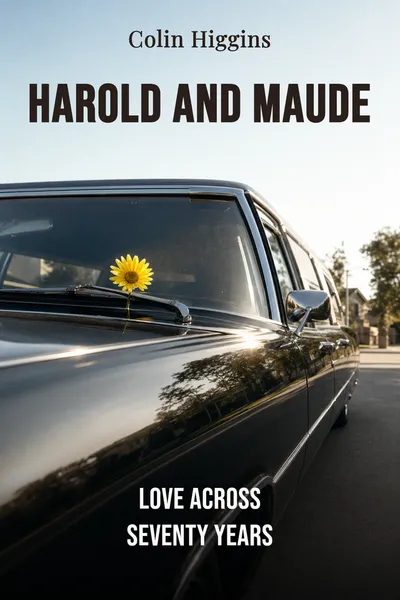
Harold Chasen is nineteen, rich, and preoccupied with his own death. He stages elaborate suicides — a body hanging in the hall, a slit throat by the bathtub, a self-immolation on the front lawn — mostly to unsettle his unbothered mother, who has long since stopped reacting. He drives a hearse. He goes, for pleasure, to the funerals of people he never knew. Colin Higgins wrote the character first as a screenplay, then as a slim novel published in 1971, the same year Hal Ashby's film reached theaters. On the page as on screen, Harold is a young man performing an ending nobody around him will take seriously.
Then, at one of those funerals, he meets Maude. She is seventy-nine, about to turn eighty, and she treats a stranger's burial as a fine place to strike up a conversation. She steals cars the way other people borrow umbrellas, transplants dying trees back into the forest, models nude for a sculptor, and greets each morning as if it might be the last one worth the trouble — which, in her arithmetic, is exactly why it counts. Where Harold rehearses death, Maude is busy with the opposite work. She is, before anything else, in love with being alive.
Higgins built the book around that sixty-year gap and refused to make it a joke or a scandal. The two of them fall for each other, plainly, tenderly, and the story asks us to accept it not as provocation but as the natural result of two people wanting the same thing from very different distances. It is a comedy about a funeral-goer and a life-lover, and it holds its strange premise with a straight face.
The question we’re asking : How does a story pair a nineteen-year-old obsessed with dying and a seventy-nine-year-old in love with living, and make the romance feel inevitable rather than absurd?What we’ll see : We follow Harold and Maude from their first cemetery meeting through a courtship that turns his rehearsed endings into a reason to begin.
Table of contents
01Chapter 1 — The boy who kept dying
Harold's first act in the book is a hanging. His mother walks into the room, sees her son swinging from a noose, and complains that he will be late for his appointment. This is the register Higgins establishes early: the boy has been faking his death so often, so theatrically, that the household has grown numb to it. The suicides are elaborate — fake blood, real flames, a severed hand — and they are all addressed, in the end, to Mrs. Chasen, a woman who fills out his computer-dating forms and books him psychiatric sessions and never once flinches at the corpse she keeps discovering in her house.
The comedy is real, but Higgins is careful to make it point somewhere. Harold isn't suicidal in any clinical sense; he is a young man surrounded by a life that has been fully arranged for him and drained of any content he chose. His mother selects his dates. An uncle wants to steer him toward the military. A psychiatrist decodes his every gesture. The staged deaths are the one performance that is entirely his, the one place his family cannot manage the outcome. Playing dead is how a boy with no say announces that he exists.

02Chapter 2 — The woman who kept living
Maude arrives at the same funerals, and she treats them completely differently. She is not there to mourn; she is there because a gathering of people is a gathering of people, and she likes people. She chats with Harold over the casket, offers him licorice, and by the time the service ends she has borrowed — that is, stolen — a car to drive home in. Higgins gives her a whole philosophy of light-fingered generosity: things belong to whoever needs them at the moment, and returning them, more or less, is a courtesy, not a law.
Nearly eighty, Maude lives in a converted railway car crammed with the evidence of a long, curious life. She has an odor organ that mixes scents, sculptures she has modeled for, a collection of experiences she keeps adding to rather than displaying. She uproots a street tree suffocating in the city and replants it in the forest so it can breathe. She sings, she dances, she flirts, she drives too fast and laughs about it. Where Harold has narrowed his world to a single gesture, Maude keeps hers wide open on principle.
03Chapter 3 — Where the funeral becomes a courtship
What grows between them is not a lesson but a courtship, and Higgins insists on that word. Maude does not lecture Harold out of his fascination with death; she absorbs him into her fascination with life until the first quietly loses its grip. They visit a carnival, watch the stars, plant things, talk. She teaches him to play the banjo. He starts to laugh at things that are actually funny rather than staging things that are meant to disturb. The staged suicides thin out, not because anyone has forbidden them, but because he no longer needs the performance.
The romance is physical, and the book does not blink at it. Harold and Maude become lovers, and Higgins presents the fact without leer or apology. The sixty-year gap is the whole scandal of the premise, and the story's boldness is to treat it as no scandal at all — simply two people who have found, across an improbable distance, someone who wants them fully awake. When Harold announces to his appalled family that he intends to marry Maude, the outrage of the adults around him only confirms how alive the two of them have become to each other.
04Chapter 4 — A comedy that refuses to be morbid
Step back from the plot and the book is arguing with a habit we barely notice we have: the habit of deciding, by the calendar, whose life is ahead of them and whose is behind. Harold at nineteen has already filed himself under finished, surrounded by people who assume the young man simply needs managing until he settles into the life laid out for him. Maude at seventy-nine is filed, by everyone but herself, under expired — an old woman who ought to be winding down, not stealing cars and modeling nude and falling in love. Higgins puts them side by side to show how badly age predicts appetite.
The joke of the pairing is really a correction. We tend to picture a life as a slope: a rising front half full of firsts, a declining back half full of lasts. The book scrambles the slope entirely. It is the teenager who is exhausted and the near-octogenarian who is greedy for more. Vitality, in Higgins's telling, has nothing to do with how much time remains and everything to do with what a person decides to do with the day in front of them. Maude's forty-year head start on death has not dimmed her; if anything it has clarified her.
05Conclusion
Harold ends the book alive, and that is the quiet triumph of it. In the film's final image he sends his hearse off a cliff and walks away playing the banjo Maude taught him — the funeral vehicle discarded, the instrument kept. The boy who staged his death for an audience that wouldn't watch has learned, from a woman who staged nothing, how to actually live in front of no one at all. Maude is gone, on her own terms, at the age she chose, and her going is the last thing she teaches him.
Related books