Groundwork of the Metaphysics of Morals
Duty derived from reason alone
Description
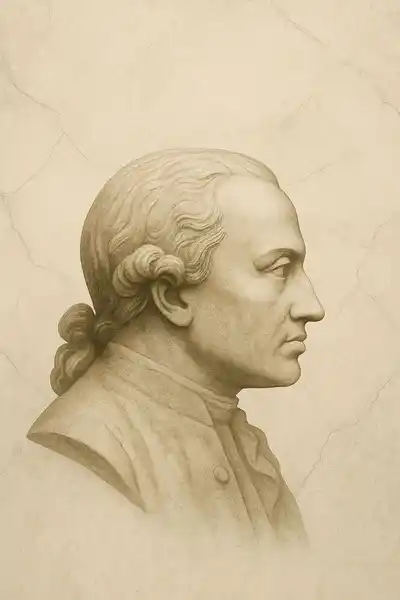
In 1785, a professor in Königsberg who had never travelled more than a few dozen miles from his hometown published a short, dense book that tried to do something almost reckless: to find the foundation of morality in reason alone, without leaning on God, on happiness, on custom, or on the way people actually behave. The book was the Groundwork of the Metaphysics of Morals, and Immanuel Kant meant every word of that title. He wasn't offering advice on how to live well. He was digging under all ordinary moral talk to see whether there was any solid rock at the bottom — a principle that would hold whether or not anyone ever obeyed it.
What makes the Groundwork strange, even now, is its starting suspicion. Kant thought that if morality depended on what we want — on being happy, on being liked, on things working out — then it wasn't really morality at all, just prudence wearing a serious face. A genuinely moral demand would have to bind us no matter what we wanted. It would have to come from something in us that every rational being shares. And that something, he decided, was reason itself, issuing commands to the will.
From that single move, everything else follows: the idea of duty done for its own sake, a moral law we can carry in our heads and apply to any situation, and a picture of other people as beings we may never treat as mere instruments. Two and a half centuries later, the argument still sits at the centre of how we talk about rights, consent, and human dignity — often without anyone remembering where it came from.
The question we’re asking : Can morality be grounded in reason alone — in a duty that binds us whatever we happen to want?What we’ll see : How a single principle, tested and retested, leads from the good will to the idea that no person may ever be used as merely a means.
Table of contents
01Chapter 1 — The only thing good without qualification
Kant opens with a claim that sounds almost naive until you sit with it: nothing in the world, or even out of it, can be called good without qualification except a good will. Intelligence, courage, wealth, wit, even happiness — all of them can be turned to bad ends. A cool head makes a criminal more dangerous, not less. Every quality we admire depends for its worth on the intention behind it. Only the will that wills rightly is good in itself, regardless of what it manages to accomplish.
This is a deliberate reversal. We usually judge actions by their results. Kant asks us to judge them by what moved the person to act. And here he draws the line that organises the whole book: the line between acting in accordance with duty and acting from duty. A shopkeeper who gives correct change because honesty is good for business is doing the right thing, but not from a moral motive. A shopkeeper who would give correct change even when cheating would go unnoticed is acting from duty. Only the second case, Kant says, carries moral worth.

02Chapter 2 — Why duty can't run on results
Kant argues that duty is the necessity of acting from respect for law. Not a particular law of a particular country, but law as such — a principle that holds universally, without exception, for every rational being. And this is where his hostility to consequences becomes a real argument rather than a mood. If what makes an action right is how it turns out, then our moral rules are always hostage to circumstance and to luck. We can never be sure of the outcome in advance, so we could never know, in the moment, that we were doing right.
He drives the point home with the idea of a maxim — the personal rule you are actually following when you act, whether or not you've spelled it out. When you decide to break a promise because keeping it has become inconvenient, your maxim is something like: I may make promises I don't intend to keep whenever it suits me. Kant's question is never Will this work out? but Could I will that everyone act on this rule? The moral test moves inward, away from prediction and toward the form of the will itself.
03Chapter 3 — The test that fits inside your head
The categorical imperative is Kant's name for that single command. He contrasts it with hypothetical imperatives, which only bind you if you happen to want something: if you want to be trusted, keep your promises. Those are conditional, and you can escape them by dropping the goal. A categorical imperative binds unconditionally. It doesn't say if you want X; it just says do this. And in its first and most famous form, it says: act only according to that maxim by which you can at the same time will that it should become a universal law.
It works less like a rulebook than like a stress test. Take the maxim, imagine it as a law that everyone follows automatically, and see whether it survives. Kant's example of the false promise is the clean case. Imagine a world where everyone makes promises they don't intend to keep whenever convenient. In that world the very practice of promising would dissolve — no one would believe a promise, so there would be nothing left to exploit. The maxim destroys the conditions that made it useful. It contradicts itself when universalised, and that contradiction is precisely why it fails.
04Chapter 4 — Persons are ends, not tools
The second formulation is the one that has escaped the philosophy seminar and entered ordinary moral speech: act so that you treat humanity, whether in your own person or in that of another, always at the same time as an end and never merely as a means. It is, Kant insists, the same imperative from a different angle. The reason a rational being can generate a universal law is that it has a worth unlike anything else. Things have a price and can be exchanged. Persons have dignity, which admits of no equivalent and no substitution.
Notice the word merely. Kant isn't banning all use of other people — we rely on the bus driver, the baker, the stranger who holds a door. We use each other constantly, and that's fine. What's forbidden is treating a person as only a tool, in a way they couldn't possibly consent to. The false promise fails this test too: the person you deceive can't agree to the real maxim, because you've hidden it from them. Deception and coercion are wrong for the same underlying reason. They route around another person's rational agency instead of engaging it.
05Conclusion
Kant set out to find bedrock, and he thought he'd hit it in a place no one had quite dug before: not in the outcomes of our actions, not in what we want, not in any command handed down from above, but in the structure of reason shared by every being capable of it. From the good will he reached duty, from duty the categorical imperative, and from that imperative the conclusion that persons are ends in themselves who may never be reduced to mere instruments. Each step is meant to follow from the last with the tightness of a proof.
Related books