Greenlights
How to catch life's green lights
Description
In the fall of 2014, Matthew McConaughey drove alone to a monastery-quiet stretch of Texas desert with thirty-six years of diaries in the trunk of his car. He had been keeping them since he was a teenager — notes scrawled on napkins, bumper-sticker phrases he called "prescriptions," confessions written at three in the morning. He had told nobody what he was planning. He rented a place off the grid, unplugged, and started reading his own life backward, looking for a pattern he could name. What he found, he decided, was a traffic signal.
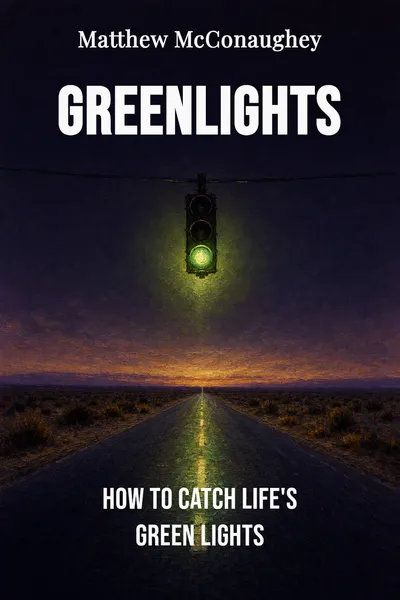
The book that came out of that trip, published in October 2020, is called Greenlights, and it spent much of that year at the top of the bestseller lists. It is not a standard celebrity memoir. There is no ghostwriter smoothing the edges, no tidy arc from struggle to triumph. Instead there are photographs, poems, all-caps aphorisms, and stories McConaughey clearly enjoys telling — some of which make him look foolish, several of which are hard to believe until you remember who is telling them. Running underneath all of it is one governing image: life as a series of lights, green, yellow, and red, and the question of what we do at each one.
The metaphor is simple enough to fit on a sticker, which is part of the point. But McConaughey pushes it further than a slogan can go, and that is where the book earns its length. A green light, in his telling, is not only good luck falling in your lap. Sometimes it is a red light you learned to read differently, months or years after it stopped you cold.
The question we’re asking : What does McConaughey actually mean by a green light, and how did a Texas childhood, a stalled acting career, and a pile of old diaries teach him to catch them?What we’ll see : A childhood of contradiction, a Hollywood detour, and the philosophy of flow that a movie star built out of thirty-six years of notes to himself.
Table of contents
01Chapter 1 — A house where love came with a slap
McConaughey grew up in Uvalde and later Longview, Texas, the youngest of three boys, in a family he describes with more affection than most people could muster for the same facts. His parents, Kay and Jim, divorced twice and married three times — to each other. The house ran on a logic that would look alarming from the outside and made total sense from within: love was loud, physical, and sometimes violent, and the violence was read as proof of how much everyone cared.
The stories he tells from those years are not softened for the reader. His father once knocked his mother's tooth out; she broke his nose and cut his hand open with a phone. Then they made up, and the making up was as intense as the fighting. McConaughey does not present this as a trauma to be processed so much as a school he happened to attend. The lesson he took was that a family could contain enormous conflict and enormous devotion at the same time, and that the two were not opposites.

02Chapter 2 — The art of getting relative
At nineteen, McConaughey spent a year as an exchange student in Australia, and it nearly undid him. The family he stayed with was not what the brochure promised, the isolation was real, and he lost close to thirty pounds. He came home changed — not broken, but recalibrated. Out of that low stretch came a phrase that recurs through the book like a chorus: learn to get relative with the inevitable.
The idea is deceptively plain. Some things are not going to change no matter how hard we push against them — a place, a loss, a bad break, a red light that is going to stay red. Fighting the inevitable head-on, McConaughey argues, is a waste of a life. Getting relative means adjusting your own position until the unchangeable thing works in your favor, or at least stops working against you. It is not surrender. It is the difference between resisting a current and swimming across it.
03Chapter 3 — Chasing the wrong green light in Hollywood
The break came almost absurdly easily. In an Austin bar in 1992, McConaughey met a casting director, talked his way into an audition, and landed the role of Wooderson in Richard Linklater's Dazed and Confused — the source of the line everyone still quotes back at him. Within a few years he was a leading man. A Time to Kill made him a star. And then the industry decided what he was for.
What it decided was romantic comedies. Shirtless, charming, reliably profitable romantic comedies. McConaughey does not pretend he hated the money or the ease of it — he made a great deal of both. But somewhere in the mid-2000s the green lights started to feel like the wrong color. Every offer was the same offer. He was catching them, one after another, and each one carried him further from the actor he wanted to be. The book's sharpest insight lands here: a green light that takes you somewhere you don't want to go is not a green light at all.
04Chapter 4 — What a green light actually is
Step back from the stories and McConaughey's real subject comes into focus, and it is not luck. A green light, in the fullest version of his metaphor, is a moment of flow — when preparation, timing, and willingness line up and the way forward is simply open. Some of those moments arrive as gifts. But the ones he keeps returning to are the ones he helped make, by how he handled the reds and yellows that came before.
This is what saves the book from being a bumper sticker about positive thinking. McConaughey is not saying life is easy if you smile at it. He is saying that reds and yellows are not the enemy of green lights but the raw material of them. The wrecked exchange year, the two-year silence after he quit the rom-coms, even the chaos of his parents' house — each was a stoppage that, read correctly and acted on with intention, eventually opened into passage. The diaries were his method for reading them. Thirty-six years of notes were thirty-six years of him trying to catch, in writing, the shape of his own signals.
05Conclusion
McConaughey drove back out of that desert with a manuscript instead of a diagnosis. The thirty-six years he had spent talking to himself on napkins and notepads turned out to be a single long argument about how to read a life while you are still inside it. Greenlights is that argument made public — messy, funny, occasionally hard to swallow, and unusually candid for a book with a movie star's face on the cover. It refuses the clean arc that celebrity memoirs usually promise, and it is better for the refusal.
Related books