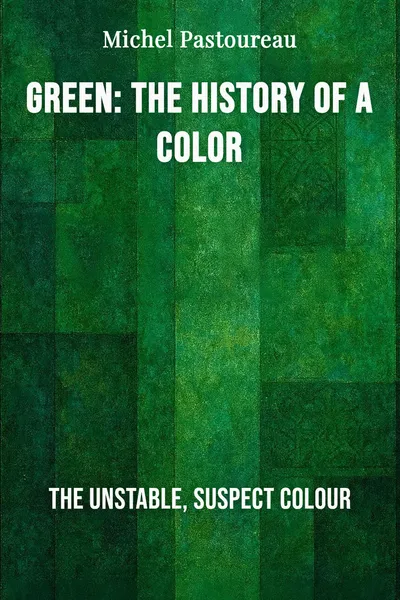
Green: The History of a Color
The unstable, suspect colour
Description
Somewhere in a European workshop around the year 1200, a dyer is trying to make cloth green, and it is not going well. He can dip the wool in a yellow bath, then in a blue one, but the guild statutes in many towns forbid exactly this — mixing dyes across trades was suspect, and a dyer who worked in blue was often not allowed to touch yellow. So he reaches for plants, for copper salts, for whatever will hold. The result fades in the sun, streaks in the rain, or eats through the fiber. For a color that grows on every hedge and every field, green turned out to be almost impossible to pin down and keep.
That small technical failure sits at the center of a much larger story. In his history of green, the medievalist Michel Pastoureau follows a single color across roughly three thousand years and finds it doing something none of the others quite do: it will not hold still. Green has been the shade of poison and of hope, of the devil and of Islam, of gambling tables and pharmacy signs, of youth and of decay. It has been banned, mistrusted, and then, almost overnight, crowned the color of nature itself — the one we now paint onto anything we want to call clean.
Pastoureau's method is to treat color not as a fact of physics but as a social object, made and remade by chemistry, law, religion and taste. Green is his most unstable case, and he clearly relishes it. Where blue slowly climbed toward respectability, green kept switching allegiances, and the reasons why say a great deal about how a society decides what a color is allowed to mean.
The question we’re asking : Why has green, of all colors, never been able to settle on a single meaning?What we’ll see : How chemistry, law and belief pulled one color in opposite directions for three thousand years.
Table of contents
01Chapter 1 — The color nobody could fix
Green's troubles begin in the dye vat. Pastoureau's first point is almost brutally material: for most of human history, there was no reliable way to make a strong, lasting green. Reds came from madder and kermes, blues from woad and later indigo, and both bonded well with fabric and stayed. Green had no equivalent single source that worked. Chlorophyll, the thing that makes actual leaves green, is chemically unstable and refuses to transfer to cloth. So dyers were left improvising with unreliable plants and mineral salts that turned dull or corrosive.
The obvious workaround — dye yellow, then blue, and let them combine — ran straight into the medieval guild system. Trades were rigidly separated, and in many towns a dyer licensed to work in blue was legally barred from also working in yellow or red. Mixing was policed as a kind of cheating, even a kind of pollution. The consequence was that the simplest route to green was, in practice, forbidden, and the greens that did get made often looked feeble or faded fast.

02Chapter 2 — From devil's hue to allowed color
Green's moral reputation moved as unpredictably as its dyes. In parts of the ancient and early medieval world it was viewed with suspicion, even hostility. The Romans associated it loosely with luxury and the exotic East, and Christian writers were often wary of it. For a long stretch, green drifted toward the sinister: it became a color of demons, of dragons, of serpents, of the strange and the venomous. The devil was frequently shown as green-skinned, and green eyes were read as a mark of the witch or the untrustworthy.
Yet the same color could be pulled the other way. Because it was the color of spring, of new leaves and growing crops, green also carried hope, renewal and fertility. Pastoureau notes how the church itself hedged its bets: green became the liturgical color for ordinary time, the long stretches of the calendar that are neither penitential nor festive — a color of quiet, ongoing life. In Islam, green took on a place of honor, associated with paradise and with the Prophet, and that reverence has held for centuries.
03Chapter 3 — The century green turned poisonous
The turn Pastoureau saves for its full weight is chemical. Around the late eighteenth century, and then more spectacularly in the nineteenth, new synthetic greens arrived that finally solved the old problem: they were bright, vivid, and stable. The most famous was Scheele's green, developed by the chemist Carl Wilhelm Scheele in 1775, soon followed by an even more brilliant variant sometimes called Paris or emerald green. For the first time, Europe could have the intense green it had never been able to fix. There was one catch. These pigments were built on arsenic.
The consequences were slow and grim. Arsenical greens went into everything the industrial age produced in volume: wallpaper, printed fabrics, artificial flowers, candy wrappers, children's toys, dress dyes. In damp rooms the pigment could release toxic compounds into the air; workers who handled the powder sickened and died. The women who made artificial leaves for hats suffered horribly. A persistent, and much-repeated, claim even holds that the arsenic-green wallpaper of Napoleon's final residence may have contributed to his decline — a story Pastoureau treats with due caution, but which captures the era's growing dread.
04Chapter 4 — A color that keeps changing sides
Step back, and green's defining trait is not any single meaning but its willingness to swap them. Pastoureau's broader claim is that colors carry no fixed nature; they are assigned meaning by societies, and those assignments drift with technique, law and belief. Green makes the case more sharply than any other because its swings are so extreme — from the devil to paradise, from luck to poison — and because they can often be traced to something concrete, a guild rule or a chemical formula, rather than to timeless human instinct.
Seen this way, the modern career of green looks less inevitable than it feels. Today green is the color of nature, of ecology, of the healthy and the safe: we grant a project the green light, we call an economy green, we trust the green cross of a pharmacy. But this is a recent costume, largely a product of the last century or two, and it sits uneasily on a color that spent most of its history signaling exactly the opposite — instability, venom, the thing not to be trusted.
05Conclusion
We began with a medieval dyer failing to fix a green that would not stay. That failure turns out to be the whole story in miniature: green resisted control at the vat, and it resisted control in the imagination. It slipped between the demon and paradise, between fortune and ruin, and when chemistry finally pinned it down in a brilliant, lasting form, the form it took was toxic. No other color in Pastoureau's work carries quite this record of switching sides.
Related books