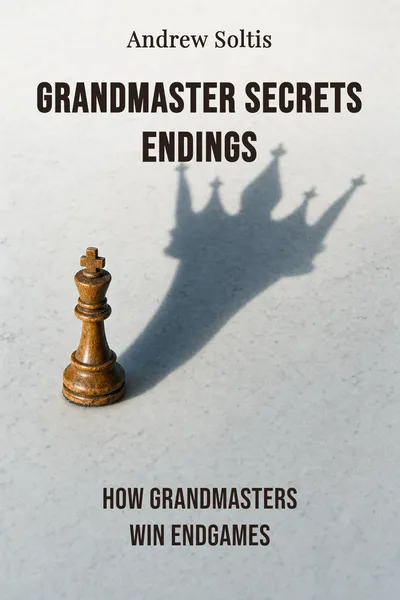
Grandmaster Secrets Endings
How grandmasters win endgames
Description
There is a moment in almost every chess game that most club players quietly dread. The queens have come off, half the pieces are gone, and what is left on the board looks less like a battle than an accounting exercise. A king, a couple of pawns, maybe a rook. On paper it should be simple. In practice, this is where games that were winning slip into draws, and games that were drawn slip into losses. It is the phase where being up a pawn is supposed to mean something, and where, over and over, it somehow doesn't.
Andrew Soltis, an American grandmaster who spent decades writing about the game for a general audience, built a whole book around that dread. Grandmaster Secrets: Endings sets out to explain not the flashy checkmates but the unglamorous truth that separates strong players from everyone else — the ability to take a small advantage in a nearly empty position and turn it, patiently and reliably, into a full point. His premise is that endgames feel mysterious only because nobody explains how grandmasters actually think when the board thins out.
The gap he is describing is real and a little humbling. Two players can know the same opening theory and see the same tactics in the middle game. Then the simplification comes, and one of them knows something the other doesn't — not a memorized position, usually, but a way of handling the phase. What is that knowledge, and why does it stay hidden from so many otherwise competent players?
The question we’re asking : What do grandmasters actually know about the endgame that lets them convert advantages the rest of us let slip?What we’ll see : How Soltis takes the last phase of chess apart and hands club players the thinking behind the technique.
Table of contents
01Chapter 1 — The board that empties, and the game that gets harder
Soltis opens from an observation that sounds like a paradox. Fewer pieces should mean fewer things to calculate, and fewer things to calculate should mean an easier game. Yet the endgame is where most amateurs feel least at home. The reason, he argues, is that the emptier board removes the crutches players lean on earlier. In the middle game a bad move can be buried under complications; there is always another piece to activate, another threat to create. In the endgame there is nowhere to hide. A single tempo, a king one square too far from where it needs to be, and the result flips.
The change is not just in the number of pieces but in the logic of the position. Values shift underfoot. The king, kept carefully tucked away for the whole game, suddenly becomes a fighting piece that belongs in the center. A rook behind a passed pawn is worth more than a rook in front of it. A pawn majority on one wing outweighs an extra piece that cannot get into play. None of this is intuitive if you have spent the game thinking about attack and defense, and Soltis is blunt that most players simply carry the wrong instincts into the phase where they matter most.

02Chapter 2 — Thinking in schemes, not moves
The core of Soltis's method is a shift in unit of thought. Amateurs, he says, try to calculate their way through endgames move by move, the same way they handle a middle-game combination. This fails almost immediately, because endgames are often too long and too quiet for concrete calculation to reach the end. Twenty accurate moves might separate the current position from the win. No human calculates twenty moves of a slow maneuvering fight. Grandmasters do something else entirely.
What they do is think in schemes — in target positions rather than move sequences. A strong player looks at an ending and asks not "what is my move" but "where do I want my pieces to be." They picture the ideal arrangement: king on this square, rook cutting the enemy king along that file, pawns fixed on a particular color. Once the destination is clear, the individual moves become a matter of navigation, and navigation is far easier than blind calculation. The plan is the anchor; the moves are just the route to it.
03Chapter 3 — The technique of the small edge
The real test of endgame skill, for Soltis, is the small advantage — the extra pawn, the slightly better minor piece, the marginally more active rook. Big material leads more or less win themselves. It is the thin edge that gets squandered, and converting it is what he calls technique. The word can sound like a mystical grandmaster quality, but he strips the mystery out of it: technique is a set of concrete habits that keep an advantage from leaking away.
The first habit is not to hurry. Endgames reward patience in a way that feels almost perverse to attacking players. Soltis returns again and again to the idea that the side with the advantage should improve the position by degrees, making the opponent's life a little worse with each move, refusing to force matters until the win is unavoidable. Rushing to cash in usually means giving something back. The stronger side has time, and using that time — reorganizing, restricting, tightening the grip — is itself the winning method.
04Chapter 4 — Where practical chess actually lives
Step back from the specific advice and a larger picture of expertise emerges from Soltis's approach. What he is really describing, under the guise of endgame lessons, is how a strong player's mind is furnished. It is not stocked mainly with variations. It is stocked with reference positions — a mental library of outcomes whose verdicts are already settled. This king-and-pawn ending is won; that rook ending is drawn; this bishop endgame turns on which color the pawns sit. The grandmaster does not calculate these afresh. They recognize them, the way a reader recognizes a word rather than sounding out its letters.
That is why his method leans so heavily on pattern and scheme rather than raw computation. Human beings are poor calculators and excellent recognizers. The whole thrust of the book is to move endgame skill from the domain where humans are weak into the domain where they are strong. When a player can look at a thinned-out board and immediately sense its character — winning, holding, dangerous — the exhausting move-by-move labor mostly falls away. The skill is perceptual before it is analytical.
05Conclusion
We began with the dread of the empty board — the moment when the pieces are gone and a winning game somehow refuses to win itself. Soltis's answer to that dread is not a stack of positions to memorize but a change in how to look. Think in schemes instead of moves. Hold a destination in mind and navigate toward it. Do not hurry the small advantage; improve it by degrees until it converts on its own. Know the reference outcomes so well that you recognize where a fight is heading before you get there. The technique that once seemed mysterious turns out to be a handful of stubborn habits applied with patience.
Related books