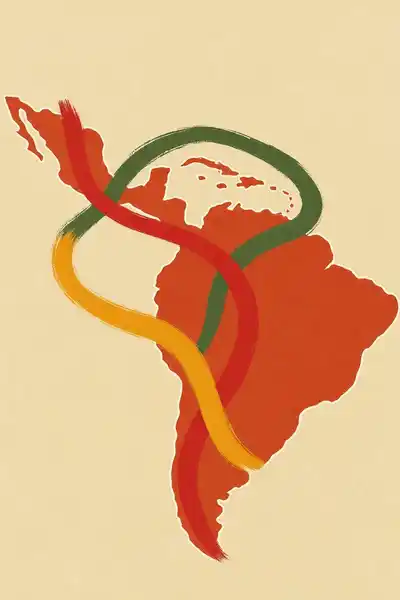
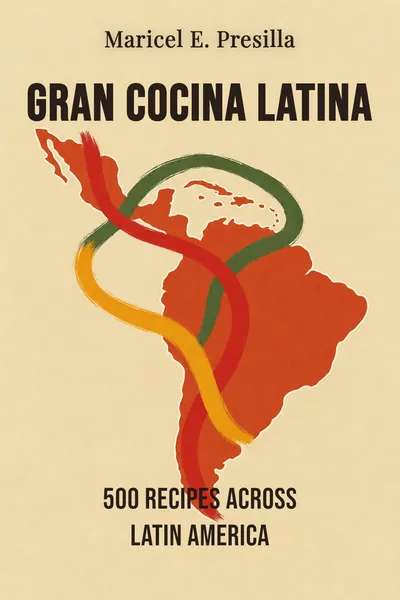
Gran Cocina Latina
500 recipes across Latin America
Description
Maricel Presilla spent the better part of thirty years doing something most cookbook writers never attempt: driving, flying and eating her way across nearly every Spanish-speaking country in the Americas, notebook in hand, asking cooks in home kitchens and market stalls how they actually did the thing. She was trained as a medievalist, ran two Latin restaurants in Hoboken, New Jersey, and carried both hats into the work. The result, published in 2012, is Gran Cocina Latina — a book of roughly 500 recipes that reaches from the moles of Mexico to the grilled beef of Argentina, taking in the sofritos and adobos of the Caribbean along the way.
It is a big book, and its size is the point. Latin America is not a country, and its food is not a genre. A tamal in Oaxaca and a tamal in Caracas share a name and a corn husk and almost nothing else. Presilla's wager was that you could hold all of it in one volume without pretending the differences away — that the ceviche of Peru and the flan of Puerto Rico belonged in the same conversation not because they taste alike but because they grew from a shared history of ingredients, empires and improvisation.
What makes the book unusual is that it never lets the recipes float free of the people who cook them. Every empanada comes with a place, often a name, sometimes an argument. Presilla writes as someone who has stood in the kitchen and asked why — and the answers turn a doorstop of a cookbook into something closer to a travelogue with dinner attached.
The question we’re asking : How do you fit the food of an entire hemisphere between two covers without flattening it into a single, false 'Latin' cuisine?What we’ll see : A cook-scholar's decades on the road, the building blocks she kept finding everywhere, and the argument that holds 500 recipes together.
Table of contents
01Chapter 1 — One kitchen, two continents, thirty years of driving
Presilla did not write Gran Cocina Latina from a library, though she could have. Born in Cuba, trained as a historian of medieval Spain, she came at food the way a scholar comes at a manuscript — but she also owned restaurants, Zafra and Cucharamama in Hoboken, and had to feed paying customers who knew what their grandmothers made. The two impulses pull the book in a useful direction. It is rigorous about where a dish comes from and unsentimental about how it tastes.
The reporting was literal. Over roughly three decades she traveled through Mexico, Central America, the Andean countries, the Southern Cone and the Spanish-speaking Caribbean, collecting recipes the slow way: watching, tasting, writing down not just quantities but reasons. When a cook in one region toasted a chile and a cook in the next steeped it raw, she wanted to know why, and she recorded the disagreement rather than smoothing it over. The book carries the texture of that fieldwork, full of small regional variants that a tidier volume would have dropped.

02Chapter 2 — The pantry before the plate
Before the book gets to finished dishes, it spends a long time on foundations — and this is where Presilla's argument quietly begins. Latin cooking, she insists, is built from a handful of flavor bases that get remade in every country, and if you learn those, the rest follows. The two she returns to most are the adobo and the sofrito: the seasoning paste and the aromatic sauté that start an enormous share of the region's savory food.
An adobo is a rub or marinade, usually built on garlic, salt, spices and often a souring agent, used to season meat before it cooks. A sofrito is what happens in the pan first — aromatics cooked down into a flavor foundation. Neither is a single recipe. The Puerto Rican sofrito leans on culantro and ají dulce; a Cuban version reaches for cumin and bell pepper; further south the components shift again. Presilla catalogs these variations carefully, because to her the sofrito is not a step, it is a fingerprint. Tell her what goes in the pan first and she can often tell you the country.
03Chapter 3 — Where the recipes actually live
Once the foundations are laid, the recipes fan out by category, and the range is the whole point. There are tamales in their many forms — corn dough steamed in husks or leaves, stuffed with meat or beans or nothing much, sweet in one country and savory in the next. There are empanadas by the dozen, ceviches built on the raw brightness of citrus and fish, and moles that can run to twenty or thirty ingredients and an afternoon of work. And there is flan, the custard that turns up, faintly different, at the end of meals from Mexico to the Caribbean.
Presilla resists the temptation to rank or simplify. A ceviche gets presented with its regional logic intact: the Peruvian version's brief, sharp cure sits beside preparations that marinate longer or add corn and sweet potato. She will note that a dish most North American readers think they know is really a family of dishes, and then give several. The book would rather be accurate and long than short and wrong.
04Chapter 4 — A map drawn in ingredients, not borders
Step back from the recipes and Gran Cocina Latina is making a quiet claim about a phrase people use loosely all the time. "Latin American food" gets treated, in restaurants and grocery aisles, as if it were one thing — a category you could put on a menu. Presilla's whole book is an argument that this is both false and, handled carefully, useful. It is false because the food of two dozen nations does not reduce to a style. It is useful because those nations do share something real, and naming it honestly is worth the effort.
What they share, in her telling, is not a taste but a history and a method. The shared inheritance is the collision of Indigenous ingredients — corn, chiles, beans, cacao, potatoes — with the Iberian conquest, the African diaspora, and later immigrant waves, all improvising with what was at hand. And the shared method is the family of techniques she front-loaded: the seasoning paste, the aromatic base, the chile blend, the masa. Unity lives in the how, not the what. That is why a single author can credibly write about the whole region without dissolving it into mush.
05Conclusion
The book that came out of those thirty years of travel is, on its surface, a practical object: 500 recipes for adobos and sofritos, empanadas and tamales, ceviches and moles and flan, organized so a cook can actually find and make them. Presilla the restaurateur made sure of that. But the driving and the asking and the writing-down produced something the recipe count alone doesn't capture — a portrait of how the food of the Americas came to be, dish by dish, kitchen by kitchen.
Related books