

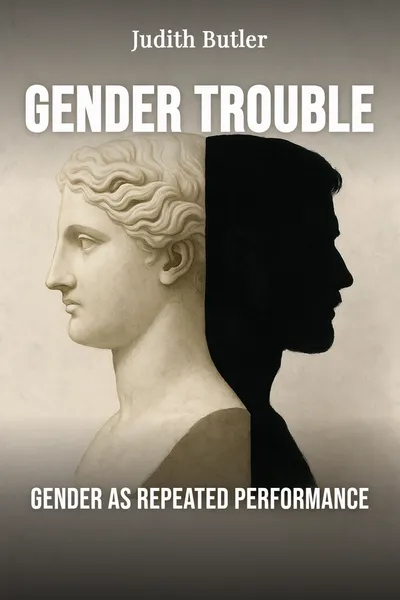
Gender Trouble
Gender as repeated performance
Description
In 1990, a philosopher named Judith Butler published a dense, argumentative book with an odd, almost mischievous title: Gender Trouble: Feminism and the Subversion of Identity. It came out of academic feminist theory, borrowed heavily from French thinkers most readers had never read, and was written in prose that even admirers call demanding. It should have stayed in seminar rooms. Instead it became one of the most cited works in the humanities of the past half-century, the founding text of what came to be called queer theory, and a book whose central idea — that gender is something we do rather than something we are — has traveled far beyond anyone who has actually finished it.
The book's move is deceptively simple to state and hard to hold onto. We tend to assume there is a stable inner core — being a woman, being a man — that then expresses itself outward in how we walk, dress, speak, desire. Butler flips the order. There is no inner core doing the expressing. The gestures come first; the appearance of a core is what they produce. Gender, in her phrase, is performative: it is made real by being repeated, over and over, until the repetition looks like nature. Pull on that thread and a great deal that feminism had treated as solid ground starts to move.
That is why the title says trouble rather than theory. Butler was not only describing gender; she was picking a fight with the version of feminism that grounded itself on a shared identity called "women." If the category is itself an effect of the system it means to oppose, then the ground shifts under everyone standing on it — which is exactly what she thought needed to happen.
The question we’re asking : If gender is not the outward sign of an inner truth, then what is it — and what holds a person together once that inner truth is gone?What we’ll see : How a difficult book unmade the idea of a fixed self by arguing that identity is something rehearsed rather than possessed.
Table of contents
01 Chapter 1 — The trouble with the noun "woman"
Butler opens not with gender at all but with a problem inside feminism. Feminism, by definition, speaks for women. To make political demands, it needs a subject on whose behalf it speaks — and that subject is "women." It seems obvious, almost too obvious to question. Who are the women's movements for, if not women? But Butler's first move is to lean on that obviousness until it cracks.
The trouble, she argues, is that there is no single thing the word names. A woman in one time, class, culture, or body is not living the same category as a woman elsewhere. Every attempt to say what all women share — biology, oppression, a certain experience — ends up quietly excluding many of the people it claims to include, and smuggling in the assumptions of whoever is doing the defining. The universal "woman" turns out to be a particular woman in disguise.

02 Chapter 2 — Sex was never the ground under gender
For decades, feminism had leaned on a clean distinction that felt like liberation. Sex is the body — chromosomes, anatomy, the raw biological fact. Gender is what culture builds on top of it — the roles, expectations, and meanings a society attaches to that fact. The distinction was powerful because it said: whatever biology hands us, the social part is not destiny, it can be changed. Butler takes this hard-won tool and asks a question that undoes it.
If gender is the cultural interpretation of sex, she notes, then sex is doing a lot of work as the thing being interpreted — the neutral, pre-cultural bedrock beneath. But is sex actually pre-cultural? The moment we point to the body and say "this is male, this is female," we are already reading it through a grid that recognizes two, and only two, kinds. The bodily facts do not sort themselves; we sort them, using categories we treat as given. What looks like the natural ground under gender turns out to be already shaped by the same cultural apparatus.
03 Chapter 3 — Performative, not a performance
Here is the idea the book is remembered for, and also the one most often garbled. Gender, Butler writes, is performative. That word does not mean gender is a costume you put on in the morning and take off at night, a free performance staged by a self who exists underneath. That reading imagines exactly the inner core she is trying to dislodge. Performative means something more radical: there is no doer behind the deed. The self we think is doing the gendering is itself produced by the doing.
She borrows the term from the philosophy of language, from J. L. Austin, who noticed that some utterances do not describe a state of affairs but bring it about — "I promise," "I now pronounce you." Saying the words makes the fact. Gender works the same way, except the utterance is not a single sentence but an endless series of small acts: how one stands, speaks, gestures, dresses, moves through a room. Repeated day after day, these acts congeal into the impression of a stable, essential gender that seems to have been there all along.
04 Chapter 4 — What comes loose when the ground moves
Step back, and the reach of Butler's argument is larger than gender. She is making a claim about how any deep category holds together — the ones we treat not as opinions but as facts of nature, the bedrock we think we are standing on. Her wager is that some of those foundations are not causes but effects: not the ground the structure rests on, but something the structure produces and then hides, so it can appear to rest on solid earth. Gender is her case study; the pattern is meant to generalize.
This is what makes Gender Trouble genuinely unsettling rather than merely provocative. It does not offer a better identity to replace the old one. It refuses the demand for a stable self to organize politics around, and it declines to say what we should be instead. Butler is often pressed on this: if there is no fixed subject, who acts, who resists, who is harmed? Her answer is that agency does not require a self that precedes its acts. We are constituted by the roles we did not choose — and precisely because we have to keep repeating them, we can inhabit them awry, expose their seams, make trouble in the gap between the script and its performance.
05 Conclusion
The book that should have stayed in the seminar became a foundation stone of queer theory, gave the word performativity its second life, and shaped how a generation talks about gender without ever citing the source. That afterlife is ironic for a text whose whole point was that foundations are effects, not origins — Gender Trouble became a kind of ground for others precisely by arguing there is no ground. Butler herself has spent the decades since clarifying, qualifying, and being misread, insisting the idea was never that gender is a matter of daily choice.
Related books











