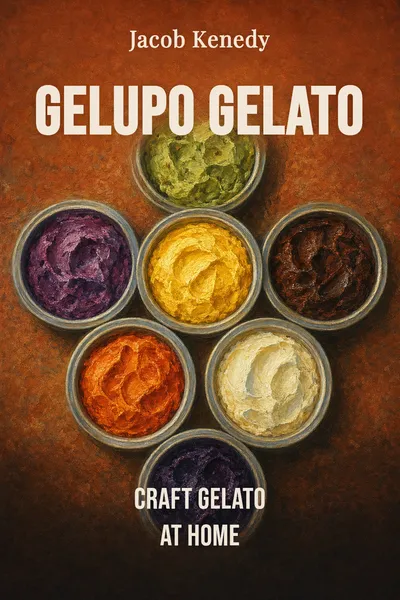
Gelupo Gelato
Craft gelato at home
Description
On Archer Street in London's Soho, a narrow room called Gelupo has been scooping gelato since 2010. It sits across from Bocca di Lupo, the Italian restaurant Jacob Kenedy opened a year earlier, and the two are joined at the hip — the same kitchen sensibility, the same insistence on doing things properly. Kenedy is a chef who trained seriously and then went and built a gelateria the way a good Italian one is built: churning small batches daily, chasing the best fruit, refusing to let a scoop sit around long enough to lose its texture. The queues on a warm evening tell you the rest.
What Kenedy did next was slightly stubborn. He wrote the recipes down — the actual ones, the ones Gelupo runs on — and put them in a book with the same name. Not a coffee-table object with a few token formulas, but a working manual: how to build a base that stays smooth, why one fruit wants sugar and another wants none, what happens to a sorbet if we get the ratios wrong. The premise is that gelato is a craft a home cook can genuinely learn, not a factory secret. That is a bolder claim than it sounds, because most of us have only ever met gelato as something bought.
So the book sets out to close the distance between the counter on Archer Street and a kitchen with a domestic ice-cream machine. It treats the reader as capable, hands them the numbers, and trusts them to taste as they go. What comes across, page after page, is less a list of desserts than a way of caring about a single, humble thing until it becomes remarkable.
The question we’re asking : Can the exacting craft of an Italian gelateria really move into a home kitchen, and what changes when it does?What we’ll see : A working chef opens his gelateria's notebook and, in doing so, quietly teaches a whole way of tasting.
Table of contents
01Chapter 1 — A London gelateria in a book
Gelupo the book carries the DNA of Gelupo the shop, and Kenedy makes no attempt to hide it. The recipes are scaled for a domestic kitchen, but they descend directly from what gets churned daily on Archer Street. That lineage matters, because it means the formulas have been tested by volume and by paying customers, not invented for a photo shoot. When Kenedy tells us how much sugar a strawberry sorbet needs, he is reporting from years of scooping, not guessing.
The organizing spirit is generosity rather than gatekeeping. A lot of professional cooks treat their recipes as trade secrets; Kenedy treats them as things worth sharing precisely because they are hard-won. He explains the why alongside the how — why gelato is churned slower than ice cream, why a fruit sorbet lives or dies on the ripeness of the fruit, why the freezer at home is both an ally and an enemy. The tone is that of a friend who happens to run one of the best gelaterie in the city and would genuinely like us to eat well.

02Chapter 2 — Why gelato is not ice cream
The first thing Kenedy insists we unlearn is the idea that gelato is just Italian for ice cream. They are cousins, not twins, and the differences are technical enough to change everything about how the stuff behaves in the mouth. Gelato is churned more slowly and with less air whipped into it, so it comes out denser. Where a scoop of ice cream can be light and almost fluffy, gelato is compact, closer packed, which is why a small portion feels satisfying.
Then there is fat. Classic ice cream leans heavily on cream and egg yolks, building richness through fat. Gelato typically uses more milk and less cream, and many gelato bases carry little or no egg at all. Less fat sounds like a compromise, but Kenedy makes the opposite case: fat coats the tongue and mutes flavor, so a leaner base actually lets a pistachio or a lemon come through more clearly. The density does the work that richness does in ice cream, without dulling the taste.
03Chapter 3 — The obsession with the base
If there is a hero in the book, it is the base — the plain milk-and-sugar foundation that almost every flavor is built on. Kenedy spends real time here, because a wobbly base cannot be rescued by a good flavor on top. Get the base right and half the battle is won; get it wrong and even the finest pistachio will turn grainy or icy. Much of what separates a great gelato from a merely decent one happens before any flavor is added.
The central problem is texture, and the enemy is ice. Water in the mix wants to freeze into crystals, and large crystals are what make a homemade batch turn crunchy and coarse. Sugar is the main tool against this: it lowers the freezing point and keeps the mixture soft and scoopable. But sugar is not only sweetness — it is structure. Kenedy explains why the amount cannot simply be dialed down for a less sweet result without the whole thing turning to a brick, and why different sugars behave differently. Balancing sweetness against texture is the quiet skill the book keeps teaching.
04Chapter 4 — Flavor as a way of paying attention
Step back from the recipes and Gelupo turns out to be a book about attention as much as about dessert. To make gelato well, we are forced to taste properly — to notice whether a strawberry is truly ripe, whether a batch of milk is fresh, whether a scoop is a degree too cold. Those are small acts of noticing, and Kenedy's real gift is making them feel worthwhile rather than fussy. The gelato is the reward, but the habit of tasting closely is the deeper thing being passed along.
This is why the book keeps insisting on the quality of ingredients. A gelato has almost nowhere to hide; with so few components, every one of them is exposed. Mediocre chocolate makes a mediocre chocolate gelato, full stop. Kenedy's enthusiasm for good fruit, good milk, real pistachios is not snobbery — it is a straightforward consequence of the craft. When there is nothing to mask a flavor, the flavor has to be good on its own. Making gelato teaches this lesson faster than almost any other kind of cooking.
05Conclusion
Gelupo began as a narrow room in Soho where Jacob Kenedy scooped dense, vivid, freshly churned gelato across a counter. The book carries that room home with us, and it does so without watering anything down: the same bases, the same ratios, the same refusal to accept a coarse texture or a muddy flavor. What looked at first like a professional's secret turns out to be a set of understandable principles — air, fat, temperature, sugar, and the ripeness of the fruit in front of us.
Related books