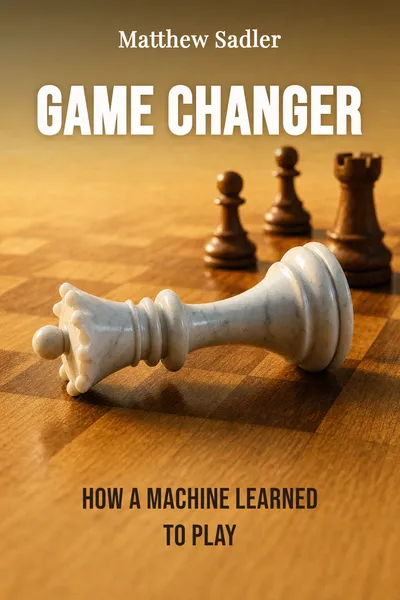
Game Changer
How a machine learned to play
Description
In December 2017, a research team at DeepMind, the London artificial-intelligence lab owned by Google's parent company, released a paper and a handful of chess games that stopped the chess world cold. The program was called AlphaZero. It had been given nothing but the rules of chess — no opening theory, no database of grandmaster games, no human coaching of any kind — and told to play against itself. After roughly nine hours of that self-play, it sat down against Stockfish, the strongest conventional chess engine in the world, and did not lose a single game across a hundred-game match. The ten games DeepMind published were not just wins. They were beautiful, reckless-looking, full of sacrifices no cautious machine should have made.
Two of the people who looked hardest at those games were Matthew Sadler, an English grandmaster, and Natasha Regan, a chess and mathematics writer. Their book, Game Changer, came out of a rare arrangement: DeepMind gave them access to more than two thousand unpublished AlphaZero games and let them talk to the engineers who built it. Sadler had spent a career studying how the best conventional engines calculated. What he found in AlphaZero was something that did not calculate the way he expected — something that played, in his word, with a kind of purpose he associated with human masters rather than with silicon.
That is the tension the book sits inside. A machine that learned chess alone, in an afternoon, produced play that looked less mechanical, not more. It preferred activity over material, long-term pressure over safe consolidation, positions a human romantic might have chosen and a computer supposedly never would. Sadler and Regan set out to explain how that happened, what the games actually teach, and why any of it should matter to someone who has never studied an opening in their life.
The question we’re asking : How did a machine that taught itself chess in a few hours end up playing in a style people called brilliant, human, and impossible to beat?What we’ll see : How AlphaZero learned, what its games reveal that decades of engine-building had missed, and where a machine that develops something like judgment starts to matter beyond a chessboard.
Table of contents
01Chapter 1 — The ten games that landed like a shock
To understand why the reaction was so intense, it helps to know what chess engines had become by 2017. For twenty years, since Deep Blue beat Garry Kasparov in 1997, computers had been the strongest chess players on earth, and nobody disputed it. Programs like Stockfish worked by brute calculation — searching tens of millions of positions per second, pruning the hopeless branches, and scoring the rest against a set of rules humans had hand-tuned over decades. They were terrifyingly strong and, to grandmasters watching, a little soulless. Engine chess was correct chess. It was rarely inspiring chess.
AlphaZero broke that expectation in the first games DeepMind released. It gave up pawns for activity. It pushed a wing pawn far up the board just to cramp its opponent, ignoring the material cost. It parked its own pieces in ways that constrained Stockfish's king for move after move, refusing to cash the advantage in until it was overwhelming. Sadler, going through the games, kept reaching for the vocabulary of human masters — Kasparov's energy, the positional grip of a Karpov — rather than the vocabulary of software.

02Chapter 2 — A machine that taught itself from scratch
The method behind AlphaZero is where the story turns strange, because it is so much simpler than what came before. There was no library of human games poured in, no encyclopedia of openings, no list of principles about controlling the center or developing pieces. The engineers gave the system the rules — how each piece moves, what counts as checkmate, what counts as a draw — and then set it to play against copies of itself, millions of times over.
At the start, it played randomly, flailing like a beginner who has just learned which way the knight jumps. But after each game it adjusted. A neural network — the same broad kind of pattern-learning system used to recognize faces or translate languages — slowly tuned itself toward the moves that tended to lead to wins. It was, in effect, running its own tournament against itself and learning from every result, with no human ever telling it that a bishop is worth roughly three pawns or that an open file is good. Those ideas, to the extent AlphaZero used them at all, it discovered on its own.
03Chapter 3 — What AlphaZero saw that the engines missed
The reason Game Changer runs to hundreds of pages is that Sadler and Regan treat the games as a curriculum, not a curiosity. Freed from the conventional engine's obsession with material, AlphaZero kept doing things human theory had always half-suspected were strong but could never quite trust. It valued the mobility of its pieces above almost everything, happily giving up a pawn if it meant its bishops could breathe and its opponent's could not.
One motif recurs so often that Sadler names it: the far-advanced wing pawn, pushed deep into enemy territory not to promote but to jam the opposing position, taking away squares and tying pieces down. Conventional wisdom treated such pawns as weaknesses to be defended. AlphaZero treated them as long-term investments in space, and it was right often enough to force human players to reconsider. The same held for its handling of the initiative — its willingness to sacrifice material for a lasting attack that might not pay off for twenty moves, if it paid off at all.
04Chapter 4 — When intuition returns through the back door
Step back from the sacrifices and the pawn pushes, and the deeper claim in Game Changer is about the shape of the intelligence involved. For most of computing's history, the machine's advantage over the human was calculation — speed, tirelessness, the ability to check every possibility. Human beings held the opposite territory: intuition, pattern, the feel for a position that no one could fully write down as a rule. The two seemed like different currencies. AlphaZero blurred the line, because it won the way humans were supposed to be good — by judgment — using a method that produced judgment out of nothing but experience.
That matters because AlphaZero's designers were never really trying to solve chess. Chess was a controlled arena, a closed world with clear rules and clear outcomes, ideal for testing whether a system could teach itself competence without being told the answers. The same DeepMind lineage went on to attack problems with no tidy rulebook at all, most famously the prediction of how proteins fold — a challenge with enormous consequences for medicine and biology, and nothing like a game. The chess story was a proof of concept for a way of learning.
05Conclusion
The ten games DeepMind published in December 2017 still hold up as the thing they were meant to be: evidence that a machine given only the rules could, in an afternoon of playing itself, arrive at chess of startling quality. What Sadler and Regan added, with their two thousand games and their access to the team, was the explanation underneath the spectacle — the self-play, the trained sense of where to look, the willingness to prize activity and initiative over the safe accumulation of material that conventional engines had always chased.
Related books