
Friday Night Lights
When football defines a town
Description
In the fall of 1988, a journalist named H.G. Bissinger moved his family from the East Coast to Odessa, a flat, oil-scarred city in West Texas, to follow a high school football team for a single season. He had left a job at a major newspaper to do it. The team was the Permian Panthers, one of the most successful programs in the country, and Bissinger wanted to understand why a town of about ninety thousand people would build so much of its life around teenagers playing a game on Friday nights. He rented a house, showed up at practices, sat in living rooms, and stayed until the season was over.
What he found was not a feel-good story about small-town spirit, and the book that came out of it — published in 1990 as Friday Night Lights — was not received as one in Odessa. The stadium held around twenty thousand seats and filled them. The head coach earned more than the school principal. Booster clubs flew the team to away games on chartered planes while the same district cut funding for the classroom. Bissinger recorded all of it plainly, and when the book appeared, some in Odessa were furious enough that he was warned not to come back for a signing.
The book has since become the most respected piece of writing American sport has produced about itself — later a film, then a television series that softened its edges. But the original is harder and colder than either. It watches a place pour its hopes, its grievances and its sense of worth into a handful of seventeen-year-olds, and it asks what happens to everyone involved when the season finally ends.
The question we’re asking : Why would an entire town stake its identity on a high school football team — and what does that bargain cost?What we’ll see : A season in Odessa, the boys who carried it, and what the lights were really lit for.
Table of contents
01Chapter 1 — A town built around a stadium
Odessa in the late 1980s was a place the boom had left behind. The oil economy that once drew workers by the thousands had cratered when prices collapsed earlier in the decade, and the city Bissinger described was jittery, hard-drinking, and unsure of what it was for. Jobs had vanished. Houses sat empty. The civic mood was one of permanent unease. Into that vacuum football did not so much intrude as expand, filling the space where a stable future was supposed to be.
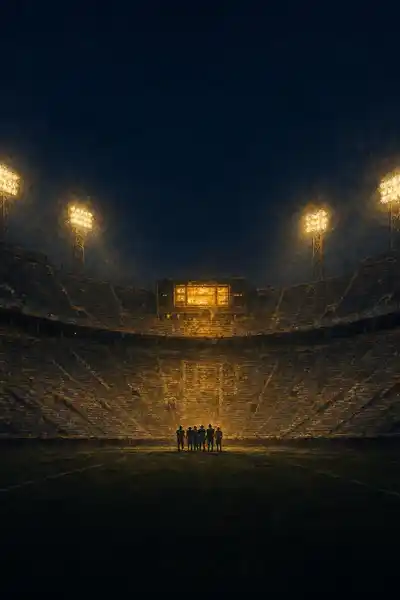
The scale of it startled Bissinger. Ratliff Stadium, where the Panthers played, had cost more than five million dollars and seated close to twenty thousand — a high school venue larger than many college fields. On game nights the town emptied into it. Businesses closed. Strangers argued about the depth chart in the grocery store. The Friday result was not sports news; it was the single fact that organized the week, discussed with an intensity most places reserve for elections or funerals.

02Chapter 2 — The boys under the lights
The season Bissinger followed belonged to a specific set of teenagers, and the book's power comes from refusing to treat them as symbols. He learned their families, their grades, their fears about what came after graduation. He watched them carry a town's expectations in bodies that were still growing, and he recorded what that weight did to them one at a time.
There was Boobie Miles, the gifted running back everyone assumed was headed to a major program and a way out of Odessa. Early in the season he tore up his knee in a meaningless preseason scrimmage. The injury was the hinge of the book. As long as Boobie could run, the town treated him as its most valuable asset; once he could not, the same adults who had celebrated him grew cool, and the college recruiters stopped calling. Bissinger watched a boy discover, at seventeen, that he had been loved for his usefulness, and that the usefulness was gone.
03Chapter 3 — What the town could not see
Beneath the Friday spectacle, Bissinger uncovered the fault lines the celebration was built to paper over. Odessa was sharply divided, and the divisions ran along the same lines they ran everywhere in America — race, class, geography — but here the football team sat directly on top of them, sometimes hiding them, sometimes making them worse.
Permian High served the wealthier, whiter side of town, while the schools on the other side had older facilities and fewer resources. The book documented how attendance zones had been drawn and redrawn in ways that kept the strongest programs stocked and the disadvantaged schools depleted. The team that united Odessa on Friday nights was, on closer inspection, a product of a system that had never treated its neighborhoods as equal. The unity was real to the fans and partial in fact.
04Chapter 4 — When a game does the work a place cannot
Step back from Odessa and the season, and the deeper subject of Bissinger's book comes into focus. It is not really about whether football matters too much in West Texas. It is about what happens when a community outsources its sense of worth to something it cannot control — and then defends that arrangement all the harder because it has nothing else.
A stable, confident place does not need a high school team to tell it that it is good. Odessa did, because the things that had once given it pride — steady work, a growing future, a reason young people stayed — had drained away. Football did not cause that loss; it moved into the empty room the loss had created. The intensity Bissinger documented was the measure of a wound, not of an enthusiasm. The louder the stadium, the more it revealed about everything the stadium was compensating for.
05Conclusion
Bissinger's season ended the way most seasons do, short of the ultimate prize, and the town moved on to the next fall the way it always had. The boys graduated into ordinary lives, some better than others, most far from the mythic futures Friday nights had seemed to promise. Boobie Miles never played the way he once had. The stadium filled again the next August for a new set of seventeen-year-olds, and the bargain renewed itself without anyone needing to state its terms.