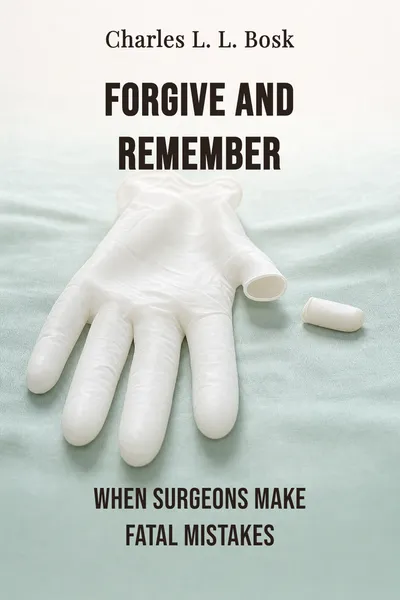
Forgive and Remember
When surgeons make fatal mistakes
Description
In the early 1970s, a young sociologist named Charles Bosk did something most of us would find hard to imagine: he asked a major American teaching hospital whether he could follow its surgeons around for a year and a half, watching them cut, watching them talk, and — the part that mattered — watching them get things wrong. For roughly eighteen months he trailed two surgical services, sitting in on rounds, standing in operating rooms, listening to the corridor conversations that happen when a patient does badly. The result, published in 1979 as Forgive and Remember, is one of the strangest and most honest books ever written about how doctors handle their own failures.
The setup sounds almost morbid. A researcher parked inside a hospital, notebook open, waiting for a scalpel to slip or a diagnosis to miss. But Bosk was not there to count bodies or expose scandal. He wanted to understand something quieter and more unsettling: what a group of people do when their errors can kill, and when the person who made the error is the same person best placed to judge it. Surgery, more than almost any other job, turns mistakes into consequences you cannot take back.
What he found was not chaos and not a cover-up. It was a system — informal, unwritten, and remarkably consistent — for sorting error into kinds. Some mistakes a surgical chief would shrug off the same afternoon. Others would follow a young resident for years. The difference between the two had surprisingly little to do with whether the patient survived.
The question we’re asking : How does a profession where mistakes are fatal decide which mistakes it can live with?What we’ll see : An eighteen-month study of surgeons at work, and the quiet code that tells them what to forgive and what to never forget.
Table of contents
01Chapter 1 — Eighteen months in scrubs
Bosk arrived as an observer, not a doctor, which turned out to be the point. He could not scrub in, could not judge whether a suture was clean, could not tell a good anastomosis from a bad one. So he watched the humans instead — how they spoke to each other, what they laughed off, what made a room go silent. Over the eighteen months he shadowed two surgical services at a hospital he called Pacific, following attending surgeons at the top and the residents in training below them, through the whole vertical chain of a teaching service.
The structure of that chain shaped everything he saw. A surgical service is steeply hierarchical: at the top, the attending surgeon who holds the reputation and the responsibility; below, chief residents, junior residents, and interns, each supposedly learning the craft from the rung above. Training is an apprenticeship in the oldest sense — you learn to cut by cutting, under the eye of someone who has cut before. And because the stakes are a living body, the person teaching you is also the person who must answer for what you do wrong.

02Chapter 2 — The mistakes that get forgiven
The forgivable errors, in Bosk's account, came in two flavors. The first he called technical: the resident's hands were not yet good enough, the judgment not yet sharp enough, and something went wrong because skill takes years to build. A knot tied badly, a step misjudged, a complication not caught fast enough. These were the ordinary failures of someone still learning, and the surgeons treated them as such — the price of turning a novice into a competent operator.
The second kind he called judgmental: the resident chose a reasonable course of action that, in hindsight, turned out to be the wrong one. Medicine is full of decisions made under uncertainty, where a defensible choice can still lead to a bad end. A surgeon who weighs the options honestly and lands on the losing side has not, in this scheme, done anything shameful. They have simply run into the limits of what anyone could have known.
03Chapter 3 — The mistake that ends a career
Then there were the errors that were not forgiven, and here Bosk found the real moral core of surgical life. He called them normative errors, and they had almost nothing to do with skill. A normative error was a failure to do the job the way a conscientious surgeon is supposed to do it — cutting a corner, not checking on a patient, not admitting a mistake, not calling for help when you should have. The offense was not that the resident lacked ability. It was that they had failed in their duties, in their honesty, in their conscience.
The tell was the reaction. Where a technical error drew a correction, a normative error drew something closer to outrage. A resident who covered up a complication, who lied about having examined a patient, who behaved as though the rules of thoroughness did not apply to them — that resident was in serious trouble, regardless of whether the patient came to harm. Bosk watched attending surgeons forgive men whose patients had died and turn cold toward men whose patients were fine but who had shown they could not be trusted.
04Chapter 4 — Why the profession watches itself
Step back from the operating room and Bosk's real subject comes into view: how a profession that no outsider can properly judge manages to police itself. No patient can evaluate whether a surgeon's decision was sound. No hospital administrator can stand over every incision. The only people equipped to judge a surgeon's work are other surgeons — which means the profession is, in effect, left to watch itself. Bosk's book is an X-ray of how that self-surveillance actually works, day to day, on the ward.
What he saw was that the surgeons had turned their control problem into a moral training system. Because they could not follow each resident everywhere, they concentrated on producing people who would behave correctly unsupervised. The obsessive attention to normative error — the honesty, the thoroughness, the willingness to admit a mistake — was not moralizing for its own sake. It was the profession's practical answer to the fact that most of what a surgeon does happens beyond anyone's sight. You train character because you cannot install a camera in every conscience.
05Conclusion
Eighteen months of watching left Bosk with a picture that resists easy judgment. The surgeons he followed were not callous about death, nor were they lax about error. They had simply built, over generations, a way of distinguishing the failures that come with learning a hard craft from the failures that reveal a person unfit to practice it. They forgave the first and remembered the second, and they did so with a consistency that had nothing to do with whether the patient on the table lived or died.
Related books