Filipino Tattoos
Ink, heritage, and identity
Description
When the ships of Ferdinand Magellan reached the central Philippine islands in 1521, the Europeans found people whose skin was covered, chest to ankle, in dense geometric designs. They called these islands Las Islas de los Pintados — the Islands of the Painted Ones — assuming the marks were paint that would wash off. They did not. The designs had been tapped into the flesh with thorn and soot, worn for life, and read by everyone who saw them like a public record of who a person was and what they had done.
Nearly five centuries later, the same designs are reappearing. Not as museum photographs or ethnographic curiosities, but on living skin, tapped by hand in the old way. In the mountain village of Buscalan, an elderly Kalinga woman named Whang-od has become the most recognized practitioner of a craft that colonization, conversion, and shame very nearly killed. Filipinos scattered across the diaspora are traveling home to receive marks their grandparents were taught to hide. Something that was almost lost is being pulled back into the present.
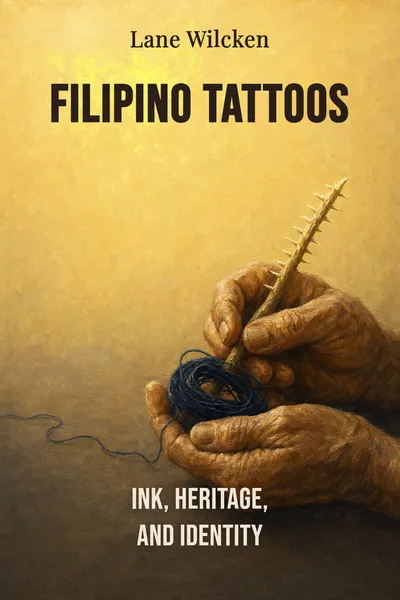
In his book Filipino Tattoos, Lane Wilcken treats these marks not as decoration but as a language — one that carried genealogy, spiritual protection, status, and belonging long before the alphabet arrived. He follows the practice from its ancient indigenous roots through the long silence imposed by empire and church, into a revival that is as much about identity as it is about ink. The story he tells is about what a people remembers when the memory is written on the body itself.
The question we’re asking : Why did an entire archipelago inscribe its identity onto the skin, and what happens when that language is nearly erased and then reclaimed?What we’ll see : How the marks were made and read, what they meant to those who wore them, how the hand-tapping tradition came back, and what it means for heritage to survive in the flesh.
Table of contents
01Chapter 1 — The mark that spoke before writing did
Long before Spanish friars brought the Roman alphabet, the peoples of the Philippine islands had ways of recording who they were, and one of the most durable was the tattoo. Wilcken makes the case that the mark was a form of communication in a society where the body was the most reliable page available. A stranger arriving in a village could read, from the designs a person wore, their lineage, their community, their achievements, and their standing. The skin was legible, and everyone knew how to read it.
The word Wilcken keeps returning to is batok, the term used in the northern Cordillera for the hand-tapped tattoo, though the practice ran across the archipelago under many names. Among the Visayans of the central islands — the Pintados the Spanish had named — tattooing was so bound up with worth that a person without marks was considered incomplete, even pitiable. Marks were earned, not bought. A warrior added to his designs as he proved himself; a woman's patterns spoke of her skill, her fertility, her place in the weave of kin.

02Chapter 2 — Skin as a map of the ancestors
If the tattoo was a language, its deepest grammar was spiritual. Wilcken devotes much of the book to the belief systems the marks were embedded in, and here the tattoo stops being a badge and becomes something closer to a passport for the soul. Across many Philippine cultures, the designs were understood to offer protection — against illness, against enemies, against malevolent forces — and to matter not only in this life but in what came after it.
The recurring idea is ancestry. Many traditional designs were not free inventions but inherited motifs, tied to specific families and specific spirits. To wear them was to carry one's forebears on one's skin, to keep them present and to be recognized by them. Wilcken records the belief, held in various forms across the islands, that the marks would allow the dead to be identified by their ancestors in the afterlife — that an unmarked person might arrive and not be known, and so not be received. The tattoo was continuity made visible.
03Chapter 3 — The hand-tap and the return of batok
The tradition did not fade on its own. Wilcken traces how Spanish colonization, beginning in the sixteenth century, and the spread of Catholicism steadily pushed tattooing to the margins. Marks that had signified honor were recast as marks of the heathen, the uncivilized, the unconverted. Over generations the practice retreated into the highland regions the colonizers never fully controlled, and even there it thinned. By the twentieth century, in many places, the tattooed elders were the last of their line, their designs dying with them.
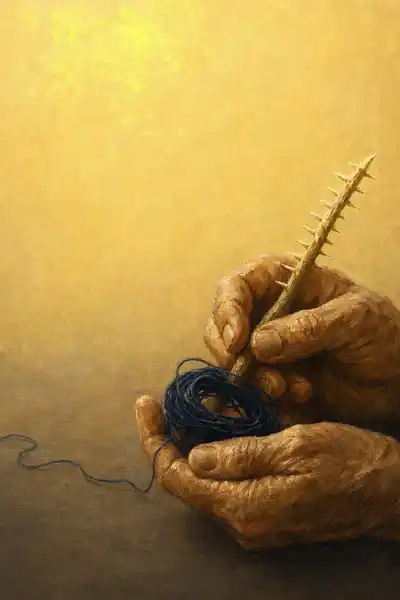
What survived did so largely in the Cordillera mountains of northern Luzon, among peoples like the Kalinga, where the hand-tapping method continued into living memory. It is here that the revival found its anchor. Whang-od, the Kalinga mambabatok born in the early 1900s, kept tapping designs by the traditional method — a thorn from a pomelo or calamansi tree, soot for ink, a stick to drive it in — long after the customary reasons for the marks had eroded. Her persistence made her a bridge between the old world and a generation hungry to reconnect with it.
04Chapter 4 — What we carry when we carry a mark
Step back from the specific designs and Filipino tattooing becomes a case study in how a culture remembers when its usual containers for memory have been taken away. The Philippines endured centuries of Spanish rule and decades of American occupation. Written records were kept in colonial languages, filtered through colonial priorities; indigenous scripts and practices were suppressed or lost. Much of what could have documented the pre-colonial world simply did not survive in any archive. But the tattoo survived, because it was stored in the one place empire could not fully reach: the body itself.
This is the larger point Wilcken's book presses toward. A tradition written on skin has a different relationship to erasure than one written on paper. It cannot be burned in a library or edited by an occupier. It can only be interrupted by ending the practice — by shaming the last practitioners into silence, or by letting the elders die untranscribed. That the marks came so close to disappearing shows how nearly that interruption succeeded. That they returned shows how much was still held in a handful of living memories.
05Conclusion
The Spanish who named the central islands after their painted inhabitants assumed they were looking at something temporary. Five centuries later, the marks they misread are being tapped again into new skin, by the same method, drawn from the same well of meaning. The people who nearly lost the tradition to conversion and shame are the ones now traveling back into the mountains to reclaim it, one thorn-prick at a time.
Related books