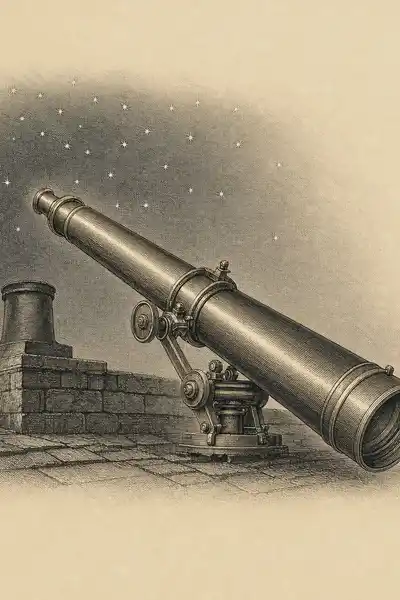
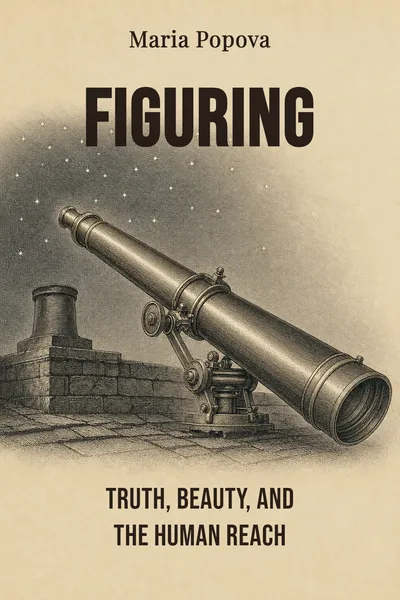
Figuring
Truth, beauty, and the human reach
Description
Figuring opens on a strange, almost cosmic scale, then immediately pulls close. Four centuries of atoms, Maria Popova writes, have arranged and rearranged themselves into the particular configurations she is about to follow — into Kepler and his mathematics of grief, into Maria Mitchell sweeping the night sky from a Nantucket rooftop, into Margaret Fuller and Emily Dickinson and Rachel Carson. The book refuses, from its first page, to treat these lives as separate stories. It reads them as one long human motion, a reaching outward toward truth and inward toward one another, and it insists the two reaches are the same gesture.
The book appeared in 2019, written by the founder of the long-running site once called Brain Pickings, and it does something most intellectual history does not dare. It moves by association rather than chronology, letting a letter, a discovery, or an unrequited love pull the narrative from an astronomer to a poet to a sculptor across generations. The connective tissue is not argument but longing — the sense that everyone in these pages is trying, against the odds of their era, to see clearly and to be truly seen.
What holds a book like this together, if not a thesis? Figuring wagers that the pursuit of knowledge and the pursuit of love are not two things but one, and that the history of science is unreadable without the history of the heart. It is a meditation dressed as a group biography, and it asks its reader to hold beauty and fact in the same hand without flinching.
The question we’re asking : How does a book braid astronomers, poets, and reformers into a single story about the human reach toward truth and toward each other?What we’ll see : A journey through interlaced lives where discovery and longing turn out to be the same motion, and where the private heart keeps shaping the public record.
Table of contents
01Chapter 1 — Four centuries opened by a comet
The opening move of Figuring is deceptively simple. Popova asks us to consider that the same atoms have cycled through the universe for billions of years, that we are, in Walt Whitman's phrase, made of matter that once belonged to something else. From this she draws not a physics lesson but a permission — permission to treat the lives of people separated by centuries as continuous, as arrangements of the same longing rather than isolated biographies. It is a bold way to begin a book of history, and it sets the terms for everything that follows.
The figures she gathers are not chosen for fame alone. Johannes Kepler, who worked out that planets move in ellipses. Maria Mitchell, the first American woman to discover a comet, in 1847. Margaret Fuller, the transcendentalist writer and editor. The astronomer Caroline Herschel. Emily Dickinson, Harriet Hosmer, Rachel Carson. What connects them is not a shared field but a shared predicament: each reached toward some form of truth while also reaching, often unrequitedly, toward another person. Popova treats those two reaches as inseparable.

02Chapter 2 — Kepler, and the mathematics of grief
Kepler enters Figuring not as a triumphant father of modern astronomy but as a man beset. Popova lingers on the texture of his life: the poverty, the religious upheaval of the early seventeenth century, the deaths of children, the precariousness of a Protestant astronomer in a fracturing Europe. His laws of planetary motion, worked out in the years around 1609 and 1619, are rendered as hard-won order pulled from a life that offered very little of it. The mathematics, in her telling, is a form of consolation.
The episode she returns to is the trial of Kepler's mother, Katharina, accused of witchcraft. For years Kepler fought to defend her, marshalling reason against superstition in a legal system prepared to torture and burn an old woman on the word of neighbors. Popova reads this not as a detour from his science but as its emotional center. The same man who mapped the harmony of the spheres spent years in courtrooms trying to save the person who had first shown him the sky. The rational cosmos and the endangered mother occupy the same heart.
03Chapter 3 — The women the sky was not supposed to hold
A large share of Figuring is devoted to women who did serious intellectual work in eras that gave them almost no room to do it. Maria Mitchell, born on Nantucket in 1818, taught herself astronomy, discovered a comet, won a gold medal from the King of Denmark, and later became a professor at Vassar. Popova follows her not only through her observations but through her fierce sense of what women were owed and denied — the small salaries, the doubted competence, the expectation that a woman's mind should stay indoors.
Caroline Herschel, sweeping the skies in England, discovered comets and catalogued nebulae while long treated as an assistant to her brother. Harriet Hosmer sculpted in Rome and defied the assumption that a woman could not command marble. Margaret Fuller wrote the first major American feminist work and edited the transcendentalist journal The Dial before drowning off Fire Island in 1850, her manuscript lost with her. Popova gathers these lives to show a pattern of brilliance forced to work at the margins, and often forced to choose between the work and a conventional life.
04Chapter 4 — Every atom belonging to another
Step back from the individual lives and Figuring reveals what it is really attempting as a form. It is a sustained argument against the tidy walls we build between the disciplines and between the parts of a person. We are used to keeping science in one room and poetry in another, intellect on one shelf and emotion on the next. Popova's whole method is to knock those walls down and show that they were never load-bearing — that Kepler's grief and Kepler's ellipses came from the same source, that Mitchell's comet and Mitchell's longing were one act of attention.
The book borrows its deepest conviction from Whitman, whose line about every atom belonging to us as much as to him runs beneath the whole enterprise. If the matter is shared, so is the reaching. Popova reads across four centuries as if she were reading a single long letter, passed from hand to hand, each figure adding to a collective attempt to understand the universe and to be understood by another human being. The associative structure is not decoration; it is the thesis made into shape.
05Conclusion
Figuring closes the way it opened, on the scale of atoms and centuries, but the vastness now feels populated. The comet, the ellipse, the lost manuscript off Fire Island, the letters that dared to say too much — they have accrued into a single texture, and the book has taught us to read them together. What began as a startling premise, that shared matter makes for a shared reaching, ends as something closer to a way of seeing. The people Popova follows are gone, but the motion she traced through them keeps going.
Related books