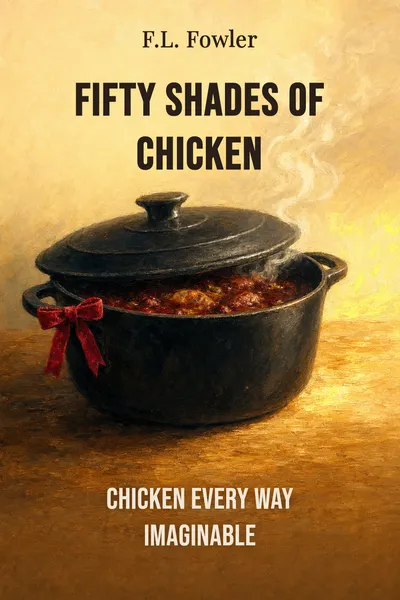
Fifty Shades of Chicken
Chicken every way imaginable
Description
In late 2012, a small hardcover appeared on bookstore tables with a title that made people do a double take: Fifty Shades of Chicken. The cover was matte black, a length of kitchen twine coiled where a necktie or a pair of handcuffs might have been, and the author was listed as F.L. Fowler — a pen name, obviously, riffing on the E.L. James phenomenon that had just sold tens of millions of copies worldwide. Inside were fifty chicken recipes with names like Dripping Thighs, Mustard-Spanked Chicken, and Learning-to-Truss-You Chicken. The whole thing was a gag, built on the biggest publishing story of the year.
And yet the joke had teeth. Behind the innuendo, every recipe was real, tested, and cookable — a proper roast chicken, a spatchcock, a coq au vin dressed up as Chicken with a Lardon. The parody was a frame around an actual working cookbook. Clarkson Potter, the publisher, put it out knowing full well the title would carry it, but the recipes had to hold up or the whole thing collapsed into a one-line greeting card. They held up. People bought it to laugh, then found themselves roasting a bird on a Tuesday.
It's a strange little object — half literary spoof, half kitchen manual — and it sold far better than anyone spoofing a bestseller has any right to expect. The premise sounds like it should run out of steam by page ten. It doesn't, and figuring out why means looking at what the book is actually doing underneath the wink.
The question we’re asking : How does a one-note parody title turn into a cookbook people actually use?What we’ll see : A book that plays a joke straight-faced, narrates from the chicken's point of view, and smuggles in fifty genuinely good recipes.
Table of contents
01Chapter 1 — A parody with a real recipe on every page
The setup is simple enough to explain at a dinner table. In 2012, E.L. James's Fifty Shades of Grey had become the fastest-selling paperback in history, a romance built around a wealthy, controlling suitor and a young woman who narrates her own undoing in breathless first person. Half the planet had either read it or made fun of it. Fifty Shades of Chicken lands squarely in the second camp: it takes the erotic-thriller register and points it at a roasting pan.
So the recipes get renamed accordingly. Dripping Thighs. Sticky Chicken Fingers. Vanilla Chicken, which is exactly what it sounds like — a plain, unadorned roast, the one you make when you don't want anything complicated. Bacon-Bound Wings, Mustard-Spanked Chicken, Holy Hell Wings for the heat-seekers, Spatchcock Chicken for the technique, and the groan-worthy Learning-to-Truss-You Chicken, which teaches you to tie up a bird with string. The names are the whole comedic engine, and Fowler commits to them completely.

02Chapter 2 — The bird narrates, and it changes everything
The move that turns Fifty Shades of Chicken from a punny recipe list into something more sustained is the narrator. Fowler doesn't just rename the dishes. The book is written in the voice of the chicken — a raw, trussed bird who narrates its own seduction by a domineering cook, in the same swooning first person as the original novel. The chicken is the innocent; the cook is the Christian Grey figure, all commanding hands and knowing glances over the cutting board.
It sounds absurd on paper, and it is. But the conceit gives the parody somewhere to go. Between recipes, short interludes carry the story forward: the chicken's nervous anticipation, its growing surrender to the marinade, the heat, the trussing string. The cook murmurs instructions that double as recipe steps and as the language of a romance. The bird swoons. The reader, who came for a gag, gets a running narrative that ties fifty separate recipes into one arc.
03Chapter 3 — Fifty recipes that actually teach technique
Strip away the voice and the double entendres and you're left with a cookbook that quietly covers a lot of ground. The fifty recipes are arranged so that a nervous beginner can start with something forgiving and work up to dishes that demand a bit of nerve. Vanilla Chicken is the on-ramp — a straightforward roast, the fundamental skill everything else builds on. From there the book widens out into braises, wings, fried pieces, whole birds, and slow-cooked stews.
Some entries teach genuine technique under the cover of the gag. Learning-to-Truss-You Chicken walks through tying a bird with kitchen string, a real skill that helps a chicken cook evenly and look presentable, and one plenty of home cooks never learn. Spatchcock Chicken teaches you to remove the backbone and flatten the bird so it roasts faster and crisps better — a technique that has since become fashionable, taught here years ago with a straight face and a filthy title.
04Chapter 4 — When a joke sells a million copies
Step back from the twine and the innuendo and Fifty Shades of Chicken is a small case study in how a novelty book actually succeeds. Most parody titles are disposable — a laugh in the store, a shrug at home, a fast trip to the discount bin. This one didn't behave that way. It rode the wave of a cultural moment, but it outlasted the moment, and the reason is structural: the joke and the usefulness were welded together so that neither could exist without the other.
Timing did a lot of the work. In 2012, everyone already had the reference loaded; no one needed the setup explained. A parody only lands if the thing it's mocking is universal enough that the title alone communicates the entire premise, and Fifty Shades of Grey had reached exactly that saturation. Fowler and Clarkson Potter caught it at its peak, when a black cover and a length of kitchen string said everything in a single glance.
05Conclusion
The trussed bird on that matte-black cover turned out to be a more durable idea than a one-liner deserves. Fifty Shades of Chicken took the biggest publishing gag available in 2012 and, instead of cashing it in for a quick laugh, built a working cookbook underneath it — fifty tested recipes narrated by a chicken swooning toward its own dinner. Dripping Thighs and Vanilla Chicken and Learning-to-Truss-You Chicken are jokes you can actually eat.
Related books