
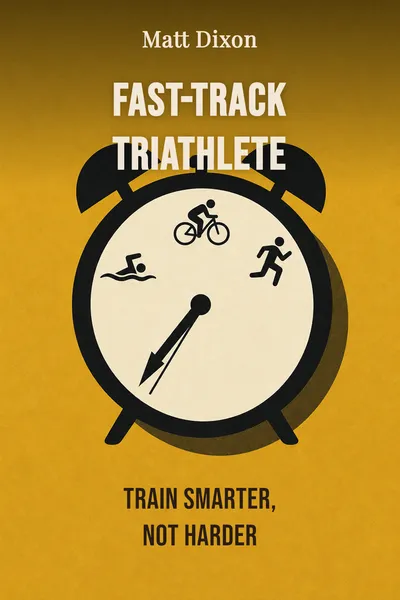
Fast-Track Triathlete
Train smarter, not harder
Description
There is a familiar figure in the endurance world: the amateur triathlete who works a full day, has a family, sleeps too little, and still decides to sign up for an Ironman. The logic they reach for is almost always the same — more. More hours in the pool, more miles on the bike, more early alarms stolen from an already thin margin of sleep. The training plan swells until it collides with the rest of the life, and something breaks. Usually it is the athlete. Matt Dixon, a former professional triathlete turned coach who founded the training company Purple Patch Fitness, spent years watching exactly this pattern play out among the executives, parents and time-starved amateurs he coached in San Francisco.
His book "Fast-Track Triathlete" starts from a blunt premise: most age-group athletes do not have twenty hours a week to train, and the good news is they never needed them. Dixon argues that the sport has been quietly captured by a volume mindset borrowed from full-time professionals, then sold to people whose lives look nothing like a pro's. The result is a lot of tired, over-trained, under-recovered amateurs who plateau, get injured, or quit — convinced they simply lacked the discipline to do more.
The counter-proposal is not a shortcut in the lazy sense. It is a reordering of what actually produces fitness when time is scarce. Dixon's athletes trained roughly eight to twelve hours a week and still reached the finish line of long-course races, sometimes faster than peers logging nearly double. The book is the method behind that claim, and the reason it holds together.
The question we’re asking : How does an amateur with a job and a family train for a long-distance triathlon without letting the training swallow the rest of the life?What we’ll see : Dixon's case for treating limited time as an advantage rather than a handicap — and the method that makes it work.
Table of contents
01Chapter 1 — The busy athlete has a schedule, not an excuse
Dixon opens by refusing the two stories busy athletes usually tell themselves. The first is that they can't really train seriously because life is in the way. The second, more dangerous, is that they can train like a professional if they just grind harder. Both are wrong, and both come from the same mistake — measuring training by hours accumulated rather than by adaptation produced. A professional trains twenty-five hours a week because their whole day is built around it: they sleep nine hours, nap in the afternoon, eat on a schedule, and have nothing more taxing to do than recover. Copy their volume without their life, and you get the workload with none of the support.

02Chapter 2 — The four pillars nobody wants to hear about
The heart of Dixon's system is that training is only one of four things that make an athlete, and it is not even the most neglected. He talks about four pillars: endurance training, recovery, nutrition, and functional strength. Amateurs obsess over the first and treat the other three as optional extras to be squeezed in if time allows. Dixon flips this. For the time-starved athlete, the pillars everyone ignores are precisely the ones that unlock the training they're already doing.
Recovery gets the sharpest treatment. Fitness, he insists, is not built during the workout — it is built afterward, when the body absorbs the stress and adapts. Skip the recovery and the stress just accumulates as fatigue, which the athlete then misreads as a sign they aren't working hard enough. So they add more, dig deeper, and stall. Sleep is the single most powerful recovery tool available, and it is free, and most amateurs sacrifice it first. Dixon treats a good night's sleep as a training session in its own right.
03Chapter 3 — Where the hours actually go
Once the pillars are in place, the question becomes how to spend the limited training hours themselves. Dixon's answer is unfashionable in a sport that romanticizes suffering: most of the training should be genuinely easy, and a small, precise portion should be genuinely hard. The trap that catches most amateurs is the gray middle — sessions ridden or run at a moderate, uncomfortable pace that feels like work but is too hard to build endurance and too easy to build speed. It accumulates fatigue without accumulating benefit.
So Dixon splits the week deliberately. The bulk of the volume goes into aerobic work at a conversational effort — the pace that builds the deep endurance base a long-course race demands, done easily enough that it doesn't cost much recovery. Then a couple of key sessions each week carry the real intensity: focused, high-quality efforts where the athlete pushes hard because the rest of the week left them fresh enough to do so. Fresh legs make hard sessions count; tired legs turn them into just more gray middle.
04Chapter 4 — The athlete who fits a life
Step back from the swim sets and the sleep charts, and "Fast-Track Triathlete" is really an argument about performance under constraint — one that reaches well past triathlon. Dixon's core insight is that limitation, far from being the enemy of excellence, is often what makes excellence legible. When time is unlimited, the temptation is always to do more, and doing more feels virtuous even when it produces nothing. Scarcity strips that comfort away. It forces the uncomfortable question the abundant athlete never has to face: of everything I could do, what actually matters?
That question turns out to be the productive one. The busy triathlete who can only train ten hours a week is compelled to distinguish the sessions that build fitness from the ones that merely feel like effort, the recovery that enables adaptation from the grinding that just adds fatigue. The pro with unlimited time can hide inefficiency inside sheer volume. The amateur cannot hide anything, and that exposure is precisely what makes the amateur's training sharper once they stop apologizing for it.
05Conclusion
The busy triathlete from the opening — the one reaching for more hours and breaking under them — is exactly who Dixon wrote the book to rescue. His answer isn't to lower their ambitions but to redirect their effort: fewer hours, spent better; the ignored pillars of recovery, fuel and strength taken as seriously as the workouts; the gray middle abandoned in favor of easy volume and sharp, well-rested intensity. Eight to twelve honest hours, protected by a sustainable life, turn out to carry an amateur to a long-course finish line more reliably than twenty ragged ones ever could.