Faces of the Enemy
How propaganda poisons the mind
Description
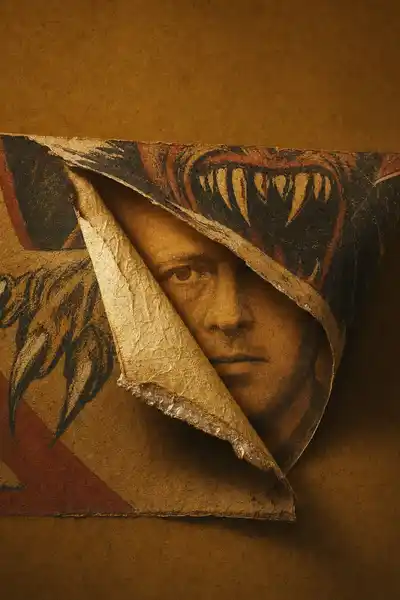
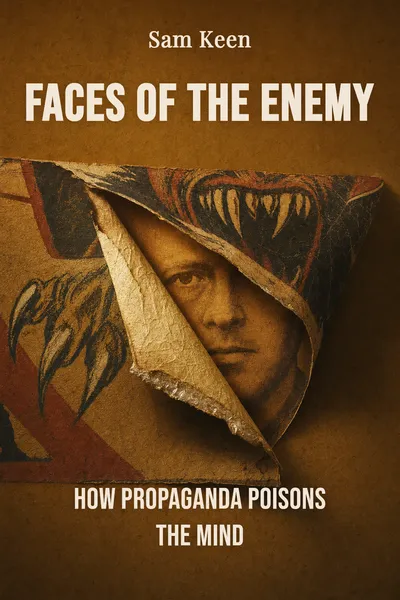
Before the first shot, there is a picture. In the early 1980s, a former Presbyterian minister turned philosopher named Sam Keen began collecting war posters, political cartoons, and recruitment art from across the twentieth century — American, German, Soviet, Japanese, propaganda from every side of every conflict he could find. Laid side by side, the images told a story their makers never intended. The enemy in a Nazi poster and the enemy in an Allied one looked strikingly alike: the same fangs, the same grasping claws, the same reduction of a human face into something less than human. Keen turned the collection into a book, published in 1986, that argued something unsettling — that we draw the enemy long before we meet him, and that the drawing comes from inside us.
Keen was not a military historian, and this was not a book about who started which war. He was a student of Carl Jung and of the philosophy of religion, and what interested him was the machinery underneath the grievances — the recurring cast of monsters that human societies conjure whenever they prepare to kill. Barbarian, rapist, beast, insect, death itself: the same figures return across centuries and continents, regardless of the actual quarrel. Ordinary people, decent neighbours, churchgoers and family men, look at these images and feel not horror but permission.
That is the disturbing core of the book. Enmity, for Keen, is not primarily a response to a real threat. It is a psychological act we perform first, and then find reasons for. The propaganda poster does not manufacture hatred from nothing; it releases something already waiting, and gives it a face to land on. Understanding how that face gets drawn is the closest thing we have to understanding how ordinary people become willing killers.
The question we’re asking : How do ordinary, decent people come to hate and kill their neighbours — and what role do the images we make of the enemy play in that transformation?What we’ll see : How a lifetime of war posters reveals a shared psychological machinery of enmity, and why Keen locates its source not in the world but in the mind.
Table of contents
01 Chapter 1 — The war starts in the imagination
Keen's first move is to reverse the order we assume. We tend to believe that hostilities produce hostile feelings — that we hate the enemy because he attacked us, and the ugly images come afterward, as expressions of a hatred already earned. Keen's collection suggests the opposite sequence. The dehumanizing image comes first, or at least does the crucial work first. Before a nation can send its sons to kill strangers, it has to perform an act of imagination: it has to redraw those strangers as something that can be killed without guilt.
This is why he calls the enemy a creation before he is an antagonist. A soldier cannot easily shoot another human being who looks like his brother, prays as his mother prayed, loves his own children. So the propaganda apparatus goes to work erasing exactly those resemblances. The enemy's face is coarsened, his eyes turned reptilian, his body made hairy or scaled or swollen. What remains is a target, not a person. Keen argues that this transformation is a precondition of organized violence, not a byproduct of it.

02 Chapter 2 — The bestiary of the enemy
From his archive Keen draws out a recurring cast — a bestiary of hostile imagination that repeats across wars with almost liturgical regularity. The enemy appears first as the barbarian, the horde at the gates, faceless and numberless, threatening not just lives but civilization itself. He appears as the rapist, coming for our women, a figure that fuses the fear of violation with the call to protect. He appears as the beast: the ape, the reptile, the predator whose killing carries no moral weight because beasts are not moral beings.
Then the images grow smaller and more chilling. The enemy becomes vermin — the rat, the insect, the germ. This is the most dangerous transformation of all, because vermin are not fought, they are exterminated. Once a people has been drawn as lice or as a spreading infection, the language of hygiene replaces the language of war, and mass killing can present itself as sanitation. Keen is unflinching about where this figure led in the twentieth century, and about the fact that it appears in the propaganda of every side, not only the ones history condemns.
03 Chapter 3 — Why the mind needs a devil
Having laid out the images, Keen turns to the harder question: why do we make them at all? His answer draws on Jung and on the psychology of projection. Every person, and every society, carries a shadow — the parts of ourselves we cannot bear to acknowledge: our own aggression, cruelty, greed, and lust. These impulses do not vanish when we refuse to own them. They go looking for somewhere else to live. The enemy is where they move in.
Projection is the mechanism. We take what we deny in ourselves and see it, vividly, in the other. The nation convinced of its own peaceful innocence is precisely the nation most in need of an enemy who embodies violence, so that its own aggression can be exercised while feeling like self-defence. The cruelty we cannot admit becomes the enemy's defining trait. In this reading, the enemy's face is a self-portrait we refuse to recognize — a mirror held up at arm's length and mistaken for a window.
04 Chapter 4 — The paranoid loop we can name but not leave
Step back from the individual images and Keen's larger claim comes into focus: enmity is a structure, and it runs mostly beneath awareness. He describes what he calls the paranoid loop, a self-sealing cycle in which our hostile image of the enemy provokes hostile behaviour in us, which provokes real hostility in them, which then confirms the image we started with. The picture in our heads reaches out and manufactures the reality that proves it right. By the time the shooting starts, both sides can point to genuine wounds, and each experiences itself as the reasonable party defending against a monster.
The unsettling consequence is that fact-checking the enemy is not enough. If enmity arose only from misinformation, better information would dissolve it. But Keen has located the source further down, in the psychology of projection, where the image serves the maker before it describes anyone. You can prove that the enemy does not have fangs, and the mind will simply supply a subtler monster. The work Keen points toward is not primarily political but inward: the reclaiming of the shadow, the willingness to recognize in ourselves the very aggression and cruelty we have been assigning to the other.
05 Conclusion
Keen's collection of posters ends where it began, with a shelf of images that were meant to move populations to war and instead exposed the mind that made them. Set beside one another, stripped of their captions, they stop being reports on distant enemies and become a single portrait of the human interior. The barbarian, the beast, the vermin, the devil: not observations of the world, but the recurring dream a frightened species has about itself, projected outward until it hardens into a target.
Related books