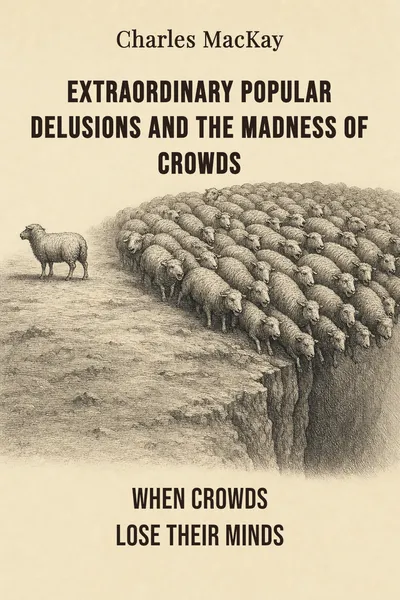
Extraordinary Popular Delusions and the Madness of Crowds
When crowds lose their minds
Description
In 1841, a Scottish journalist named Charles MacKay published a sprawling three-volume book with a title almost as long as its ambition: Extraordinary Popular Delusions and the Madness of Crowds. MacKay was in his mid-twenties, a working newspaperman with a taste for songs, history, and the strange corners of human behavior. What he assembled was less an argument than a gallery — a walk through centuries of moments when large numbers of otherwise sensible people had, all at once, believed something absurd, chased something worthless, or feared something that did not exist. The book has never gone out of print since.
He did not invent the phenomena he described. The tulip frenzy, the great financial schemes of Paris and London, the witch trials, the alchemists, the fortune-tellers — all of it was on the historical record already. What MacKay did was line them up side by side, so the reader could see the shape they shared. Read one bubble and it looks like an accident. Read a dozen, told in his dry and slightly amused voice, and they start to rhyme. That juxtaposition is the whole method, and it is why the book outlived the events it catalogues.
The volumes have had an odd afterlife. Bankers press copies on new analysts. Fund managers quote the line about men going mad in herds and recovering their senses slowly, one by one. The book that a Victorian wrote partly to entertain became, a century and a half later, a fixture of financial reading lists — which raises the question of what exactly he was writing about, and whether the people quoting him have read past the tulips.
The question we’re asking : What did MacKay actually collect in these volumes, and why does a Victorian catalogue of follies keep landing on trading-desk bookshelves?What we’ll see : A walk through his gallery of manias — the money ones everyone cites and the stranger ones almost nobody mentions — and what the collection adds up to.
Table of contents
01 Chapter 1 — A Scottish journalist and a catalogue of folly
Charles MacKay was born in Perth in 1814 and made his living the way an energetic Victorian man of letters did: newspapers, poetry, popular songs, histories written at speed for a broad audience. He was not a philosopher and did not pretend to be. When he sat down to write about popular delusions, his instinct was a reporter's instinct — collect the cases, tell each one well, let the reader draw the pattern. The result reads less like a treatise than like a very long, very good dinner-table monologue from someone who has read everything.
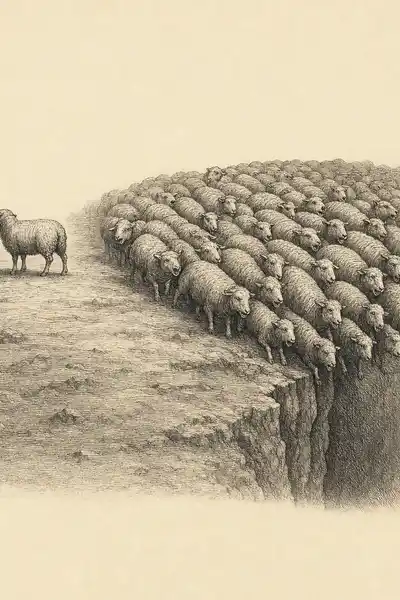
The organizing idea, such as it is, sits in his preface and never really leaves. People, MacKay writes, go mad in herds while they recover their wits slowly, and one at a time. The line has become the book's brand, quoted far more often than anything else in it. But he is careful not to over-theorize. He does not offer a mechanism, a formula, or a cure. He offers instances, and trusts that after enough of them the reader will feel the recurrence in their bones.

02 Chapter 2 — Three bubbles that ended the same way
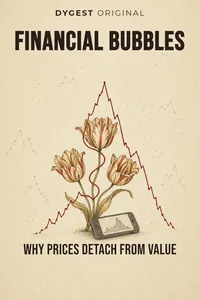
The financial chapters are the ones that made the book famous, and the most quoted is the tulip mania of the 1630s in the Dutch Republic. Rare tulip bulbs, MacKay recounts, became objects of frantic speculation, changing hands at prices that could rival a house, traded by people who had no interest in flowers and every interest in selling the bulb on for more. Then, almost overnight, buyers vanished, prices collapsed, and fortunes evaporated. Modern historians have picked at his figures and argued the frenzy was narrower than he made it sound. What survives is the arc he drew.
His larger set pieces are the Mississippi Scheme and the South Sea Bubble, both around 1720. In France, the Scotsman John Law persuaded a whole nation to pour money into a company built on the promise of wealth from Louisiana, backed by a new paper currency and Law's own dazzling confidence. In England, the South Sea Company promised riches from trade it could barely conduct, its shares climbing on nothing but the certainty that they would keep climbing. MacKay lingers on the crowds — the traders spilling into the streets, the aristocrats and servants alike convinced they had found the sure thing.
03 Chapter 3 — When the delusion had nothing to do with money
Read only the opening chapters and it is easy to file MacKay under finance. But the money manias are a minority of the book. Far more of it deals with delusions where nobody was trying to get rich at all, and this is the part the trading-desk readers tend to skip. His crowds do not only chase profit. They chase salvation, revenge, secret knowledge, and safety from invisible threats.
He devotes long stretches to the witch trials that swept across Europe, in which communities convinced themselves that their neighbors were servants of the devil and put thousands to death on evidence that amounted to fear feeding on fear. He walks through the slow-poisoning panics, the alchemists who spent lifetimes and patrons' fortunes chasing the transformation of metal into gold, and the fortune-tellers and prophets who found eager audiences whenever anxiety was high. He recounts the Crusades as a form of continental mania, and lingers on smaller crazes — haunted houses, dueling fashions, the popular obsession with the beards and hairstyles of the powerful.
04 Chapter 4 — The crowd is older than the market
This is where MacKay's book quietly resists the use it has been put to. Investors adopted him as a prophet of bubbles, and he is one, but the volumes are not really about markets. They are about a recurring human condition: the moment when a person stops thinking as an individual and starts thinking as a member of a mass. The tulips and the South Sea shares are two exhibits in a much larger case, and the case is that the crowd predates and outlives any particular thing it happens to be excited about.
That framing helps explain why the book has aged the way it has. Later thinkers built more systematic accounts of the same terrain — Gustave Le Bon on crowd psychology, later economists on manias and panics, modern work on herd behavior and information cascades. Much of it is more rigorous than MacKay, who got dates wrong and figures inflated and never tested a claim he could not narrate well. Yet the plain observation at the center has held up better than his details. People are more reasonable alone than in groups, and the group can persuade itself of almost anything if the persuasion moves fast enough.
05 Conclusion
Charles MacKay went on to a long, busy Victorian career — more histories, more songs, a stint as a correspondent covering the American Civil War, a life of mixed fortune that included some financial reversals of his own. He died in 1889, and the book he had written as a young man, half as entertainment and half as instruction, quietly became the thing he is remembered for. Its details have been corrected and its stories retold, but the gallery he assembled still works exactly as he intended: line up the follies, and they begin to rhyme.
Related books