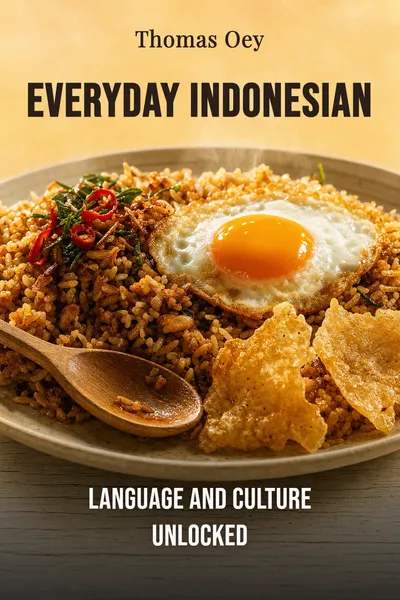
Everyday Indonesian
Language and culture unlocked
Description
Picture the moment most travelers know: a warung by the road in Yogyakarta, a plate of nasi goreng in front of you, and a shopkeeper waiting while you point, smile, and hope the gesture does the work language won't. Indonesia makes that moment gentler than most places. With more than 270 million people spread across some 17,000 islands and hundreds of local tongues, the country runs on a shared national language — Bahasa Indonesia — that was deliberately built to be a bridge. It's one of the more learnable languages a newcomer can pick up. No tones, no genders, no verb conjugations to memorize. And yet most visitors still arrive with nothing but a smile.
Thomas Oey's Everyday Indonesian sets out to close that gap, and it does so with an ambition wider than its pocket size suggests. It isn't only a list of phrases to survive a taxi ride or a hotel check-in. It's an illustrated introduction to how the language works, why it works that way, and what the culture behind it expects of the people who speak it. The premise is quietly radical for a travel companion: that you can't really separate the words from the world they come from.
That's the thread worth pulling. A phrase you memorize is a transaction. A phrase you understand is an invitation. Oey's book keeps insisting that the difference matters — that the same handful of syllables lands completely differently depending on whether you know what they carry.
The question we’re asking : Can a compact phrase book actually teach not just what to say in Indonesia, but how to be received there?What we’ll see : How Oey turns a travel companion into a door into the language and the culture standing behind it.
Table of contents
01Chapter 1 — A phrase book that refuses to stay a phrase book
Most phrase books are built for emergencies. They assume you'll open them in a panic — at a ticket counter, a pharmacy, a police station — find the line you need, read it aloud badly, and snap the book shut. Everyday Indonesian is organized around a different assumption. It assumes you're curious, not just cornered. The phrases are there, grouped the way you'd expect: greetings, directions, food, shopping, numbers, getting sick, getting help. But between them, Oey keeps stopping to explain why a phrase is shaped the way it is.
The illustrations do real work here. This isn't decoration dropped in to break up the columns of vocabulary. Objects, gestures, and scenes are drawn so that a word attaches to an image rather than to an English translation. You learn the Indonesian for a becak — a three-wheeled pedicab — by seeing one, not by mapping it onto a word you already have. That matters more than it sounds, because a lot of everyday Indonesian life doesn't line up neatly with Western equivalents, and translation quietly flattens the things that don't fit.

02Chapter 2 — How the language actually works
Part of what makes Bahasa Indonesia so approachable is that it strips away the machinery English speakers spend years wrestling with in other languages. There are no verb tenses to conjugate — you signal time with a small word like sudah (already) or akan (will), and the verb itself never changes. Nouns have no gender. There are no articles agonizing over the and a. Plurals are often just context, or, when you need to be explicit, the noun doubled: buku is book, buku-buku is books. The reduplication trick turns up everywhere, and once you notice it, the language starts to feel almost transparent.
Pronunciation is the other gift. Indonesian is written in the Latin alphabet, and it's largely phonetic — letters mostly do what they look like they should. Oey walks through the handful of sounds that trip people up, like the c that lands closer to ch, so that a reader can approximate real speech without a teacher standing by. For a traveler, this is the payoff: you can read a sign, a menu, a street name aloud and be roughly understood, which is not something you can say for many languages a visitor meets for the first time.
03Chapter 3 — Words that carry a whole worldview
Some words in Everyday Indonesian can't be translated cleanly, and those are the ones Oey lingers on. Take the constellation of terms around hospitality and respect. Indonesian has a rich system for addressing people — bapak and ibu, roughly sir and ma'am but closer to father and mother, extended warmly to strangers who are older or deserving of deference. You don't call a shopkeeper by a neutral pronoun; you place them in a web of relationships, and the word you choose says how you see them. Getting this right is not politeness in the decorative sense. It's the price of entry to an easy conversation.
Then there's the famous jam karet — literally rubber time — the elastic relationship to punctuality that visitors either learn to accept or spend their whole trip resenting. Oey presents it not as a stereotype to chuckle at but as a genuinely different sense of how appointments and obligations flex around people. A phrase book that only gave you the words for early and late would leave you baffled the first time a meeting drifted. Understanding jam karet is the difference between feeling disrespected and feeling at home.
04Chapter 4 — The traveler who becomes a guest
Step back from the individual phrases and Everyday Indonesian is making a larger claim about what a little language can do. The gap between a tourist and a guest is small in effort and enormous in effect. A visitor who points and pays is served. A visitor who says selamat pagi, asks a question in halting Indonesian, and uses the right word for the person in front of them is received. The book bets that most travelers would rather be received, and that they underestimate how little it takes to cross that line.
This is why the compact size is almost a philosophy rather than a limitation. Oey isn't trying to make anyone fluent — fluency isn't the goal and never was. The goal is enough. Enough to signal respect, enough to open a door, enough to turn a transaction into a moment where two people actually meet. In a country as vast and various as Indonesia, where a single traveler will never learn all the local languages layered beneath the national one, the shared tongue is precisely the tool designed for that meeting. Learning even a fragment of it is a way of accepting the invitation the language was built to extend.
05Conclusion
Come back to that warung by the road. The version of the traveler who arrived with nothing but a smile still eats well, still pays, still leaves. But the version who spent an hour with Everyday Indonesian on the plane leaves differently — having called the cook ibu, having stumbled through a compliment about the food, having learned that the bargaining was never a fight. Same meal, entirely different encounter. That's the whole wager of the book compressed into one small scene.
Related books