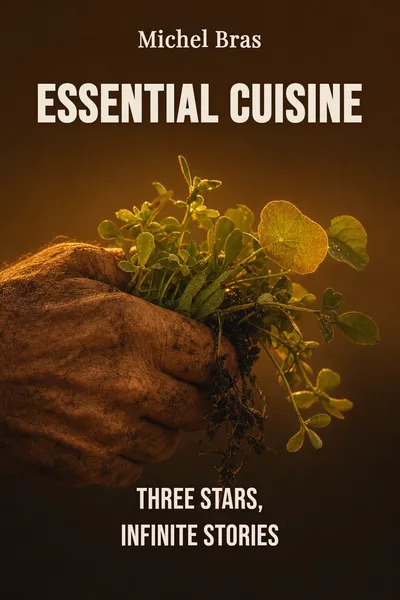
Essential Cuisine
Three stars, infinite stories
Description
There's a road in the Aubrac, in the south of the Massif Central, that climbs onto a high, treeless plateau where the wind moves through the grass and the light changes every ten minutes. At the top of it, near Laguiole, sits a low glass building that seems to have grown out of the basalt. It's called Le Suquet, and for decades it held three Michelin stars. The man who built it, Michel Bras, grew up a few kilometers away, in a modest hotel-restaurant run by his mother, Angèle, in the village. He learned to cook in her kitchen before he learned to cook anywhere else. Essential Cuisine is the book he wrote about all of it — not a manual, not quite a memoir, but something closer to a long letter about where food comes from.
What surprises about the book is how little it behaves like the work of a three-star chef. There are recipes, yes, and they are exacting. But the plates keep dissolving back into something else: a childhood walk, the smell of a particular herb crushed underfoot, the memory of his father's hands, a specific quality of morning cold on the plateau. Bras writes as if the cooking were almost secondary — a way of holding on to a place and the people in it. The famous dishes are here, but they arrive wrapped in weather and biography.
That's the tension the book lives inside. A restaurant that draws people from across the world, awarded the highest honors the profession gives, run by a man who insists that everything he does is only the Aubrac speaking through him. It raises a question that goes well past one kitchen in the middle of France.
The question we’re asking : How does a chef turn a specific patch of ground — its plants, its light, its people — into food that strangers travel across continents to taste?What we’ll see : We follow Bras from his mother's kitchen to the glass room on the plateau, through the dish that made him, and into what his cooking says about who really writes a plate.
Table of contents
01Chapter 1 — A plateau, a boy, and a plate of vegetables
Michel Bras was born in 1946, and the first kitchen he knew was not his own. It belonged to his mother, Angèle, who ran the family hotel-restaurant in Laguiole with the steady, unshowy competence of someone feeding travelers and locals every day. Bras writes about this kitchen the way other people write about a first language. He absorbed its rhythms before he could name them — the way a stock is watched, the way bread is handled, the way you don't waste. He never trained in a grand Parisian house, never did the classic apprenticeship under a famous name. His formation was Angèle, the village, and the plateau above it.
The Aubrac itself does most of the work in these early pages. Bras describes walking it as a boy: the cold, the granite, the wild plants he learned to recognize by smell and taste long before he thought of putting them on a plate. There's a tenderness in the way he returns to these walks. They're not scenic backdrop — they are, in his telling, the actual source of everything that came later. The herbs he would build famous dishes around were first just things underfoot, part of a landscape he loved without analyzing.

02Chapter 2 — The gargouillou, and the day the plate went quiet
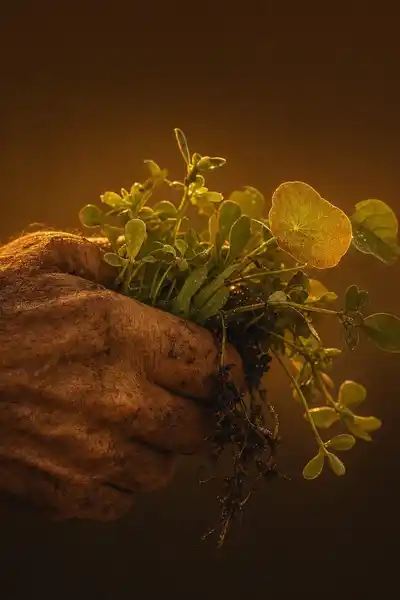
The dish that made Bras famous has an odd, gurgling name: the gargouillou. In its fully realized form it is a composition of dozens of vegetables, young shoots, herbs and edible flowers — sometimes fifty or sixty elements — each cooked or dressed to its own logic and arranged on the plate as a kind of edible landscape. It looks, deliberately, like a patch of the Aubrac in miniature. Bras conceived it, by his account, in the late 1970s, on one of his walks, seized by the feeling that he wanted to put the plateau's spring vegetation onto a plate more or less as it was.
What's striking in the book is how unheroic he makes the invention sound. There's no eureka scene staged for effect. He describes a physical sensation, a longing to translate what was around him, and then years of patient work to make it hold together as food rather than decoration. The gargouillou is not a trick. Each element has to taste of itself and belong to the whole. The difficulty is enormous and almost invisible, which is exactly how Bras seems to want it.
03Chapter 3 — Aubrac is the recipe
The middle of the book keeps circling one insistence: the Aubrac is not a supplier of ingredients, it is the thing being cooked. Bras writes about specific plants — the ones with sharp green bitterness, the ones that taste of anise or hay or cold — as if introducing members of a family. He knows where they grow, when, in what soil and weather. This isn't romantic vagueness. It's a working knowledge accumulated over a lifetime of walking the same ground, and it's the reason his food can't simply be reproduced somewhere else by following a list.
Le Suquet, the restaurant he built in 1992 on the plateau above Laguiole, is part of the argument. The building is glass and stone, low and quiet, angled so the plateau is always visible from the tables. You eat looking at the landscape that's on your plate. Bras designed it, with his family, so there would be no gap between the food and its origin. The dining room doesn't decorate the cooking; it points at where the cooking comes from. It's the same gesture as the gargouillou, made in architecture.
04Chapter 4 — When a place cooks the cook
Step back from the individual dishes and the book is making a larger claim about where cooking of this kind actually comes from. We tend to read a great restaurant as the expression of a great chef — a talent that could, in principle, set up anywhere and produce the same brilliance. Bras spends a whole book quietly refusing that reading. His cooking is not portable. Move it off the Aubrac and something essential leaks out, because the landscape isn't the raw material of the plates; it's their co-author.
That reframing changes what the chef is for. If the place is already saying something — through its plants, its seasons, its light and cold and wind — then the cook's job is closer to translation than creation. The skill is in listening well: knowing which vegetable is at its brief peak, knowing when to stop adding, knowing how to arrange things so the plateau comes through rather than the technique. Bras is exacting precisely because bad translation buries the original. The restraint he preaches is the discipline of a translator who refuses to overwrite the text in front of him.
05Conclusion
The book ends more or less where it began: on the plateau, in the wind, with a man who insists that everything he's known for was already there before he arrived. Le Suquet earned its three stars, drew visitors from every continent, and became one of the reference points of modern French cooking. Bras handed the kitchen to his son Sébastien in the 2000s and kept writing, kept walking, kept pointing at the ground. Essential Cuisine is his attempt to make that gesture legible — to explain why a plate of vegetables arranged like a spring meadow could carry a whole life.
Related books