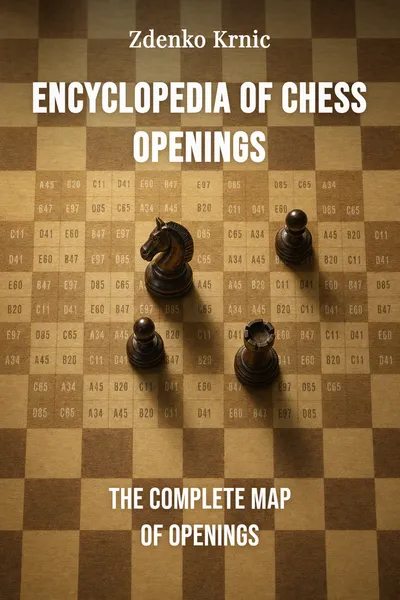
Encyclopedia of Chess Openings
The complete map of openings
Description
A serious chess game begins before either player has thought for themselves. The first ten or fifteen moves have, in most cases, been played thousands of times by other people — analyzed, refuted, revived, refined. A grandmaster in 2024 sitting down to a Sicilian is walking a path worn smooth by a century of predecessors, and the interesting question is not whether the path exists but how anyone keeps track of it. Opening theory is enormous. It is also, unusually for a body of knowledge, almost entirely a record of practice: not a set of principles handed down, but a sediment of games actually played.
The Encyclopedia of Chess Openings, edited under the direction of Zdenko Krnic and published in Yugoslavia by the Šahovski Informator team beginning in the 1970s, set out to do something that sounds impossible when stated plainly: catalogue all of it. Not the best openings, not a selection for beginners, but the whole landscape of what strong players had tried, organized so that any position could be located, compared, and studied. The result runs across five volumes and a coding system that has quietly become the common language of competitive chess.
What makes the project worth looking at is less any single line of analysis than the ambition behind the whole thing — the decision to treat the chaos of opening play as something that could be mapped, indexed, and made navigable. A reference work rarely changes the thing it describes. This one arguably did.
The question we’re asking : How do you take a body of knowledge as sprawling as chess opening theory and turn it into something a player can actually navigate?What we’ll see : How the encyclopedia organized the whole tree of openings, and what a shared map does to the game that uses it.
Table of contents
01Chapter 1 — The problem of remembering every first move
Before the encyclopedia, opening knowledge lived in scattered places. There were monographs on individual openings, columns in magazines, personal notebooks kept by players, and the accumulated memory of trainers who had seen a lot of games. A strong player knew a great deal, but that knowledge was private and uneven. Two masters studying the same variation might not even agree on what to call it, and comparing their conclusions meant translating between vocabularies that had grown up independently in different countries.
The scale of the problem is easy to underestimate. Chess has a modest number of legal first moves, but the tree branches fast. After a handful of moves by each side, the number of reasonable, seriously played positions runs into the tens of thousands, and each of those positions has been the subject of games whose outcomes carry information. The knowledge was not just large; it was constantly updated by new tournament play. Any attempt to write it all down risked being obsolete before it reached print.

02Chapter 2 — A code for the whole tree
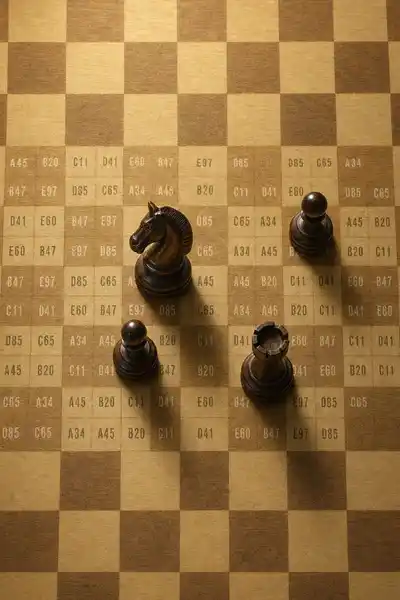
The organizing idea was a classification code, and its elegance is that it is almost brutally simple. Every opening was assigned a position in a grid of five letters, A through E, each letter subdivided into a hundred numbered slots from 00 to 99. Five hundred pigeonholes in total, and every serious opening variation could be filed into one of them. A player who learned the code could locate any position in the theory by a short label — a letter and two digits — the way a book sits at a call number on a shelf.
The five broad letters carve the tree at its base. Volume A gathers the flank openings and irregular first moves, the games that do not begin with the two central pawns. Volume B covers a large family of semi-open games, most prominently everything that follows the Sicilian and the French among Black's replies to the king's pawn. Volume C takes the open games and the rest of the king's-pawn replies, including the Ruy Lopez and the French proper. Volumes D and E handle the queen's-pawn openings, the closed and half-closed games, and the Indian defenses that dominate modern practice.
03Chapter 3 — What the letters actually classify
Inside each of the five hundred slots, the encyclopedia does the work that justifies its bulk. For a given variation it lays out the main line and the significant deviations, then hangs on that skeleton the evaluations drawn from practice — this move gives White a small edge, that one equalizes, this sideline is unclear. The assessments are expressed in the Informant's language of symbols, the same shorthand that lets a diagram of analysis be read across borders. A reader follows branches of the tree and sees, at each fork, what the accumulated evidence suggested.
The evaluations are not pulled from principle but from games. Behind a compact judgment sits a body of tournament practice, and the encyclopedia's authority comes from that grounding. It is a map drawn by walking the terrain, not by reasoning about how the terrain ought to look. That is why it needed contributors who were themselves strong players and analysts: someone had to decide which lines mattered enough to include and how honestly to assess the murky ones, and those decisions required real understanding rather than mere compilation.
04Chapter 4 — When a map starts shaping the territory
A reference work is supposed to describe its subject from the outside, leaving the thing itself untouched. The encyclopedia's classification did not quite manage that. Once the code existed, players began to think in it. A prepared line became, in a competitor's mind, a slot to be studied cold; a database of games could be sorted by the code; a trainer could assign homework by letter and number. The tool for navigating the theory quietly became part of how the theory was learned, discussed, and stored. The map started to shape how people moved through the territory.
The deeper effect was standardization of memory. Before a shared system, every serious player carried a somewhat idiosyncratic mental filing cabinet. Afterward, the profession converged on a common structure, and that convergence had consequences. It made preparation more transferable and more industrial — knowledge could be packaged and handed on rather than rebuilt by each generation. It also raised the baseline. When the accumulated state of a variation sits in a known place, being merely well-read in the openings stops being an advantage and becomes the entry price.
05Conclusion
The game still begins before either player thinks for themselves, but now the path they walk has been surveyed, labeled, and shelved. The Encyclopedia of Chess Openings took the sediment of a century of practice and turned it into something findable — five letters, a hundred slots each, an address for every fight that had been fought often enough to matter. What began as an extension of the Chess Informant's border-crossing notation became the common tongue of competitive opening study, revised edition after edition as the theory it described kept moving underneath it.
Related books