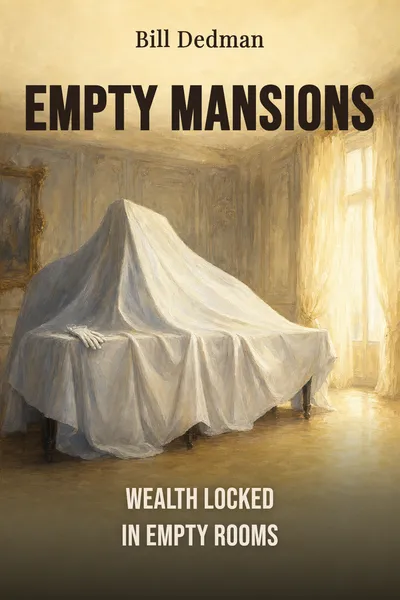
Empty Mansions
Wealth locked in empty rooms
Description
In 2009, a reporter named Bill Dedman was looking at houses online — idle browsing, the kind anyone does — when he came across a listing for a mansion in New Canaan, Connecticut, priced at around $24 million. The house had never been lived in. It belonged to a woman named Huguette Clark, then 103 years old, who had bought it decades earlier and had, as far as anyone could tell, never spent a single night there. She also owned an apartment on Fifth Avenue that ran to forty-two rooms, and an estate in Santa Barbara with an ocean view she had not seen in more than half a century. All of it sat empty, dusted and maintained by staff, waiting for an owner who was not coming.
Huguette Clark was the youngest daughter of William Andrews Clark, one of the richest men America ever produced — a copper magnate and U.S. senator whose fortune, at his death in 1925, rivaled the Rockefellers'. She had grown up in a 121-room house on Fifth Avenue, been painted by society artists, married briefly, divorced, and then, sometime in the middle of the twentieth century, simply withdrawn. By the time Dedman found her, she had lived for around twenty years in a plain hospital room, though she was not sick, while three fully staffed homes stood ready and unused.
Dedman's reporting, later written up with Clark's cousin Paul Clark Newell Jr., turned a real-estate curiosity into something stranger and more human. Here was a Gilded Age fortune that had survived intact into the age of email, held by a woman almost no one had seen in decades — and, waiting just offstage, a $300 million inheritance and the people circling it.
The question we’re asking : How does a woman with three mansions and a copper fortune end up choosing, for decades, a bare hospital room and near-total invisibility?What we’ll see : A fortune born in nineteenth-century Montana, the empty houses it bought, the strange retreat of the woman who inherited it, and the fight over what she left.
Table of contents
01Chapter 1 — A fortune dug out of Montana copper
To understand the empty rooms, we have to start with the man who paid for them. William Andrews Clark was born in Pennsylvania in 1839 and went west as a young man with nothing in particular to recommend him except appetite. He tried gold, then turned to something more useful: he lent money to miners, bought their claims when they failed, and worked his way into the copper deposits around Butte, Montana. Copper was about to become the metal that carried electricity into every home in America, and Clark owned a great deal of it.
By the turn of the century he was one of the wealthiest men in the country, with mines, banks, railroads, and a wire empire spread across several states. He also wanted, badly, to be a senator. In 1899 the Montana legislature elected him to the U.S. Senate amid such open bribery that the Senate refused to seat him — an episode so brazen that Mark Twain wrote that Clark was 'as rotten a human being as can be found anywhere.' Clark eventually got his seat a few years later, on a second try, and served a single unremarkable term.

02Chapter 2 — The rooms she paid for and never entered
Huguette married once, in 1928, to a man named William Gower, the son of her father's associate. The marriage lasted barely two years and was never, by most accounts, much of a marriage at all; they divorced in 1930, and she never married again. From there her life narrowed by choice. She kept the enormous Fifth Avenue apartment where she had settled with her mother, and she began, over the following decades, to acquire property with no apparent intention of using it.
There was Bellosguardo, the Santa Barbara estate she had inherited and rebuilt — a beautiful house on a bluff over the Pacific, staffed and maintained in perfect order for decades after she stopped visiting. She last set foot there in the early 1950s. Everything else was kept as if she might arrive tomorrow: the gardens tended, the rooms cleaned, the cars in the garage. The New Canaan house she bought in the late 1990s, sight unseen in the ordinary sense, seems to have been purchased as a possible refuge in case of some emergency that never came, and she never slept in it.
03Chapter 3 — Twenty years in a hospital she didn't need
Around 1991, Huguette Clark checked into a New York hospital with some skin problems that had gone untreated — she had let a couple of facial cancers develop far longer than she should have, out of her horror of being examined and seen. The medical issue was real and got fixed. But once inside, she did not leave. She stayed in the hospital, in a plain room, for roughly the last twenty years of her life, well into her second century, though she was not meaningfully ill for most of that time.
She could have gone home to any of three homes at any moment. She chose the hospital. It gave her what she seems to have wanted above everything: walls, routine, distance from the world, and a small circle of people who came to her rather than the reverse. She watched cartoons, kept up her French, worked on her miniatures, and spoke on the phone with a handful of relatives and advisers. Almost no one saw her face. She refused photographs. When Dedman went looking, he could barely find an image of her from the previous fifty years.
04Chapter 4 — The two hundred million left to the people around her
Clark died leaving an estate worth roughly $300 million, and two wills signed within about six weeks of each other in 2005 that said very different things. The first left much of the fortune to her distant relatives — grandnieces and grandnephews she barely knew. The second, signed weeks later, cut them out almost entirely and steered the money toward her nurse, her goddaughter, the hospital, her lawyer, her accountant, and a planned arts foundation at Bellosguardo. The relatives challenged it, arguing she had been unduly influenced by the very people who stood to gain. The case settled in 2013: the second will was largely set aside, the relatives received a substantial share, the nurse kept less than she had been promised, and the estate paid out.
Step back from the courtroom and the story stops being about one eccentric woman and becomes something about how great fortunes behave. Clark's money was made by a hard, ambitious, morally flexible man in the 1880s and 1890s, and it kept working long after he and his world were gone. It funded a life of near-total withdrawal for a granddaughter who did almost nothing to earn or spend it in any ordinary sense. A fortune like that does not simply pass down; it accumulates a gravity of its own, pulling in caretakers, advisers, institutions, and hopeful heirs, all orienting themselves around a person who has stopped participating in the world.
05Conclusion
The house in New Canaan that first caught Bill Dedman's eye eventually sold. So did the Fifth Avenue apartments and, in time, the plan for Bellosguardo took shape as the arts foundation Clark had wanted, opening the Santa Barbara estate to the public she had spent her life avoiding. The dollhouses and dolls were catalogued and dispersed. The relatives got their share; the nurse kept a fraction of what she'd been given; the paintings her father bought by the crateload went to auction. A century after William Andrews Clark dug his fortune out of Montana, it finally scattered.
Related books