Elements
The building blocks of everything
Description
Somewhere in a barn in rural Illinois, Theodore Gray keeps a wooden periodic table with a hollow compartment under each square. Inside those compartments sit the actual things: a curl of sodium under oil, a nugget of gold, a vial of bromine the color of dried blood, a lump of the man-made metals that exist for fractions of a second before they blink out. Gray built the table himself, then spent years filling it. What began as a woodworking project turned into one of the most complete private collections of the chemical elements in the world, and eventually into a book.
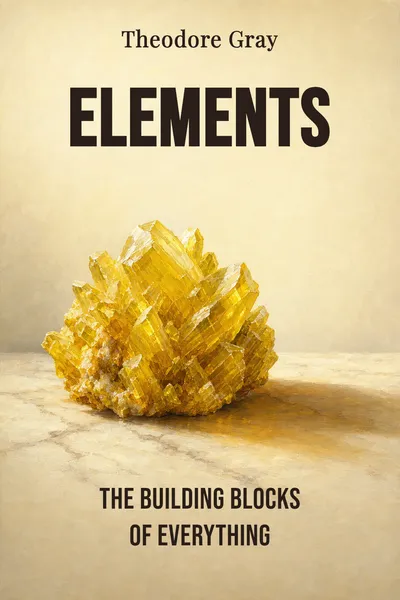
That book, first published in 2009, is called The Elements, and it has since sold well over a million copies worldwide and been translated into dozens of languages. It is a strange object for a bestseller — no plot, no argument, no self-help. Just 118 elements, one at a time, each photographed against a plain black background with a clarity that makes iron look like treasure and sulfur look like something you'd want to hold. Gray, a software guy by trade who co-founded Wolfram Research, made the whole thing feel less like a textbook and more like a museum you could carry.
Most of us met the periodic table as a wall poster to be endured — a grid of abbreviations to memorize before a test and forget after. Gray's book treats that same grid as a catalog of physical stuff, every square a real substance you could weigh in your hand, most of which is quietly running the world around us. It's the difference between reading a menu and eating the meal.
The question we’re asking : How does a book turn the most intimidating chart in science into something we actually want to look at?What we’ll see : How Gray built his collection, why he tells the table as a story of real matter, and what it changes to hold an element rather than name it.
Table of contents
01Chapter 1 — The photographer who wanted the real thing
Gray did not set out to write a chemistry book. He set out to build a piece of furniture. Around 2002 he made a wooden table shaped like the periodic table itself, with a little cavity beneath every element's square, meaning to display samples the way a naturalist might display beetles. Then he discovered that once you have 118 empty boxes, you develop an itch to fill them. Collecting became the obsession, and the collecting is what the book is really made of.
Filling the boxes is harder than it sounds, and this is where Gray's story gets its texture. Some elements you can buy — copper, tin, a bar of bismuth grown into rainbow crystals. Some you scavenge: mercury from an old thermometer, tungsten from a light-bulb filament, carbon in the form of a diamond or a pencil lead. Some are radioactive and shipped in tiny sealed amounts. And a handful, the synthetic heavyweights at the bottom of the table, can never be collected at all, because they exist for a heartbeat in a particle accelerator and then are gone. Gray photographs a stand-in or an equation instead, and admits the gap.

02Chapter 2 — The table read as a story, not a chart
The periodic table has an order, and most of us never learn to read it. It runs left to right, top to bottom, by increasing number of protons — hydrogen with one, helium with two, all the way to the synthetic giants past a hundred. Gray takes that sequence literally and walks it element by element, so the book has a spine even though it has no plot. You start at the lightest, most abundant stuff in the universe and end at things humans had to invent, and the walk itself tells a story about what matter can be.
But Gray refuses the textbook's flatness. Each element gets its own spread and its own voice. He tells you that gallium melts in your hand, that it was once used for a classic prank — a spoon that dissolves in hot tea. He tells you which element makes fireworks green and which makes them red, why the filament in an old bulb is tungsten, why we stopped putting lead in paint and gasoline. The chemistry arrives smuggled inside anecdote, so you absorb the properties without feeling lectured.
03Chapter 3 — Where the elements actually live
One of Gray's quiet arguments is that the elements are not confined to a laboratory. They are in the room with you right now. The tungsten glowing in a heater, the silicon in the phone, the neon in a bar sign, the potassium in a banana, the titanium in a bike frame or a hip replacement — the book keeps pointing outward from the black-background sample to the ordinary place you'd actually encounter the stuff. Each element earns its keep somewhere in daily life.
This is where the collector's eye pays off. Because Gray sources his samples from the real world rather than a chemical supplier, his examples are objects, not abstractions. Neodymium becomes the absurdly strong magnet in your headphones and your hard drive. Helium is the gas that makes voices squeak and also the coolant that lets hospital scanners work. Chromium is what gives a mirror-shine bumper its shine. The element and its use are photographed as the same fact, so you never quite separate the science from the thing on the shelf.
04Chapter 4 — What a collection knows that a formula doesn't
Step back from the individual pages and the whole project starts to look like a claim about how we come to trust matter. Chemistry, as most of us receive it, is symbols and equations — a language about substances we never actually meet. Gray's wager is that a symbol is a poor substitute for a sample. His book keeps insisting on the object itself: the weight of it, the color of it, the fact that it once sat in a compartment in a barn in Illinois. Knowing an element and holding one turn out to be different kinds of knowledge.
There is something almost old-fashioned in this, and deliberately so. Gray belongs to a lineage of collectors and cabinet-makers who believed the way to understand the world was to gather pieces of it and lay them out in order. The periodic table is arguably the most successful ordering scheme in the history of science — a grid that predicted elements before anyone found them. Gray takes that intellectual triumph and makes it tactile, as if to say the order only becomes real once you can point to the thing in each box.
05Conclusion
The wooden table in the barn is still there, its compartments mostly full, a few of them holding stand-ins for elements no one can keep. From that homemade cabinet came a book that did what no poster on a classroom wall ever managed: it made people want to linger over the periodic table, square by square, the way you'd wander a museum with no rush to leave. The samples on black, the tea-spoon that melts, the murder-weapon poisons and the invented metals — all of it adds up to a portrait of matter as a collection rather than a curriculum.
Related books