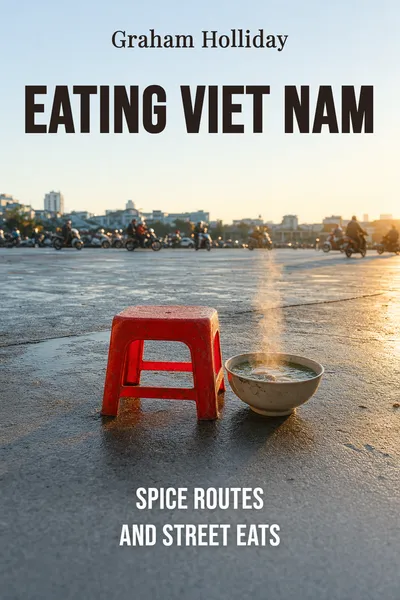
Eating Viet Nam
Spice routes and street eats
Description
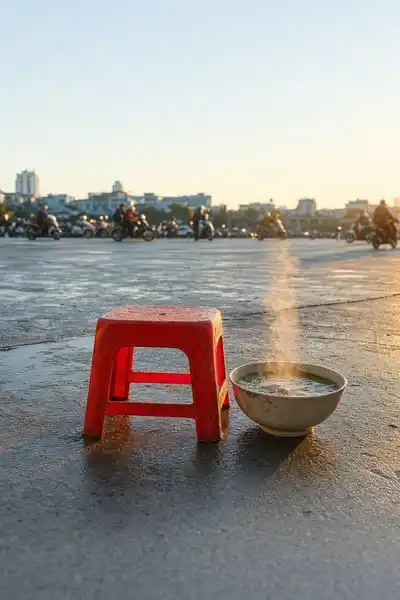
Sometime in the mid-1990s, a young Englishman named Graham Holliday moved to Viet Nam to teach, sat down on a low plastic stool on a Hanoi sidewalk, and ordered a bowl of pho he could barely name. He didn't speak the language. He didn't know what most of the herbs on the plate in front of him were, or which sauce went where, or that ordering the wrong cut would mark him instantly as a clueless foreigner. What he had was a stubborn conviction that the real food of a country was never in its restaurants. It was on the street, in the alleys, at the stall run by one woman who had made the same single dish, the same way, for thirty years.
Out of that conviction came years of eating — and eventually a blog, and eventually a book. "Eating Viet Nam" is the record of a man who decided that the fastest way to understand a place was through his stomach, and who was willing to eat things most travellers would photograph and quietly leave untouched. Coagulated blood soup. Dog. Fermented shrimp paste that clears a room. Balut, the duck embryo eaten from the shell. Holliday ate it all, not to shock but because refusing felt like refusing the country itself.
The book carries a foreword by Anthony Bourdain, which tells you the register it is aiming for: hungry, curious, allergic to the polished travel-guide voice. It is less a guide to Vietnamese cuisine than a portrait of one obsessive appetite loose in a country that rewards it. And it keeps circling a quieter question underneath the noodles.
The question we’re asking : Can a foreigner actually eat his way into a country, or does the plate always keep him at arm's length?What we’ll see : One appetite, a decade of street stalls, and the pleasures and limits of learning a place through what it feeds you.
Table of contents
01Chapter 1 — The plastic stool and the pho that started it
The book opens on a fixation. Before Viet Nam, Holliday had already caught the bug in other Asian cities — the sense that the food worth eating was the food nobody wrote about, sold by people who owned no menu and answered to no health inspector. When he lands in Hanoi, that instinct hardens into a method. Skip the restaurant with the English sign. Follow the crowd of locals to the stall with no sign at all. Sit on the stool, point if you must, and eat whatever arrives.
Pho is where it begins, because pho is where everyone begins. Holliday is good on how deceptively simple it looks — a broth, some rice noodles, a few slices of beef — and how much sits underneath that simplicity. The broth simmered for hours with charred onion and ginger and a small arsenal of spices. The near-religious debate over northern versus southern styles, the clear Hanoi version against the sweeter, herb-piled bowl of the south. He learns that you don't drown it in sauce, that the plate of extras is a set of choices, not a garnish, and that getting it slightly wrong in front of the woman who made it is its own small education.

02Chapter 2 — Hanoi, learned the hard way
Hanoi is the book's home base, and Holliday treats the city as a maze to be walked rather than a destination to be seen. The Old Quarter, with its streets historically named for the trades once practised there, becomes a hunting ground. He learns that certain dishes belong to certain corners, that the best bun cha — grilled pork patties in a bowl of tangy broth, eaten with noodles and a fistful of herbs — is worth crossing the city for, and that the woman making it may only appear at a particular hour before selling out and vanishing.
He is honest about how hard the entry was. Vietnamese is a tonal language, and getting a word slightly wrong doesn't just mangle it — it means something else entirely. His early attempts to order produce confusion, amusement, the wrong dish. Vendors are not automatically charmed by a foreigner trying; some are indifferent, some wary, some happy to charge the clueless Westerner a premium. Holliday doesn't sand these edges down. The learning is slow and often humbling, and the book is better for admitting it.
03Chapter 3 — The country on a bicycle
Eventually Holliday widens the frame beyond the capital, and the book becomes a proper journey. He rides and travels the length of the country, and one of its running arguments is that Vietnamese food is not one cuisine but many, changing shape with the geography. The clear, restrained flavours of the north give way to the imperial refinement of the centre and the sweeter, brasher, herb-drenched abundance of the Mekong south. What counts as pho, or as the right amount of sugar, or as too much chilli, shifts as he moves.
The regional stops give the book its most vivid set pieces. In the centre, around Hue, he encounters the fussier, more courtly dishes born of the old imperial city. In the south, the markets sprawl and the tropical produce piles up and the cooking loosens. Everywhere the pattern holds: the best food is cheap, local, and made by someone who does one thing supremely well. Holliday keeps chasing the specialist over the generalist, the single-dish stall over the do-everything restaurant.
04Chapter 4 — What a foreigner can and can't reach
Step back from the stools and the broth, and "Eating Viet Nam" is quietly wrestling with a harder subject than dinner. It is a book about being an outsider who wants in, and about how far food can actually carry that wanting. Holliday's whole method rests on a hopeful bet: that if you eat what the locals eat, where they eat it, the way they eat it, you close the distance between visitor and place. Much of the book is the pleasure of that bet paying off — the recognition from a vendor, the correctly ordered bowl, the sense of belonging on a particular corner at a particular hour.
But the honest part of the book is where it admits the bet has limits. No amount of coagulated blood soup makes Holliday Vietnamese. The language keeps tripping him. The prices sometimes still carry the foreigner's markup. There are jokes he half-catches, contexts he can sense but not fully enter. Food gets him closer than a guidebook ever could, closer than most travellers bother to go — and then it stops, at a border he can taste but not cross. The plate opens a door and keeps him standing in it.
05Conclusion
By the end, Holliday is no longer the man who sat down helpless in front of his first bowl of pho. He knows the streets, the hours, the specialists, the dishes most foreigners will never knowingly touch. The plastic stool that once felt like an ordeal has become the natural place to be, and the country he arrived unable to order in has become, at least at the table, legible. The book closes not on mastery but on a hard-won ease — an appetite that finally knows its way around.
Related books