Early Middle English Literature
Medieval texts, modern inbox
Description
For roughly a century and a half after 1066, English almost stopped being written down. Not spoken — spoken it stayed, in kitchens and fields and market towns from Kent to the Scottish border. But the men who held the pens now wrote in Latin for the church and in French for the court, and English became a language without a prestige to attach itself to. When R.M. Wilson set out to survey the literature of this stretch, roughly the twelfth and thirteenth centuries, he was writing about a period that generations of scholars had treated as a gap: the silence between the great flowering of Old English poetry and the arrival of Chaucer.
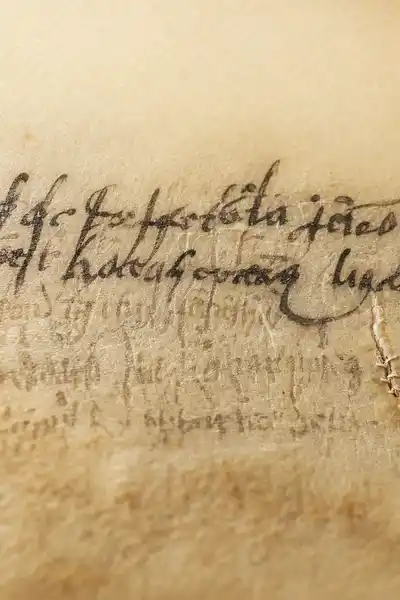
Wilson's argument, made across a career spent reading fragments most people never open, was that the silence was mostly an illusion of the record. Manuscripts burned, rotted, got scraped clean and written over, or were simply thrown out when nobody could read the old hand anymore. What survives is a fraction, and the fraction is misleading. The homilies, the saints' lives, the strange debate between an owl and a nightingale, the devotional handbooks written for anchoresses walled into their cells — these were not the whole of what existed. They were what happened to make it through.
So the question is less about what Early Middle English literature was than about how we know anything at all, and what our knowing leaves out. Wilson's book is, underneath its patient catalogue of texts, a meditation on the accident of survival — on the difference between a culture that produced little and a culture whose production we have mostly lost.
The question we’re asking : How do we read a literary period when most of it has vanished, and what does the little that remains actually tell us?What we’ll see : The century when English went quiet on the page, the odd handful of texts that survived, the arguments they've provoked, and what any of it says about how literary history gets built.
Table of contents
01Chapter 1 — A language nobody was writing for
The Norman Conquest did not kill English. It demoted it. Before 1066, English had been a working literary language with real institutional weight behind it — the West Saxon standard, cultivated in monastic scriptoria, had given the island a written vernacular that most of Europe lacked. Old English poetry, laws, chronicles and sermons were copied in a recognizable literary tradition. Then the aristocracy that had patronized that tradition was replaced, more or less wholesale, by French-speaking newcomers, and the church's upper ranks filled with Latin-trained clerics from the Continent.
What followed was not silence in the streets but silence in the archive. The people who could afford to commission a manuscript, or who had a reason to write one, now reached for Latin or French. English carried on as the ordinary speech of the vast majority, but it had lost the settings where writing happened — the court, the chancery, the higher clergy. Wilson keeps returning to this practical point: literature needs patrons, scribes and a purpose, and for a long stretch English had almost none of the three.

02Chapter 2 — What the surviving manuscripts actually hold
The corpus Wilson works with is small enough to describe and strange enough to resist easy summary. A great deal of it is religious, which is unsurprising given who was still writing: homilies, saints' lives, prayers, and works of instruction meant to reach people who had no Latin. Much of it is anonymous, undated within decades, and preserved in a single copy — lose that one manuscript and the text vanishes from history entirely, as many surely did.
A few pieces stand out because they do something the religious material does not. The Owl and the Nightingale, probably late twelfth or early thirteenth century, is a long verse debate between two birds who argue, with real wit and legal cunning, about their respective merits. It is secular, funny, formally accomplished, and completely without obvious purpose beyond delight — which makes it precious, because it proves the period could produce sophisticated non-devotional writing when the record so rarely shows it.
03Chapter 3 — The debate that never stayed quiet
Because the evidence is so thin, almost everything about these texts is contested — and Wilson is careful to lay the arguments out rather than settle them by decree. Dating is the first battlefield. A poem preserved in a manuscript from around 1250 might have been composed decades earlier; the copy tells us when someone wrote it down, not when someone made it. Scholars argue over these gaps by the internal evidence of language and reference, and the arguments rarely close cleanly.
Authorship is the second. Ancrene Wisse and a cluster of related devotional works share so much in style and vocabulary that many have proposed a single author or at least a single circle — sometimes called the Katherine Group after one of the texts. But single copies and anonymous scribes make certainty impossible. Wilson's instinct is to note the family resemblance while resisting the temptation to invent a named genius to hang it on.
04Chapter 4 — Reading a period that refused to disappear
Step back from the individual texts and Wilson's survey becomes an argument about how literary history gets made in the first place. We tend to speak of periods as if they were self-evident — the Old English age, the age of Chaucer — with the awkward stretch between them treated as a corridor rather than a room. But that corridor exists mostly because the material that would have furnished it was lost. The period looks empty because our lamp is dim, not because there was nothing there.
This is the quiet unsettling core of the book. If Early Middle English seems thin, it is partly because we have decided in advance which centuries count, and then read the surviving evidence to confirm the decision. The saints' lives and homilies that dominate the record were never the whole picture; they are what a handful of religious houses happened to preserve. The secular, the popular, the everyday writing — songs, tales, the working prose of ordinary literacy — largely burned or wore away, because nobody thought it worth the parchment to recopy.
05Conclusion
The literature of the century and a half after 1066 comes down to us as a handful of manuscripts, most of them religious, most of them anonymous, several preserved in single copies that could easily have perished. Wilson's book reads that handful with the patience it deserves — dating what can be dated, grouping what seems to belong together, marking clearly where the evidence gives out. What emerges is not a barren interval but a living language caught in a moment when almost nobody was writing it down.
Related books