
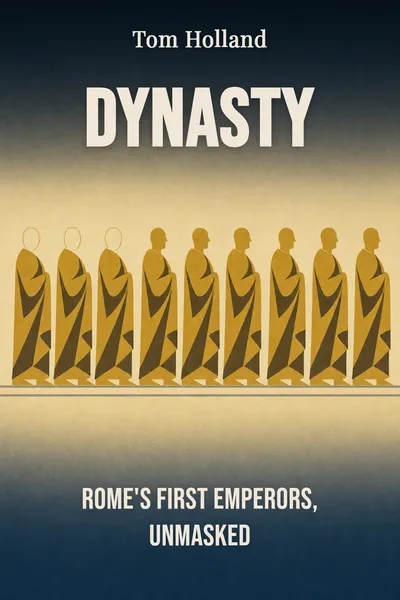
Dynasty
Rome's first emperors, unmasked
Description
Somewhere around 27 BC, a man in his mid-thirties stood before the Roman Senate and gave everything back. Armies, provinces, the machinery of the state — all of it, he announced, returned to the Senate and the people of Rome. The Republic was restored. The senators, who a few years earlier had watched this same man win a civil war and preside over proscriptions that killed thousands, applauded and begged him not to abandon them. He accepted a few modest honours, a new name, and the fiction that he was merely the first among equals. His name had been Octavian. From that day he was Augustus, and Rome had an emperor while pretending it had none.
That sleight of hand is the engine of Tom Holland's Dynasty. The book follows five men — Augustus, Tiberius, Caligula, Claudius, Nero — across roughly a century, from the founding of one-man rule to the moment the last of the bloodline drove a dagger into his own throat. They are the Julio-Claudians, a single sprawling family knotted together by adoption, marriage, murder and the constant recycling of a handful of wives and heirs. Holland draws on the ancient sources — Suetonius, Tacitus, Cassius Dio — without swallowing them whole, treating the gossip and the horror as evidence of what Romans believed power did to the people who held it.
What Holland is really tracking is a paradox. Rome had spent five centuries loathing the very idea of a king; kingship was the founding sin the Republic had been built to prevent. And yet within a generation it accepted absolute rule, provided the ruler kept up the appearance of the old forms. Dynasty is the story of what happens inside that gap between what Rome said it was and what it had become.
The question we’re asking : How did a republic that hated kings end up ruled by one family for a hundred years — and what did that arrangement do to the people trapped at its centre?What we’ll see : The founding con, the succession that would not settle, the violence at the heart of the palace, and what a single dynasty reveals about power dressed as freedom.
Table of contents
01Chapter 1 — The man who called himself first citizen
Augustus is Holland's masterclass in disguise. Born Gaius Octavius, a sickly great-nephew of Julius Caesar, he inherited a name and a fortune at eighteen and turned them into an army before he could legally hold office. The road to sole power ran through blood — the proscriptions of 43 BC, in which he and his allies posted death lists and confiscated the estates of the condemned, and the long war against Mark Antony and Cleopatra that ended at Actium in 31 BC. By the time he stood in the Senate to hand it all back, there was no one left to take it. The gift was safe precisely because it could not be accepted.
What Holland brings out is the sheer patience of the performance. Augustus never wore a crown, never called himself king, never sat on a throne. He accumulated ordinary republican titles — consul, tribune, princeps, meaning first citizen — and stacked them until they added up to something no republican had ever held. He lived, or claimed to live, in a modest house on the Palatine. He dressed plainly. He let the Senate keep meeting and passing laws. The magistracies still had their names; they had simply been hollowed out and refilled with him.

02Chapter 2 — The poisoned inheritance
Augustus wanted a successor of his own blood, and blood kept failing him. His only child was a daughter, Julia, whom he married off in turn to the men he intended to raise up. His chosen grandsons died young. His nephew Marcellus died young. Death worked its way so steadily through the preferred candidates that the ancient sources reached for the obvious explanation, and Holland lets the suspicion hang in the air: the shadow at the centre of it was Livia, Augustus's formidable wife, whose own son from an earlier marriage kept surviving everyone in front of him. That son was Tiberius.
Tiberius came to power in AD 14 as a man who had spent his life being passed over, recalled, remarried against his will, and finally chosen only because everyone else was dead. He was a capable general and a genuinely reluctant ruler, and Holland reads his reign as the story of the disguise curdling. The forms Augustus had performed with such warmth, Tiberius performed with contempt, until the Senate's grovelling and his own suspicion drove him into a kind of hatred of the whole business. Eventually he simply left — retreating to the island of Capri and governing Rome by letter, never to return.
03Chapter 3 — Blood in the marble
With Caligula, the fiction stops being a fiction. He came to power in AD 37, young and adored, the son of the beloved general Germanicus, and for a few months Rome loved him back. Then something turned — an illness, the sources say, or simply the discovery of what the position allowed. Holland is careful with the wilder stories, the horse supposedly made consul, the wars declared on the sea; many are later slander, and he treats them as portraits of how absolute power looked to those beneath it. What is not in doubt is that Caligula grasped the truth his predecessors had hidden: he could do anything, and the Senate would applaud. He was murdered by his own guard in AD 41, after less than four years.
What happened next exposed the whole arrangement. With Caligula dead and no plan, the Praetorians found his uncle Claudius — long dismissed as a stammering, limping embarrassment kept out of public life — and made him emperor, reportedly discovering him hiding behind a curtain. The point was not who Claudius was but what he represented: the family, the bloodline, the continuity the soldiers were paid to protect. Rome's ruler was now chosen by the men with swords, and the Senate ratified it after the fact. Claudius, dismissed as a fool, turned out to be a shrewd administrator who conquered Britain and expanded the citizenship. He was, the sources agree, poisoned — most likely by his own wife, Agrippina, clearing the path for her son.
04Chapter 4 — The trap of one family
Step back from the individual monsters and Holland's real subject comes into focus: not five bad men but one bad shape. The Julio-Claudians were the first attempt to run a monarchy that could not admit it was one, and every catastrophe of the century flows from that founding contradiction. A king can name an heir openly and train the whole state to expect him. A first citizen cannot, because heirs imply dynasty and dynasty implies exactly the kingship the Republic was built to forbid. So the succession had to be managed in the shadows, through adoption and marriage and, when those failed, through poison. The murders were not a flaw in the system. They were the system doing succession the only way it was allowed to.
The other half of the trap was the audience. Autocracy dressed in republican clothing needed everyone to keep performing the old script — the Senate to keep debating, the magistrates to keep being elected, the emperor to keep insisting he was merely first among equals. This mutual pretence is what gave the reigns their peculiar horror. Men debated freely in a chamber where a wrong word meant death; they praised a ruler they knew might kill them; they preserved the forms of a liberty that no longer existed. Holland's sources, above all Tacitus, are so bitter precisely because they were writing from inside a world that had learned to call servitude peace.
05Conclusion
The story closes where it is bound to, back at that Senate house in 27 BC, with a man handing power away in order to keep it forever. Everything that followed — Tiberius on his island, Caligula's contempt, Claudius behind the curtain, Nero with the blade at his throat — was written into that first performance. Augustus had solved the problem of ending civil war by making himself indispensable, and in doing so had bequeathed his heirs a role no ordinary person could safely fill and no honest person could openly claim.